Accessory Drive Belt Inspection
- Do not attempt to inspect the accessory drive belt with the vehicle running.
- When working near the radiator cooling fan, disconnect the fan motor wire. The fan may cycle on and off at any time regardless of ignition switch position. You could be injured by the moving fan blades.
- You can be seriously injured when working on or around a vehicle. Perform only service work for which you have the knowledge and proper equipment. If you have any doubt about your ability to perform service, take your vehicle to a qualified technician.
When inspecting accessory drive belts, small cracks running across the ribbed surface of the belt, from rib to rib, are considered normal. This is not a reason to replace the belt. However, cracks running along a rib (not across) are not normal. Any belt with cracks running along a rib must be replaced. A belt should also be replaced if it shows excessive wear, frayed cords, or severe glazing.
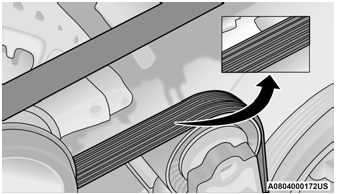
Accessory Drive Belt (Serpentine Belt)
Conditions requiring replacement:
- Chunking (one or more ribs separated from the belt body)
- Rib or belt wear
- Longitudinal cracking (cracks between two ribs)
- Belt slippage
- Belt jumping off the groove (belt does not stay properly positioned on the pulley)
- Torn belt
- Noise (squealing, chirping, or a growl heard or felt during belt operation)
NOTE:
Identify and correct the cause of the problem before installing a new belt.
Some conditions may be caused by a faulty component such as a belt pulley. Pulleys should be carefully inspected for damage and proper alignment.
Belt replacement on some models requires the use of special tools. We recommend having the vehicle serviced by an authorized dealer.
Test yourself
A quick Jeep Wrangler quiz: every answer comes with an explanation and a link to the manual page.