Driving Your Vehicle
Automatic Transmission Operation
In this manual: Driving Your Vehicle
~1min read
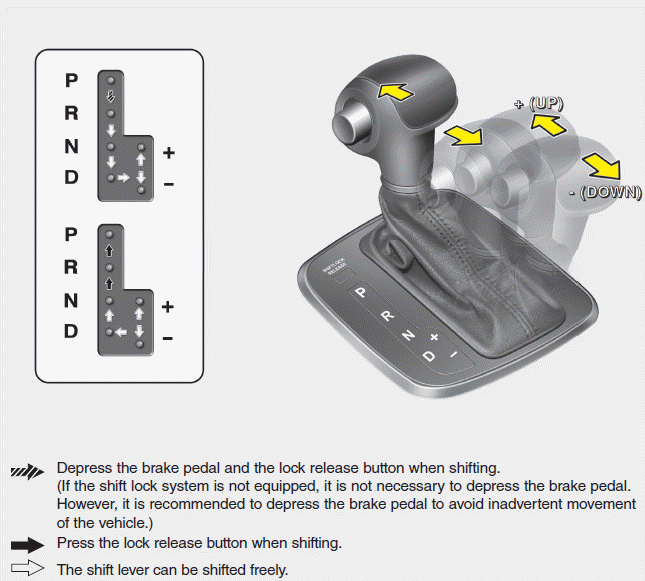
The high-efficiency automatic transmission has 6 forward speeds and one reverse speed. Individual speeds are selected automatically depending on the position of the shift lever.
✽ NOTICE
The first few shifts on a new vehicle, or after the battery has been disconnected, may be somewhat harsh. This is normal, and the shift sequence will adjust after the shifts have cycled several times through the TCM (Transmission Control Module) or PCM (Powertrain Control Module).
For smooth operation, depress the brake pedal when shifting from N (Neutral) to a forward or reverse gear.
WARNING! Automatic Transmission
- Always check the areas around your vehicle for people, especially children, before shifting into D (Drive) or R (Reverse).
- Before leaving the driver's seat, always make sure the shift lever is in P (Park); then fully apply the parking brake and turn off the engine. Unexpected and sudden vehicle movement may occur if these precautions are not followed in the order specified.
- Do not use engine braking (downshifting from a high gear to a lower gear) abruptly on slippery roads. The vehicle may skid, causing an accident.
CAUTION
- To avoid damage to the transmission, do not accelerate the engine in R (Reverse) or any forward gear position with the brake applied.
- When stopped on an incline, do not hold the vehicle in place with engine power. Use the brake pedal or the parking brake.
- Do not shift from N (Neutral) or P (Park) into D (Drive) or R (Reverse) when the engine speed is above idle.
Test yourself
A quick Kia Cee'd quiz: every answer comes with an explanation and a link to the manual page.
Was this page helpful?