Engine Electrical System
Description and Operation
In this manual: Engine Electrical System
~1min read
Description
The charging system consists of the battery, an alternator with integrated regulator, and the charge indicator and wiring. The AC generator has eight built-in diodes, each of which converts alternating current to direct current. Therefore, direct current appears at the "B" terminal of the alternator. In addition, the charging voltage of this alternator is regulated by the battery voltage sensing system. The alternator is regulated by the battery voltage sensing system. The main components of the alternator are the rotor, stator, rectifier, capacitor, brushes, bearings and the pulley with the poly-V belt. The brush holder contains an integrated electronic voltage regulator.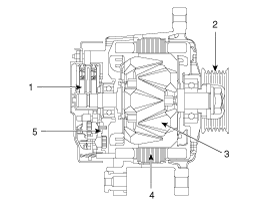
1. Brush 2. Drive Belt Pulley 3. Rotor 4. Stator 5. Rectifier
Generator Control System
The generator control system regulates the charging voltage setpoint to improve fuel economy and to manage generator load under various operating conditions. Keep the battery charged and protect the battery from overcharging. The engine control module controls generation voltage by operating cycle (charging control, discharging control, normal control) depending on the battery condition and vehicle operating conditions. The system performs discharging control during vehicle acceleration. The vehicle reduces the generator load and draws electrical power from the battery. The system performs charging control during vehicle deceleration. The generator load is increased and the battery is charged.Test yourself
A quick Kia Cee'd quiz: every answer comes with an explanation and a link to the manual page.
Was this page helpful?