Engine Electrical System
Repair Procedures
In this manual: Engine Electrical System
8steps
~48min
3/5difficulty
Done 0 of 8
Inspection on Vehicle
[General Inspection]
- Check the battery terminals and fuses
- Make sure the battery terminals are not loose or corroded.
- Check the fuses for continuity.
- Inspect the drive belt
- Visually inspect the belt for excessive wear, frayed cords, etc. If any defect is found, replace the drive belt.
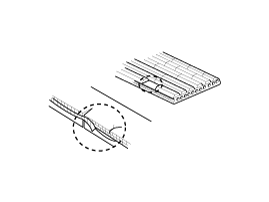
- Visually inspect the belt for excessive wear, frayed cords, etc. If any defect is found, replace the drive belt.
- Inspect and adjust the drive belt tension. (See Engine Mechanical System - Drive Belt)
- Visually inspect the alternator wiring and listen for abnormal noise.
- Make sure the wiring is in good condition.
- Make sure there is no abnormal noise from the generator while the engine is running.
- Check the charge warning lamp circuit.
- Warm up the engine, then turn it off.
- Turn off all accessories.
- Turn the ignition switch ON. Make sure the charge warning light illuminates.
- Start the engine. Make sure the light goes off. If the light does not go off as specified, troubleshoot the charge warning light circuit.
[Inspection of Specified Electrical Values]
- Generator Output Wire Voltage Drop Test. This test determines whether the wiring between generator terminal "B" and the battery terminal (+) is in good condition using the voltage drop method.
- Preparation
a. Turn the ignition switch to the OFF position. b. Disconnect the output wire from generator terminal "B". Connect the ammeter (+) lead to generator terminal "B" and the ammeter (-) lead to the output wire. Connect the voltmeter (+) lead to generator terminal "B" and the voltmeter (-) lead to the battery (+) terminal. 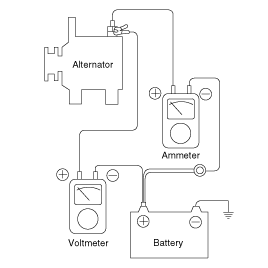
- Test
a. Start the engine. b. Turn on the headlights and blower motor, and increase engine speed until the ammeter reads 20 A. Then read the voltmeter. - Result
a. The voltmeter may show the standard value. Standard value: 0.2 V max.
b. If the voltmeter reading is higher than expected (more than 0.2 V maximum), a wiring fault is suspected. In this case, inspect the wiring from generator terminal "B" to the battery (+) terminal. Check for loose connections, discoloration due to harness overheating, etc. Repair them before retesting. b. After completing the inspection, set the engine speed to idle. Turn off the headlights, blower motor, and ignition switch.
- Preparation
- Output Current Test. This test determines whether the generator produces output current equivalent to normal output.
- Preparation
a. Before testing, check the following items and correct as necessary. Check the battery installed in the vehicle to make sure it is in good condition. For the battery inspection method, refer to the "Battery" section. The battery used to check the output current should be partially discharged. With a fully charged battery, the test may not be performed correctly due to insufficient load. Check the generator drive belt tension. For the belt tension inspection method, refer to the "Drive Belt Inspection" section. b. Turn the ignition off. b. Disconnect the battery ground cable. d. Disconnect the generator output wire from generator terminal "B". e. Connect a DC ammeter (0 to 150 A) in series between the "B" terminal and the disconnected output wire. Be sure to connect the (-) lead of the ammeter to the disconnected output wire. f. Connect a voltmeter (0 to 20 V) between the "B" terminal and ground. Connect the (+) lead to the alternator "B" terminal and the (-) lead to ground. g. Attach an engine tachometer and connect the battery ground cable. h. Leave the engine hood open. 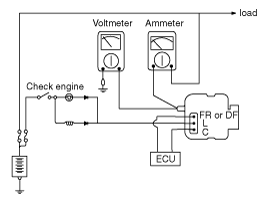
- Test
a. Make sure the voltmeter shows the same value as the battery voltage. If the voltmeter shows 0 V, an open circuit in the wire between the generator "B" terminal and the battery (+) terminal, or a poor ground, is suspected. b. Start the engine and turn on the headlights. b. Set the headlights to high beam and the blower fan switch to HIGH, quickly increase the engine speed to 2500 rpm, and read the maximum output current shown on the ammeter. - Result
a. The ammeter reading should be above the limit value. If it is lower, but the generator output wire is in good condition, remove the generator from the vehicle and test it. Limit value: 60% of the voltage standard
b. After completing the output current test, reduce the engine speed to idle and turn the ignition switch OFF. b. Disconnect the battery ground cable. d. Remove the ammeter, voltmeter and engine tachometer. e. Connect the generator output wire to the generator B terminal. f. Connect the battery ground cable.
- Preparation
- Regulated Voltage Test. The purpose of this test is to check that the electronic voltage regulator correctly regulates the voltage.
- Preparation
a. Before testing, check the following items and correct as necessary. Make sure the battery installed in the vehicle is fully charged. For the battery inspection method, refer to the "Battery" section. Check the generator drive belt tension. For the belt tension inspection method, refer to the "Drive Belt Inspection" section. b. Turn the ignition switch to the OFF position. b. Disconnect the battery ground cable. d. Connect a digital voltmeter between the generator B terminal and ground. Connect the (+) voltmeter lead to the generator B terminal. Connect the (-) lead to a good ground or the battery (-) terminal. e. Disconnect the generator output wire from generator terminal "B". f. Connect a DC ammeter (0 to 150 A) in series between the "B" terminal and the disconnected output wire. Connect the (-) lead of the ammeter to the disconnected output wire. g. Attach an engine tachometer and connect the battery ground cable. - Test
a. Turn the ignition switch ON and check that the voltmeter shows the following value. Voltage: Battery voltage
If it indicates 0 V, there is an open circuit in the wire between the generator B terminal and the battery, or the battery (-) terminal.b. Start the engine. Turn off all lights and accessories. b. Run the engine at approximately 2500 rpm and read the voltmeter when the generator output current drops to 10 A or less. - Result
a. If the voltmeter reading does not meet the standard value, the voltage regulator or the generator is faulty. b. After completing the test, reduce the engine speed to idle and turn off the ignition. b. Disconnect the battery ground cable. d. Remove the voltmeter, the ammeter and the engine tachometer. e. Connect the generator output wire to the generator B terminal. f. Connect the battery ground cable.
- Preparation
Test yourself
A quick Kia Cee'd quiz: every answer comes with an explanation and a link to the manual page.
Was this page helpful?