Dual Clutch Transmission Operation
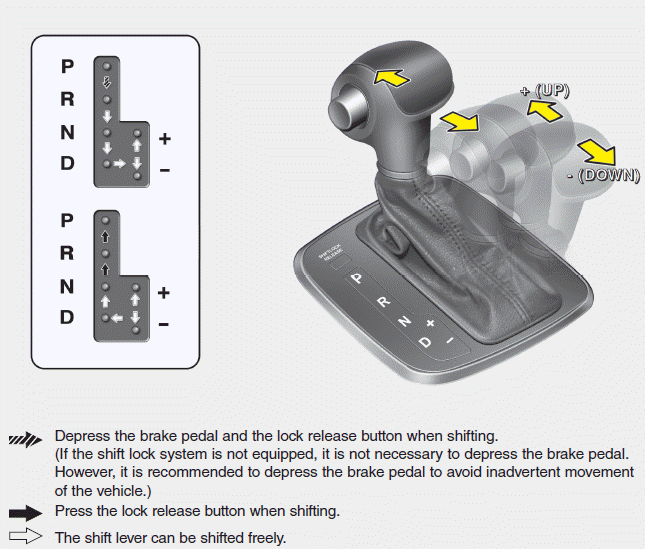
The dual clutch transmission has 7 (or 6) forward speeds and one reverse speed. Individual gears are selected automatically in the D (Drive) position.
WARNING
To reduce the risk of serious injury or death:
- ALWAYS check the areas around your vehicle for people, especially children, before shifting the vehicle into D (Drive) or R (Reverse).
- Before leaving the driver's seat, always make sure the shift lever is in the P (Park) position, then apply the parking brake and place the ignition switch in the LOCK/OFF position. Unexpected and sudden vehicle movement may occur if these precautions are not observed.
- Do not use engine braking (downshifting from a high gear to a lower gear) abruptly on slippery roads. The vehicle may skid, causing an accident.
- The dual clutch transmission provides the feel of a manual transmission, but offers the convenience of a fully automatic transmission. Unlike a conventional automatic transmission, gear shifts can be felt (and heard) in the dual clutch transmission.
- Think of it as an automated manual transmission.
- Shift into the D (Drive) range and the transmission shifts fully automatically, similar to a conventional automatic transmission. - The dual clutch transmission uses a dry-type dual clutch, which differs from the torque converter of a conventional automatic transmission, and provides better acceleration performance during driving. However, initial start-off may be slightly slower than with an automatic transmission.
- The dry-type clutch transmits torque and provides a direct driving feel that may differ from a conventional automatic transmission with a torque converter. This may be more noticeable when starting from a stop or at low vehicle speed.
- When accelerating rapidly at low vehicle speed, the engine may rev high depending on driving conditions.
- For a smooth start on an uphill slope, depress the accelerator pedal gradually depending on current conditions.
- If you release the accelerator pedal at low vehicle speed, you may feel strong engine braking, similar to a manual transmission.
- When driving downhill, you can use Sport mode and press the paddle shifter to downshift to control your speed without excessively using the brake pedal.
- When starting and stopping the engine, you may hear clicking sounds while the system performs a self-test. This is a normal sound for the Dual Clutch Transmission.
CAUTION
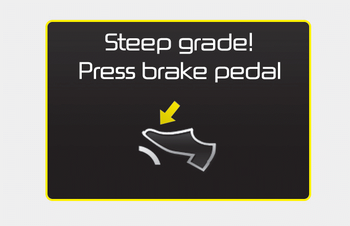
- To hold the vehicle on a slope, use the foot brake or parking brake. If the vehicle is held by depressing the accelerator pedal on a hill, the clutch and transmission will overheat, which may cause damage. At this time, a warning message will appear on the LCD display and you may feel vibration.
- If the clutch overheats from excessive use to hold the vehicle on a hill, you may feel shaking and the display on the instrument cluster may flash. When this occurs, the clutch is disengaged until the clutch cools to normal temperature. If this happens, stop in a safe place, shift into P (Park), and apply the foot brake for several minutes.
- If the LCD warning is active, the foot brake must be applied.
- Ignoring warnings may result in transmission damage.
- If the display continues to flash, for your safety we recommend that you contact an authorized Kia dealer.
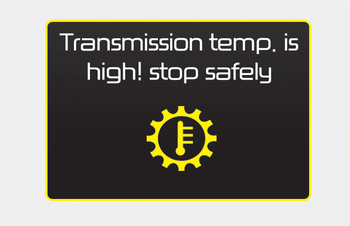
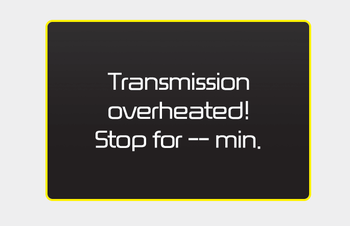
- Under certain conditions, such as restarting on steep inclines, the transmission clutch may overheat. When the clutch overheats, the fail-safe protection mode is activated. If the fail-safe protection mode is activated, the gear position indicator on the cluster flashes with an audible signal.
At this time, a warning message will appear on the LCD display and driving may not be smooth. If you ignore this warning, the driving condition may worsen. To restore normal driving condition, stop the vehicle and depress the brake pedal for several minutes before driving off. - Gear shifting may be more noticeable than with a conventional automatic transmission. This is a normal characteristic of this type of dual clutch transmission.
- An overheated dual clutch transmission may change shift characteristics, and a warning message will illuminate on the LCD display when the kickdown mechanism is used repeatedly.
- Do not use the kickdown mechanism to return to normal driving condition. Also temporarily stop the vehicle in a safe place when the warning message illuminates on the LCD display.
- During the first 1,500 km (1,000 miles), you may feel that the vehicle does not run smoothly when accelerating at low speed. During this break-in period, shift quality and performance of your new vehicle are continuously being optimized.
- Always come to a complete stop before shifting to D (Drive) or R (Reverse).
- Do not move the shift lever to N (Neutral) while the vehicle is in motion.
The indicator in the instrument cluster shows the position of the shift lever when the ignition switch is in the ON position.
P (Park)
Always come to a complete stop before shifting to P (Park).
To shift out of P (Park), depress the brake pedal and make sure your foot is not on the accelerator pedal.
The shift lever must be in the P (Park) position before the engine is turned off.
WARNING
- Shifting into P (Park) while the vehicle is moving may cause you to lose control of the vehicle.
- After the vehicle has stopped, always make sure the shift lever is in P (Park), apply the parking brake, and turn off the engine.
- Do not use P (Park) instead of the parking brake.
R (Reverse)
Use this position to drive the vehicle in reverse.
CAUTION
Always come to a complete stop before shifting into or out of R (Reverse). You may damage the transmission if you shift into R (Reverse) while the vehicle is moving.
N (Neutral)
The wheels and transmission are disengaged.
Use N (Neutral) if you need to restart a stalled engine or if you need to stop with the engine running. Shift to P (Park) if you need to leave your vehicle for any reason.
Always depress the brake pedal when shifting from N (Neutral) to another gear.
WARNING
Do not shift into a gear unless your foot is firmly on the brake pedal. Shifting into gear when the engine is running at high speed may cause the vehicle to move very quickly. You may lose control of the vehicle and strike people or objects.
WARNING
Do not drive with the shift lever in N (Neutral).
Engine braking will not function and may cause an accident.
- Parking in N (Neutral)
Follow the instructions below when parking and you want the vehicle to move when pushed.
1. After parking the vehicle, depress the brake pedal and shift the shift lever to [P] with the ignition switch in the [ON] position or with the engine running.
2. If the parking brake is applied, release the parking brake.
- For vehicles equipped with EPB (Electric Parking Brake), depress the brake pedal with the ignition switch in the [ON] position or with the engine running to release the parking brake. If [AUTO HOLD] is used while driving (if the [AUTO HOLD] indicator is illuminated in the cluster), press the [AUTO HOLD] switch. The [AUTO HOLD] function should be turned off.
3. While depressing the brake pedal, turn the ignition switch to [OFF].
- For vehicles equipped with a smart key, the ignition switch can be turned to the [OFF] position only when the shift lever is in the [P] position.
4. Shift the shift lever to [N] (Neutral) while depressing the brake pedal and press the [SHIFT LOCK RELEASE] button or insert a tool (such as a flat-blade screwdriver) into the [SHIFT LOCK RELEASE] access hole at the same time. The vehicle can then be moved by applying an external force.
CAUTION
- Except when parking in neutral, always park the vehicle in [P] (Park) and apply the parking brake for safety.
- Before parking in [N] (Neutral), first make sure the parking surface is level and flat. Never park in [N] on any slope or grade. If the vehicle is parked and left in [N], it may roll and cause serious damage and injury.
- After the ignition switch is turned off, the electric parking brake cannot be released.
- For vehicles with EPB (Electric Parking Brake), if [AUTO HOLD] was used while driving and the ignition switch is turned off, the electric parking brake will apply automatically. Therefore, the [AUTO HOLD] function must be turned off before the ignition switch is turned off.
D (Drive)
This is the normal driving position. The transmission will shift automatically through the 7 (or 6) forward gears, providing the best fuel economy and performance. For extra power when passing another vehicle or driving uphill, press the accelerator pedal further until you feel the transmission downshift.
Sport Mode
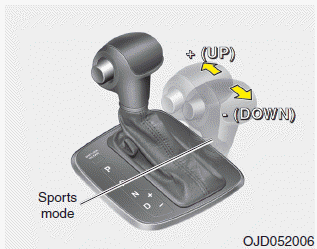
Regardless of whether the vehicle is stationary or moving, Sport mode is selected by moving the shift lever from the D (Drive) position into the manual gate. To return to the D (Drive) range, move the shift lever back into the main gate.
In Sport mode, moving the shift lever forward and backward allows you to select the desired gear range for the current driving conditions.
+ (Up): Push the lever forward once to shift up one gear.
- (Down): Pull the lever back once to downshift by one gear.
✽ NOTICE
- Only the 7 (or 6) forward gears can be selected. To reverse or park the vehicle, move the shift lever to the R (Reverse) position or the P (Park) position as required.
- Downshifting occurs automatically when the vehicle decelerates. When the vehicle stops, 1st gear is automatically selected.
- When the engine speed approaches the red zone, the transmission will upshift automatically.
- If the driver moves the lever to the + (Up) or - (Down) position, the transmission cannot shift to the requested gear if the next gear is outside the allowable engine speed range. The driver should shift to a higher gear according to road conditions, making sure the engine speed stays below the red zone.
Test yourself
A quick Kia Cee'd quiz: every answer comes with an explanation and a link to the manual page.