coolant
Repair Procedures
Filling and Bleeding
Make sure the engine and radiator are cold to the touch.
Remove the reservoir tank cap (A).
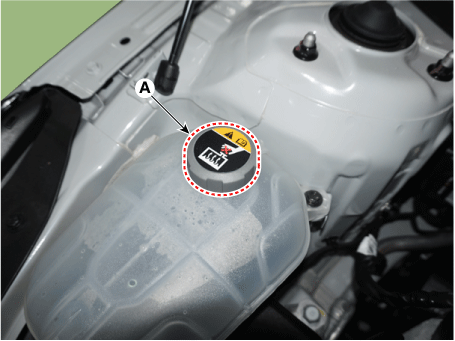
Remove the engine room cover.
(See Engine and Transaxle Assembly - Engine Compartment Cover)
Loosen the drain plug (A) and drain the coolant.

Tighten the radiator drain plug securely.
Clean the reservoir tank.
Fill the reservoir tank with coolant and tighten the reservoir tank cap.
Start the engine and warm it up to normal operating temperature. Wait for the cooling fans to turn on several times. Rev the engine to help purge trapped air. Stop the engine.
Wait until the engine has cooled down.
Repeat steps 1 through 9 until the drained water is clean.
Fill the working mixture of coolant and water (55 - 60%) (except North America, Europe and China: 45 - 50%) slowly through the reserve tank. Squeeze the upper/lower radiator hoses to easily bleed air.
Start the engine and let it run until the coolant begins to circulate. When the cooling fan is operating and the coolant is circulating, add coolant through the coolant reservoir.
Repeat step 12 until the cooling fan has come on 3 to 5 times and sufficient air has been bled from the cooling system.
Fill the coolant reservoir to the "MAX" (or "FULL") mark and tighten the reservoir cap.
Run the vehicle at idle until the cooling fan operates 2-3 times.
Stop the engine and wait for the coolant to cool down.
Repeat steps 11 through 16 until the coolant level stops dropping, bleeding air from the cooling system.
Coolant Capacity
Approx. 6.3 L (1.66 US gal, 6.66 US qt, 5.54 liters)
Inspection
Radiator Hoses
Inspect the radiator hoses for the following:
Improper installation
Leaks
Cracks
Damage
Loose connections
Chafing
Deterioration
Coolant Level
Check the coolant level in the coolant reservoir. Make sure it is between the "F" mark and the "L" mark.
If the coolant level in the coolant reservoir is at or below the "L" mark, add coolant so that it is between the "L" and "F" marks, then inspect the cooling system for leaks.
Coolant Quality
Remove the radiator cap.
Check for excessive rust or scale deposits around the radiator cap assembly and radiator filler neck. Also, the coolant must be free of oil.
If there is excessive contamination, clean the coolant passages and replace the coolant.
Install the radiator cap.
Test yourself
A quick Kia Optima DL3 quiz: every answer comes with an explanation and a link to the manual page.