Radiator
Components and Component Location
Components
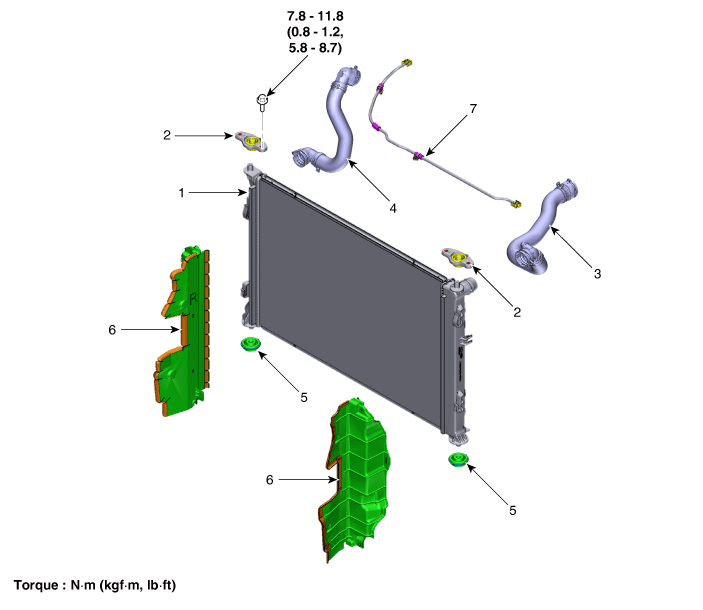
| 1. Radiator 2. Radiator Upper Mounting Bracket 3. Radiator Upper Hose 4. Radiator Lower Hose |
5. Radiator Lower Mounting Insulator 6. Radiator Air Inlet 7. Deaeration Hose and Tube |
Repair Procedures
Removal and Installation
Remove the cooling fan.
(See Cooling System - Cooling Fan)
Drain the engine coolant by loosening the drain plug.
(Refer to Cooling System - "Engine Coolant")
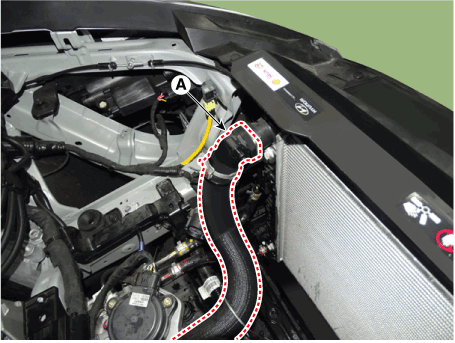
Disconnect the upper radiator hose (A).
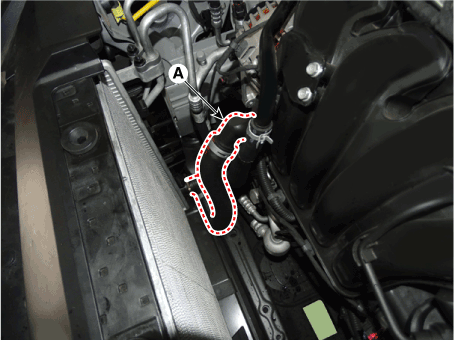
Disconnect the radiator lower hose (A).
Remove the front bumper assembly.
(Refer to Body (Interior and Exterior) - "Front Bumper Assembly")
Remove the upper radiator mounting bolts (A), then remove the radiator and upper mounting brackets.
Tightening torque: 7.8–11.8 N·m (0.8–1.2 kgf·m, 5.8–8.7 ft-lbf)
[LH]

[RH]

Remove the radiator air guard (A).
[LH]

[RH]

Separate the condenser from the radiator.
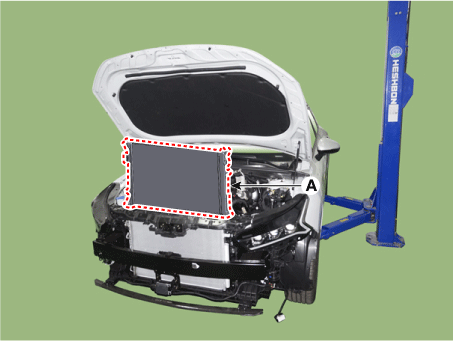
Pull the radiator (A) upward and remove it from the engine compartment.
Install in the reverse order of removal.
Fill the engine coolant.
(Refer to Cooling System - "Engine Coolant")
Start the engine and check for leaks.
Recheck the engine coolant level.
Inspection
Reservoir Cap Test
Install the sealed cap and pressure tester SST (0K253-G5100).
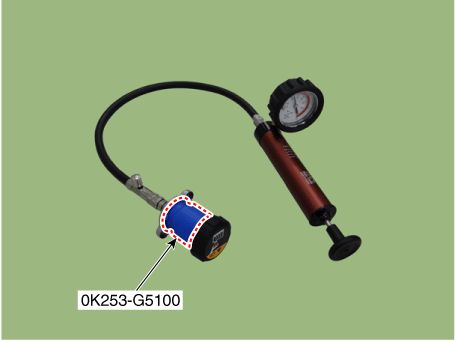
Apply pressure of 125.52 - 154.94 kPa (1.28 - 1.58 kgf/cm², 18.21 - 22.47 psi).
Check for pressure drop.
If the pressure drops, replace the radiator cap.
Radiator Leak Test
Wait until the engine has cooled, then carefully remove the coolant reservoir cap and fill the radiator with engine coolant, then install the tester.
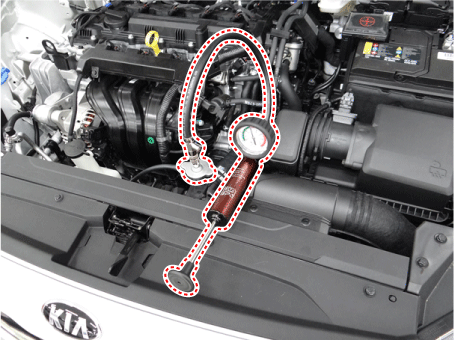
Connect the tester to the radiator and apply pressure of 125.52 - 154.94 kPa (1.28–1.58 kgf/cm², 18.21–22.47 psi).
Check for engine coolant leaks and pressure drop.
Remove the tester and reinstall the coolant reservoir cap.
Test yourself
A quick Kia Optima DL3 quiz: every answer comes with an explanation and a link to the manual page.