Evaporative Emission Control System
Description and Operation
Description
The Evaporative Emission Control System prevents fuel vapor stored in the fuel tank from escaping into the atmosphere. When fuel evaporates in the fuel tank, the vapor passes through the ventilation hoses or tubes to a charcoal-filled canister, which temporarily holds the vapor. If the ECM decides to draw the collected vapor into the combustion chambers under certain operating conditions, it uses intake manifold vacuum to move it.
Circuit Diagrams
Schematic Diagram
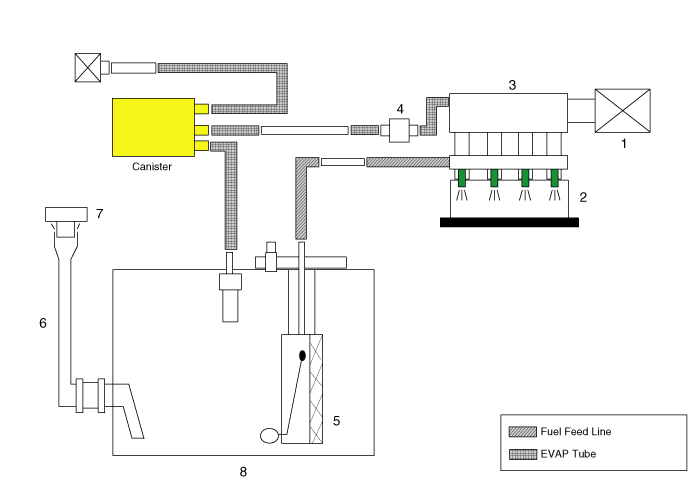
| 1. Air Cleaner 2. Delivery Pipe and Injector 3. Engine 4. Purge Control Solenoid Valve (PCSV) |
5. Fuel Pump 6. Fuel Filler Neck 7. Fuel Filler Cap 8. Fuel Tank |
Canister
The canister is filled with charcoal and absorbs evaporated fuel vapor from the fuel tank. The stored fuel vapor in the canister is drawn into the intake manifold by the ECM/PCM when the appropriate conditions are met.
Purge Control Solenoid Valve (PCSV)
The Purge Control Solenoid Valve (PCSV) is installed in the passage connecting the canister and the intake manifold. It is a duty-type solenoid valve controlled by an ECM/PCM signal.
To draw the absorbed vapor into the intake manifold, the ECM/PCM opens the PCSV. Otherwise, the passage remains closed.
Fuel Tank Cap
The ratchet tightening feature on the fuel tank cap reduces the possibility of incorrect installation and ensures the filler neck is sealed. After the gasket on the fuel tank cap contacts the filler neck flange, the ratchet produces an audible click indicating the seal is installed.
Test yourself
A quick Kia Rio YB quiz: every answer comes with an explanation and a link to the manual page.