Fuel Filler Door
Opening the Fuel Filler Door
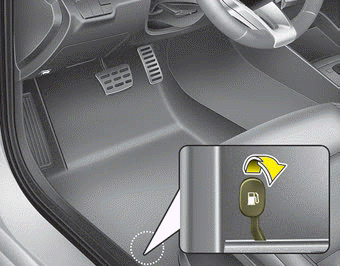
The fuel filler door must be opened from inside the vehicle by pulling the fuel filler door release.
If the fuel filler door does not open due to ice forming around it, gently tap or press on the door to break the ice and open the door. Do not pry the door open. If necessary, spray an approved de-icing fluid (do not use antifreeze) around the door, or move the vehicle to a warm place and allow the ice to melt.
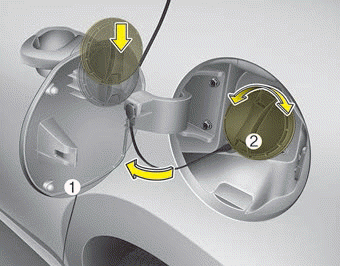
1. Stop the engine.
2. To open the fuel filler door, pull up the fuel filler door release lever.
3. Fully open the fuel filler door (1).
4. To remove the fuel filler cap, turn the fuel filler cap (2) counterclockwise.
5. Refuel as necessary.
Closing the Fuel Filler Door
1. To install the cap, turn it clockwise until it clicks. This indicates the cap is securely tightened.
2. Close the fuel filler door, lightly press on it, and make sure it is securely closed.
WARNING - Refueling
Always remove the fuel filler cap carefully and slowly. If the cap releases fuel or if you hear a hissing sound, wait until the sound stops before fully removing the cap.
If pressurized fuel sprays out, it may cover your clothing or skin and create a risk of fire and burns.
✽ NOTICE
When refueling on an uneven surface, the fuel gauge may not indicate the F position.
This is not a malfunction. If you move the vehicle to a level surface, the fuel sender will move to the full position.
✽ NOTICE
Tighten the fuel filler cap until it clicks once, otherwise the fuel filler door open warning light will illuminate.
Always check that the fuel filler cap is securely installed to prevent fuel spillage in the event of an accident.
WARNING. Risk of fire/explosion.
Read and follow all warnings posted at the filling station. Failure to follow all warnings may result in serious injury, severe burns, or death from fire or explosion.
CAUTION! Static electricity
- Before touching the fuel nozzle, discharge any potential static electricity by touching a metal part of the vehicle body away from the filler neck, nozzle, or other source of fuel vapor.
- Do not re-enter the vehicle after refueling has started. Static electricity may be generated by touching, rubbing, or sliding against any object or fabric (polyester, satin, nylon, etc.) capable of producing static electricity. A static discharge may ignite fuel vapor and cause rapid combustion. If you must re-enter the vehicle, discharge potential static electricity again by touching a metal part of the vehicle body away from the filler neck, nozzle, or other source of fuel vapor before touching the nozzle.
CAUTION! Portable fuel container
When using an approved portable fuel container, always place the container on the ground before refueling. A static discharge from the container may ignite fuel vapors, causing a fire. After refueling has started, keep in contact with the vehicle until refueling is complete. Use only approved portable plastic fuel containers designed for transporting and storing gasoline.
CAUTION! Mobile phone ignition.
Do not use mobile phones while refueling. Electrical current and/or electronic interference from cell phones may ignite fuel vapors and cause a fire.
WARNING - Refueling and vehicle fire
Always turn off the engine when refueling. Sparks produced by electrical components related to the engine may ignite fuel vapors and cause a fire. After refueling is complete, make sure the fuel filler cap and fuel filler door are securely closed before starting the engine.
WARNING - Smoking
Do NOT use matches or a lighter, do NOT SMOKE, and do not leave a lit cigarette in your vehicle at a filling station, especially during refueling. Vehicle fuel is highly flammable and may cause a fire if ignited.
Be sure to refuel your vehicle in accordance with the "Fuel Requirements" in Chapter 1.
If the fuel filler cap needs to be replaced, use only an genuine Kia cap or an equivalent specified for your vehicle. An improperly installed fuel filler cap may cause serious malfunction of the fuel system or emission control system.
CAUTION - Exterior Paint
Do not spill fuel on the exterior surfaces of the vehicle. Any fuel spilled on painted surfaces may damage the paint.
Test yourself
A quick Kia Rio YB quiz: every answer comes with an explanation and a link to the manual page.