Discharged Battery
Starting the Engine Using an External Battery
Starting the engine using an external battery is a safety hazard if it is not performed correctly. Therefore, strictly follow the procedure below. If you are not sure you can start the engine using an external battery on your own, have the procedure performed by a qualified service technician.
WARNING
 Observe the following
precautions: To ensure proper and safe battery handling, carefully read the recommendations below before using or checking the battery.
 Do not allow the positive (+) battery terminal to contact any metal object that could cause a spark: Fire and sparks near open battery cells are a safety hazard.
Hydrogen generated during normal battery operation can ignite and cause the battery to explode. A battery explosion may cause serious burns and injury. When working near the battery, make sure metal tools do not contact the positive (+) or negative (-) battery terminal.
 Do not bring fire, sparking objects or a lit
cigarette near the open battery cells: Fire and sparks near the open battery cells are a safety hazard.
Hydrogen gas, produced during normal battery operation, may ignite and cause the battery to explode. A battery explosion can cause serious burns and injury.
Do not start with an external battery a frozen battery or a battery with low electrolyte level: Starting with an external battery a frozen battery or a battery with low electrolyte level is a safety hazard.
The battery may crack or explode, causing serious injury.
Connect the negative terminal of the external battery to the ground of the vehicle being started, away from the battery: Connecting jumper cables to the negative (-) terminal of the discharged battery is a safety hazard.
A spark may ignite the gas generated by the battery and cause injury.
Keep jumper cables away from moving parts: Connecting jumper cables near or to moving parts (cooling fan, drive belt pulleys) is a safety hazard. The cable may be drawn in when the engine starts and cause serious injury.
CAUTION
The external battery must be 12 V. Using 24 V (a 24 V engine-generator set or two 12 V batteries connected in series) may damage the 12 V starter, the ignition system and other electrical systems.
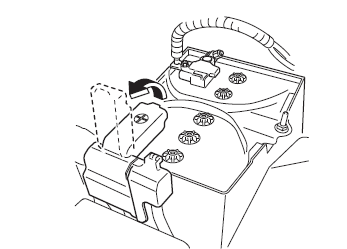
1. Remove the battery cover.
2. Make sure the external battery voltage is 12 V and that its negative terminal is connected to ground.
3. If the external battery is in another vehicle, make sure the vehicles do not touch. Turn off the engine of the vehicle with the external battery and all unnecessary electrical equipment in both vehicles.
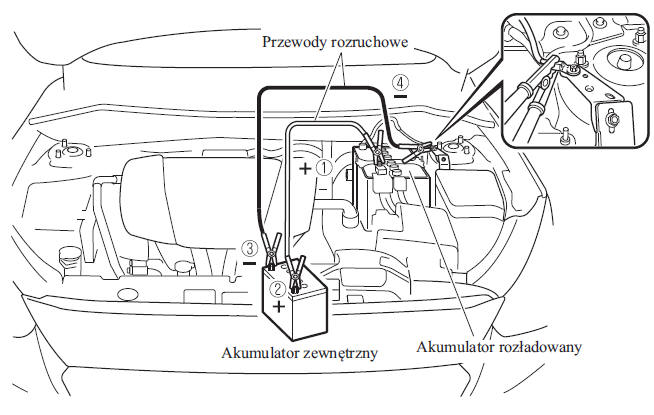
4. Connect the jumper cables in exactly the order shown in the illustration.
- Connect one jumper cable clamp to the positive terminal of the discharged battery (1).
- Connect the other clamp of this cable to the positive terminal of the external battery (2).
- Connect one clamp of the second jumper cable to the negative terminal of the external battery (3).
- Connect the other clamp of this cable to the ground point shown in the illustration, away from the discharged battery (4).
5. Start the engine of the vehicle with the external battery. A few minutes later, try to start the engine of the vehicle with the discharged battery.
6. After the operation is complete, carefully disconnect the cables in the reverse order shown in the illustration.
7. If the battery cover was removed, reinstall it in the reverse order of removal.
CAUTION
Make sure all covers are properly installed.
Test yourself
A quick Mazda 2 quiz: every answer comes with an explanation and a link to the manual page.