Tire pressure. Tire pressure information
Correct tire pressure is essential for safety and efficiency on the Mercedes E-Class (4th generation, W212, 2009–2016). This section explains the recommended values, checking methods, and the consequences of incorrect settings to prevent tire wear and accident risks.
WARNINGTires with pressure that is too low or too high present the following hazards:
- The tires can burst, especially with increasing load and speed.
- The tires wear excessively and/or unevenly, which can significantly impair tire grip.
- Handling, steering and braking behavior may be severely impaired.
Observe the recommended tire pressures and check the tire pressure of all tires, including the spare tire.
- every day before driving
- when the load changes
- before starting a long trip
- when operating conditions change, e.g. off-road driving.
WARNING
If you fit unsuitable accessories to the tire valves, the tire valves can become overloaded and fail, which may cause tire pressure loss. Tire pressure monitoring systems offered as retrofit kits keep the tire valve open due to their design. This can also lead to tire pressure loss. Risk of accident!Only fit valve caps that are standard equipment or specifically approved by Mercedes-Benz for your vehicle onto the tire valves.
WARNING
If the tire pressure drops repeatedly, the wheel, valve or tire may be damaged. Tire pressure that is too low can cause the tire to burst. Risk of accident!- Inspect the tire for foreign objects.
- Check whether the wheel or valve is leaking.
Environmental Note
Check the tire pressure regularly, at least every 14 days.The tire pressure label in the fuel filler flap of your vehicle shows a table of recommended tire pressures for different operating conditions. Observe the notes on recommended tire pressure.
Operation with the temporary spare wheel: For information on operating with the temporary spare wheel, see the general notes in the section "Temporary spare wheel" more.Operation with a trailer: The maximum value specified for the rear axle on the tire pressure label in the fuel filler flap applies.
The tire pressure label may also show the tire pressures for different load conditions. These are marked by a different number of persons and luggage in the table. The actual number of seats may differ - see the vehicle documents for information.If no tire sizes are specified, the tire pressures on the tire pressure label apply to all tires approved for this vehicle at the factory.
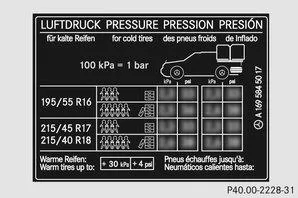
If a tire size precedes the tire pressures, the tire pressure specified after it applies only to that tire size.
Use a suitable tire pressure gauge to check the tire pressure. The outward appearance of a tire does not allow any conclusion about the tire pressure. On vehicles with electronic tire pressure monitoring, you can also check the tire pressure via the on-board computer.Correct the tire pressure only when the tires are cold, if possible.
The tires are cold,- when the vehicle has been parked for at least three hours without sunlight on the tires, and
- when the vehicle has been driven less than 1.6 km (1 mile).
 approx. 10 kPa (0.1 bar, 1.5 psi). Take this into account when checking tire pressure on warm tires. Correct the tire pressure only if it is too low for the current operating condition.
Tire pressure that is too low or too high
- shortens the service life of the tires
- promotes tire damage
- impairs handling and therefore driving safety (e.g. due to aquaplaning).
You may also use the values for higher load. These are permitted and beneficial for driving.
Speeds up to 210 km/h: Contrary to the values on the tire pressure label (fuel filler flap), the specified values can be reduced as follows for speeds up to 210 km/h and for ...R16 tires without affecting driving safety:- for sedans:
 30 kPa (0.3 bar,4 psi)
- for estate (T-Models):20 kPa (0.2 bar,3 psi)
The rolling comfort of your vehicle is improved; fuel consumption may increase slightly as a result.
The notes on tire storage for the Mercedes E-Class W212 (model years 2009–2016) show how important proper storage is for the service life and safety of the tires. Only correctly stored tires keep their material and tread in perfect condition.
Mercedes recommends clear storage conditions: cool, dry, and dark. This preserves the premium quality of the E-Class even during periods of non-use.
Question: How should tires be stored in the best way?
Answer: Standing or hanging, in a cool, dry place protected from light, to prevent material damage.
Question: Why is cleaning before storage important?
Answer: So that dirt and chemicals do not attack the rubber compound and shorten the service life of the tires.
Test yourself
A quick Mercedes-Benz E-Class quiz: every answer comes with an explanation and a link to the manual page.