Temporary spare wheel. Inflating the "Collapsible spare wheel". Technical data
The "Useful information" section on wheels and tires for the Mercedes E-Class (4th gen., W212, 2009–2016) provides general tips on selection and care. It emphasizes the importance of genuine parts and warns of risks from improper wheel fitting or the use of impermissible tires.
Inflating the "Faltrad" folding spare wheel
Note Before lowering the vehicle, inflate the "Faltrad" folding spare wheel with the tire inflator. Otherwise the rim may be damaged. Do not operate the tire inflator for more than eight minutes without interruption. Otherwise it may overheat.Once the tire inflator has cooled down, you can continue to use it.
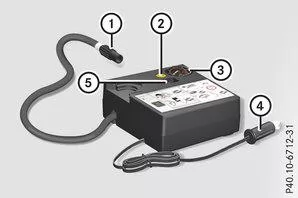
 Mount the "Faltrad" folding spare wheel as described. more
The "Faltrad" folding spare wheel must be mounted before inflating.
Pull the plug and pull the hose out of the housing.
Unscrew the valve cap from the valve of the "Faltrad" folding spare wheel.
Screw the union nut of the hose onto the valve.
Make sure the on/off switch of the tire inflator is set to 0.
Pull the pluginto a 12 V socket more in your vehicle.
Turn the key in the ignition lock to position 1 more.
Press the on/off switchon the tire inflator to I.
 .
Inflate the tire to the specified tire pressure.
The specified tire pressure is shown on the yellow label on the spare wheel.
When the specified tire pressure is reached, press the on/off switchon the tire inflator to 0.
Turn the key in the ignition lock to position 0.
If the tire pressure is higher than specified, press the release button until the correct tire pressure is set.
Screw the union nutof the hose from the valve.
Screw the valve cap of the "Faltrad" folding spare wheel back onto the valve.Pull the plugand stow the hose in the lower part of the tire inflator.
Stow the tire inflator in the vehicle.Technical data
All vehicles (except AMG vehicles)
"Minispare" spare wheelModels with 4-cylinder engine
| Tires | Light-alloy wheel |
|---|---|
| T 155/70 R17 110 M Tire pressure: 420 kPa (4.2 bar, 61 psi) |
4.0 J x 17 H2 ET 39 |
| Tires | Light-alloy wheel |
|---|---|
| T 155/70 R17 110 M Tire pressure: 420 kPa (4.2 bar, 61 psi) |
4.0 J x 17 H2 ET 34 |
| Tires | Light-alloy wheel |
|---|---|
| T 155/60 R18 107 M Tire pressure: 420 kPa (4.2 bar, 61 psi) |
4.5 J x 18 H2 ET 36 |
AMG vehicles
"Faltrad" folding spare wheel| Tires | Light-alloy wheel |
|---|---|
| 175/50 - 19 97 P Tire pressure: 350 kPa (3.5 bar, 51 psi) |
6.5 J x 19 H2 ET 14 |
The Mercedes E-Class W212 (model years 2009–2016) provides clear instructions for wheel fastening to ensure safety after a wheel change. The correct tightening sequence and torque are essential to prevent the wheel nuts from loosening while driving.
It is especially important to retighten the nuts after a short distance driven. This is how the premium quality of the vehicle becomes visible and noticeable, even during maintenance work.
Question: Why is the torque so important when changing a wheel?
Answer: To ensure a secure connection between wheel and hub and to prevent material damage.
Question: When should wheel nuts be retightened?
Answer: After approximately 50–100 km of driving following a wheel change.
Test yourself
A quick Mercedes-Benz E-Class quiz: every answer comes with an explanation and a link to the manual page.