Battery
To avoid any risk of sparks
- Make sure that all "energy consumers" (interior lights, etc.) are switched off before disconnecting or reconnecting a battery.
- When charging, switch off the charger before connecting or disconnecting the battery.
- Do not place any metal object on the battery, to avoid short-circuiting the terminals.
- Wait at least one minute after switching off the engine before disconnecting a battery.
- Make sure the battery terminals are properly reconnected after refitting.
Before carrying out any work in the engine compartment, it is essential to switch off the ignition by pressing the engine stop button (refer to the section "starting and stopping the engine" in chapter 2).
Connecting a charger
The charger must be compatible with a 12-volt nominal battery. Do not disconnect the battery while the engine is running. Follow the operating instructions supplied by the manufacturer of the battery charger you are using.
Some batteries may have specific charging requirements; seek advice from your Brand Representative.
Avoid any risk of sparks, which could cause an immediate explosion, and charge the battery in a well-ventilated area.
Risk of serious injury.
Handle the battery with care as it contains sulphuric acid, which must not come into contact with the eyes or skin. If contact occurs, rinse thoroughly with water. If necessary, consult a doctor.
Keep all flames, incandescent objects and sparks away from the battery: risk of explosion.
When working near the engine, it may be hot.
In addition, the cooling fan may start at any time.
Risk of injury.
Jump-starting with another vehicle's battery
If you need to use another vehicle's battery to start, obtain suitable jump leads (of adequate cross-section) from a Brand Representative or, if you already have starting cables, make sure they are in good condition.
Both batteries must have the same nominal voltage: 12 volts. The supplying battery must have a capacity (ampere-hour, Ah) at least equal to that of the discharged battery.
Make sure there is no contact between the two vehicles (risk of short circuit when connecting the positive terminals) and that the flat battery is properly connected. Switch off the ignition of your vehicle.
Start the engine of the vehicle supplying power and maintain a medium engine speed.
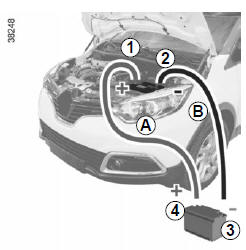
Depending on the vehicle, unclip the battery cover.
Connect positive cable A to terminal 1 (+), then to terminal 4 (+) of the supplying battery.
Connect the negative cable B to terminal 3 (-) of the battery supplying the current, then to terminal 2 (-) of the flat battery.
Start the engine. As soon as it runs, disconnect cables A and B in reverse order (2 - 3 - 4 - 1).
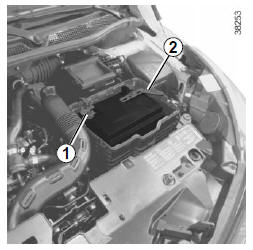
Make sure there is no contact between cables A and B, and that the positive cable A is not in contact with any metal part of the donor vehicle.
Risk of injury and/or damage to the vehicle.
Test yourself
A quick Renault Captur quiz: every answer comes with an explanation and a link to the manual page.