Pressure sensor: Operation
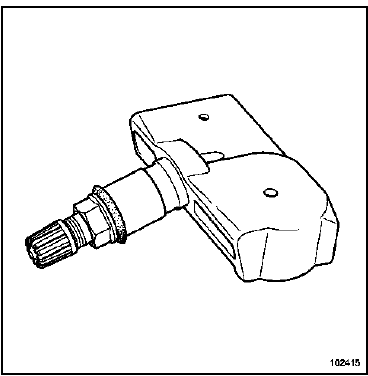
The pressure sensor consists of:
- a conventional valve,
- a pressure sensor,
- a temperature sensor,
- an acceleration sensor,
- a dedicated radio frequency transmitter,
- a non-removable battery.
Each sensor is identified by a colour marker around the valve:
- green = front left,
- yellow = front right,
- red = rear left,
- black = rear right.
The colour code must be strictly observed so that the system displays the information correctly.
Each sensor is recognised by the electronic control unit through a unique code.
OPERATION
The sensors (powered by a built-in battery) regularly measure the internal tyre pressure, temperature and acceleration.
They transmit this information and their code by radio frequency to the receiver (built into the cabin control unit).
Learning the four sensors in the cabin control unit
Note: A second set of two or four wheel sensors can be identified by the cabin control unit. Make sure the colours match their positions.When replacing the valves, carry out sensor learning using the diagnostic tool and set the speed index.
When removing the wheels, do not swap them.
Note: For the cabin control unit to take into account two or four additional wheels fitted with sensors, learning must be carried out at the first fitting. Afterwards, the system automatically recognises the wheel set fitted to the vehicle.When replacing the cabin control unit:
- set the recommended pressures,
- carry out sensor learning using tool (Ms. 1607) and the diagnostic tool.
Test yourself
A quick Renault Megane quiz: every answer comes with an explanation and a link to the manual page.