Body Electrical System
Headlamp Description and Operation
In this manual: Body Electrical System
5steps
~30min
2/5difficulty
Done 0 of 5
HIDDEN Headlamp
- Lamp
- Xenon Gas Elements: Xenon gas provides the initial reaction for rapid illumination. Molybdenum electrode: anode arcing. Metal halide salts: color-forming component
- Lighting Principle: When xenon gas and metal halide salt are discharged through the molybdenum anode in the capsule, it emits light.
- Igniter: The igniter (A) is an electromagnetic converter that receives current from the ballast and additional voltage to light the arc light source in any environment.
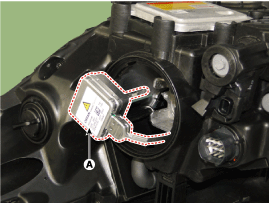
- Ballast
- The ballast (A) supplies an instantaneous high-voltage pulse to the igniter electrode to initiate discharge in the source.
- The ballast provides stable power to the bulb and igniter during initiation and normal arc operation.
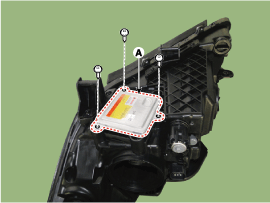
- BI TYPE
- Definition
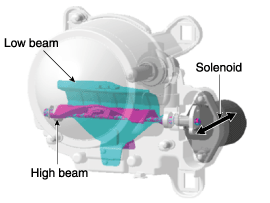
A. Headlamp with built-in high beam and low beam functions. B. Light is controlled by rotating a shield inserted in the lens (solenoid is used). 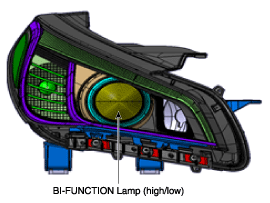
- Structure and Mechanism
A. Low Beam Operation: The lamp illuminates the limited low beam area, blocking light with the shield. 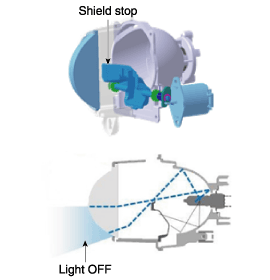
B. High Beam Operation: Light is not blocked by the open shield, and the light illuminates the high beam area. 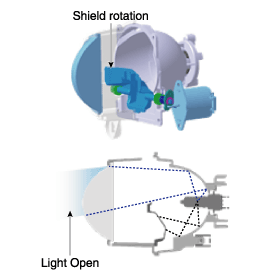
- Definition
- High Beam Assist (HBA)
- Description: The High Beam Assist (HBA) system is a convenience system that automatically switches the headlights between high beam and low beam. It uses the LDWS module (built-in camera) mounted on the windshield to detect the taillights of a preceding vehicle or the headlights of an oncoming vehicle, as well as the ambient light level, and automatically switches the headlights to high or low beam.
- Activation Conditions
- Light switch in the "AUTO" position, high beam ON (push).
- HBA is activated when vehicle speed exceeds 40 km/h.
A. If the light switch is pushed while the HBA system is active and the high beam is OFF, the HBA system is turned OFF and the high beam is turned ON. - HBA Deactivation Conditions
A. When the headlights of an oncoming vehicle or the taillights of a preceding vehicle are detected. B. When the surrounding environment is bright enough and high beams are not required. C. When a street lamp or other light source is ahead. D. When vehicle speed drops below 35 km/h.
Test yourself
A quick Hyundai Sonata LF quiz: every answer comes with an explanation and a link to the manual page.
Was this page helpful?