Steering damper control current does not flow to the solenoid valve. With ig turned on, ecm detects a failure of internal circuit element.
Solenoid current does not converge to the target value. Battery voltage is 10 v or below with the engine running.
Steering damper solenoid valve circuit interrupter element shorted.
Feedback current convergence failure.
Low battery voltage.
Ecm malfunction.
Steering damper solenoid valve circuit shorted to vcc.
Steering damper solenoid valve circuit open.
Steering damper solenoid valve circuit shorted.
P1769
H
Steering damper control current is higher than specified value. An abnormal current is detected during the vehicle standstill. Solenoid current is 0.7 A or above.
L
Steering damper control current is lower than specified value. With ig turned on, ecm detects a discontinuity. An abnormal current is detected during the vehicle standstill.
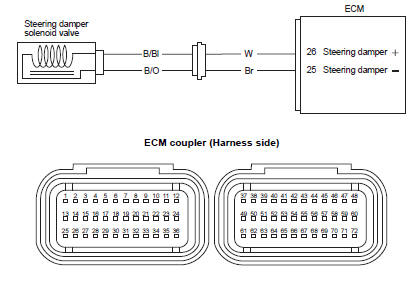
Wiring diagram TroubleshootingCaution
when using the multi-circuit tester, do not strongly touch the terminal of the ecm coupler with a needle pointed tester probe to prevent terminal damage.
Note
after repairing the trouble, clear the dtc using sds tool. Refer to “use of sds diagnosis reset procedures” .
Step
Action
Yes
No
1
Turn the ignition switch off.
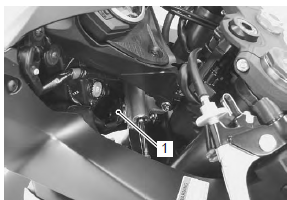
Check the steering damper solenoid valve coupler (1) for loose or poor contacts.
If ok, then measure the steering damper solenoid valve resistance.
Disconnect the steering damper solenoid valve coupler.
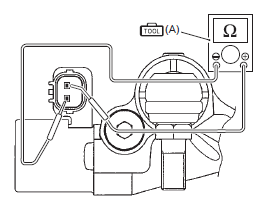
Measure the steering damper solenoid valve resistance.
Special tool (a): 09900–25008 (multi circuit tester set)Tester knob indication resistance (Ω)Steering damper solenoid valve resistance approx. 12.5 Ω at 20 °c (68 °f) Is the resistance ok?
Go to step 2.
Replace the steering damper with a new one.
2
Turn the ignition switch on.
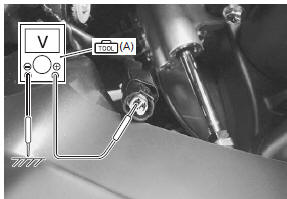
Measure the voltage between b/bl wire and ground.
Special tool (a): 09900–25008 (multi circuit tester set)Tester knob indication voltage ( ) Steering damper solenoid valve voltage approx. 10 V when battery is fully charged condition ((+) terminal: b/bl – (–) terminal: ground)
Is the voltage ok?
B/bl (w) wire shorted to vcc, or poor “26” connection failure.
B/o (br) wire open or shorted to ground, or poor “25” connection failure.
If wire and connection are ok, intermittent trouble or faulty ecm.
Recheck each terminal and wire harness for open circuit and poor connection.
Replace the ecm with a known good one, and inspect it again.
Low battery voltage or fuse is blown.
B/bl (w) wire open or shorted to ground, or poor “26” connection failure.
If wire and connection are ok, intermittent trouble or faulty ecm.
Recheck each terminal and wire harness for open circuit and poor connection.
Replace the ecm with a known good one, and inspect it again.
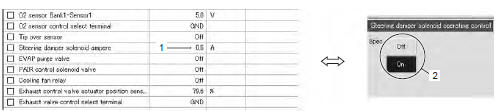
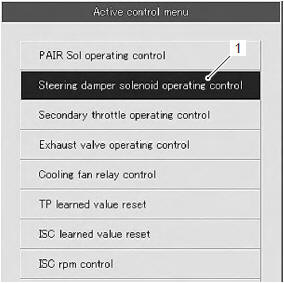
Active control inspection
Set up the sds tool. (Refer to sds operation manual for further details.)
 (a): 09900–25008 (multi
 (a): 09900–25008 (multi
 )