Wheels
If a wheel is bent, cracked, or severely corroded, have it replaced. Otherwise, the tire may come off the wheel or the vehicle may lose control.
Selecting wheels
When replacing wheels, make sure the new wheels have equivalent load capacity, diameter, width, and inset*.
Any Toyota dealer, Toyota-approved repairer, or any reliable repairer can offer you other wheels.
*: The conventional term is "offset."
Toyota advises against using:
- Wheels of different types or sizes
- Used wheels
- Bent wheels that have been straightened
Precautions for aluminum alloy wheels (on equipped models)
- Use only wheel nuts and wheel wrenches designed for your aluminum alloy wheels.
- When rotating, repairing, or replacing tires, check that the wheel nuts are still tight after 1,600 km (1,000 miles).
- If you install snow chains, take care not to damage the aluminum alloy wheels.
- For wheel balancing, use genuine Toyota wheel balance weights or equivalent, and a plastic mallet.
■ When replacing wheels The wheels of your vehicle (except the compact spare tire wheel) are fitted with tire pressure warning valves, which allow the tire pressure warning system to alert you early to any loss of tire pressure. Tire pressure warning valves must be installed whenever you replace wheels.
WARNING■ When replacing wheels
- Do not install wheels of a different size from those specified in the Owner's Manual, as this increases the risk of losing control of the vehicle.
- Never fit an inner tube into a wheel designed for tubeless tires if the wheel leaks. This could cause a serious or fatal accident.
■ When reinstalling wheel nuts
- Be sure to reinstall the wheel nuts with the tapered end facing inward.
If the nuts are reinstalled with the tapered end facing outward, the wheel may break and possibly come off the vehicle, which could cause a serious or fatal accident.
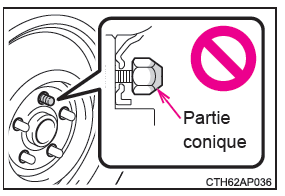
Never apply oil or grease to wheel bolts or wheel nuts.
Oil and grease may cause the nuts to be overtightened, resulting in damage to the wheel or wheel disc. In addition, oil or grease may cause the wheel nuts to loosen and the wheel to come off, which could cause a serious or fatal accident. Clean off any oil or grease on the wheel bolts or wheel nuts.
■ Do not use defective wheels Do not use cracked or bent wheels.
This could cause air leakage while driving and possibly lead to an accident.
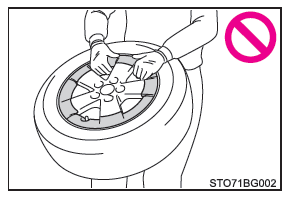
■ Handling wheels (vehicles with 16-inch wheels)
If you hold the wheel by its wheel cover, the cover may suddenly come off and the wheel may fall to the ground.
■ Replacing tire pressure warning valves
- Because tire pressure warning valves can be damaged when a tire is repaired or replaced, always have your tires serviced by a Toyota dealer, an authorized Toyota repairer, or any reliable repairer or other qualified service shop. Also, be sure to purchase tire pressure warning valves from a Toyota dealer, an authorized Toyota repairer, or any reliable repairer.
- Be sure to use only genuine Toyota wheels on your vehicle.
There is a risk that the tire pressure warning valves may not operate normally with wheels that are not genuine.
■ Handling the resin decorative parts (on vehicles equipped with 16-inch tires) If you notice a rattling noise from the resin decorative parts, or strange noises coming from the wheels while driving, have your wheels inspected by a Toyota dealer, an authorized Toyota repairer, or any reliable repairer.