Tires
Replace the tires or rotate the wheels according to the maintenance schedule or tread wear.
Tire inspection
Check whether the tread wear indicators are visible on the tires. Also check that the tires are not wearing unevenly, in particular that wear is not excessive on one side of the tread.
If you do not rotate the wheels, check the condition and inflation pressure of the spare tire.
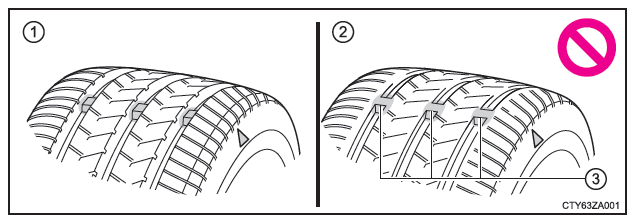
- New tread
- Worn tread
- Tread wear indicator
The location of the tread wear indicators is marked by a mark ("TWI" or "∆", etc.) molded into the sidewall of the tire.
Replace the tires if the tread wear indicators are visible on any of them.
Tire rotation
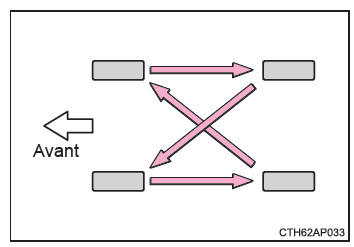
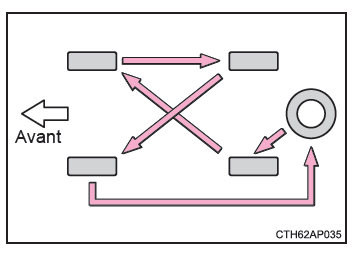
Rotate the wheels in the order shown.
Except vehicles equipped with a full-size spare wheel
Vehicles equipped with a full-size spare wheel
2WD models: To even out tire wear and extend tire life, Toyota recommends rotating the wheels every 10000 km (6000 miles).
4WD models: To even out tire wear and extend tire life, Toyota recommends rotating the wheels every 5000 km (3000 miles).
Tire pressure warning system
Your vehicle is equipped with a tire pressure warning system that uses tire pressure warning valves with transmitters to detect underinflated tires before serious problems occur.
If tire pressure drops below a predetermined level, a warning light alerts the driver.
Installing tire pressure warning valves
When you replace the tires or wheels, tire pressure warning valves must also be installed.
When installing new tire pressure warning valves, it is essential to register their ID codes with the tire pressure warning ECU, then initialize the tire pressure warning system. Have the ID codes of the tire pressure warning valves registered by a Toyota dealer, a Toyota-approved repairer, or any reliable repairer.
Initializing the tire pressure warning system
The tire pressure warning system must be initialized when tires of a different size are installed.
When the tire pressure warning system is initialized, the pressure the tires are inflated to at that time becomes the reference pressure.
■ How to initialize the tire pressure warning system
1. Park the vehicle in a safe place and set the ignition switch to "LOCK" (vehicles without the smart entry & start system) or to OFF (vehicles with the smart entry & start system).
2. Initialization cannot be performed while the vehicle is moving.
Inflate all tires to the recommended cold tire inflation pressure.
Make sure you inflate the tires to the recommended cold tire inflation pressure. The tire pressure warning system will use this pressure as the reference.
3. Turn the ignition switch to "ON" (vehicles without the smart entry and start system) or to ON mode (vehicles with the smart entry and start system).
Vehicles with monochrome display
4. Press the "DISP" button until the display shows .
Press and hold the "DISP" button to enter setting mode.
5. Press the "DISP" button until the tire pressure warning system menu is displayed.
Press and hold the "DISP" button to display the menu.
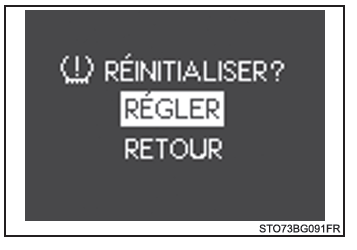
6. Press and hold the "DISP" button while the cursor is on "RESET" to initialize the system.
When initialization is complete, the tire pressure warning light flashes 3 times.
Vehicles with color display
4. Press or the meter control switch to select
 .
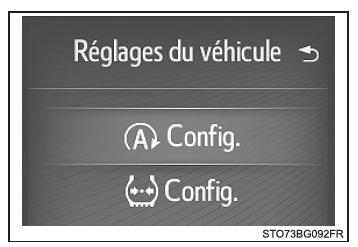
5. Press or the meter control switch to select "Vehicle Settings", then select
 to display the menu.
6. Press or the meter control switch to select
 , then press and hold
 .
7. When initialization is complete, a message is displayed on the multi-information display and the tire pressure warning light flashes 3 times.
Registering the ID Codes
The tire pressure warning valve transmitter has a unique ID code. When you replace a tire pressure warning valve transmitter, its ID code must be registered. Have the ID code registered by a Toyota dealer, a Toyota-authorized repairer, or any reliable repairer.
■ When to replace your vehicle's tires You must replace the tires when:
- The tread wear indicators appear on the tire.
- A cut, gash or crack is deep enough to expose the cord, or a bulge indicates an internal defect.
- The tire has gone flat several times or cannot be properly repaired due to the size or location of a cut or puncture.
If in doubt, consult a Toyota dealer, a Toyota-authorized repairer, or any reliable repairer.
■ Replacing tires and wheels If the ID code of the tire pressure warning valve transmitter is not registered, the tire pressure warning system cannot operate properly. After approximately 20 minutes of driving, the tire pressure warning light flashes for 1 minute and then stays on to indicate a system malfunction.
■ Tire service life Any tire more than 6 years old must be inspected by a qualified technician, even if it has been used rarely or not at all, or if it shows no obvious signs of deterioration.
■ Regular tire inflation pressure checks The tire pressure warning system does not replace regular tire inflation pressure checks. Be sure to check the tire inflation pressure when performing the daily vehicle inspection.
■ Snow tires worn to less than 4 mm (0.16 in.) tread depth These tires have lost their effectiveness in snow.
■ Situations in which the tire pressure warning system may not operate normally
- In the following cases, the tire pressure warning system may not operate normally.
- If wheels other than genuine Toyota wheels are used.
- You have replaced a tire with one that does not match the original equipment.
- You have replaced a tire with one that is not the specified size.
- The vehicle is equipped with snow chains, etc.
- The vehicle is equipped with run-flat tires with auxiliary support.
- If a tinted film that interferes with radio signals has been applied to the windows.
- If the vehicle is covered with a large amount of snow or ice, especially around the wheels and wheel housings.
- If the tire inflation pressure is much higher than the recommended value.
- If the wheels used do not have tire pressure warning valve transmitters.
- If the ID codes of the tire pressure warning valve transmitters have not been registered in the tire pressure warning ECU.
- Performance may decline in the following situations.
- When you are near a TV relay station, power plant, gas station, radio station, large electronic display panel, airport, or any other facility that emits strong electromagnetic waves (radio waves or radio interference).
- When you are carrying a radio transmitter, mobile phone, cordless phone, or any other wireless communication device.
- When the vehicle is parked, the time needed for the warning to activate or deactivate may be longer.
- When a tire loses pressure rapidly, for example when it bursts, the warning may not operate.
■ Initialization procedure
Be sure to perform initialization after correcting the tire inflation pressure.
Also, make sure the tires are cold before performing initialization or correcting the tire inflation pressure.
If you accidentally turn the ignition switch to "LOCK" (vehicles without the smart entry and start system) or to OFF (vehicles with the smart entry and start system) during initialization, it is not necessary to press the reset button again, because initialization will automatically restart the next time you turn the ignition switch to ON mode (vehicles with the smart entry and start system) or to "ON" (vehicles without the smart entry and start system).
If you accidentally press the reset button when initialization was not necessary, correct the tire inflation pressure to the recommended value while the tires are cold, then perform initialization again.
■ Tire Pressure Warning System Behavior The tire pressure warning system does not issue a warning in the same way depending on the conditions under which it was initialized. For this reason, the system may issue a warning even if the pressure has not dropped to a sufficiently low level, or if the pressure has increased compared to the pressure at which the tires were inflated when the system was initialized.
■ If Tire Pressure Warning System Initialization Fails Initialization can be completed in a few minutes. However, in the following cases, the values have not been stored and the system will not operate correctly. If the problem persists after several attempts to store the tire inflation pressure values, have the vehicle inspected as soon as possible by a Toyota dealer, a Toyota authorized repairer, or any reliable repairer.
- When you initialize the system, the tire pressure warning light does not flash 3 times and the message does not appear on the multi-information display.
- After driving for some time following completion of initialization, the warning light comes on after flashing for 1 minute.
■ Registering ID Codes You can register the ID codes of tire pressure warning valve transmitters for two sets of wheels.
It is not necessary to register ID codes when you replace summer tire wheels with winter tire wheels, if the ID codes for both sets of wheels (summer and winter) have been registered beforehand.
For further information on changing ID codes, contact a Toyota dealer, a Toyota authorized repairer, or any reliable repairer as soon as possible.
WARNING■ When Inspecting or Replacing Tires Observe the following precautions to prevent the risk of accidents.
Failure to do so may cause damage to the powertrain and dangerous handling characteristics, which may result in a serious or fatal accident.
- Do not use tires of different brand, model, or tread pattern on the same axle.
Likewise, do not use tires on the same axle with visibly different wear levels.
- Do not fit tires of sizes other than those recommended by Toyota.
- Do not use different types of tires on the same axle (radial, bias, or bias-belted construction).
- Do not fit summer, winter, and all-season tires on the same vehicle.
- Do not fit tires that have previously been used on another vehicle.
Do not use tires if you do not know how they have been used previously.
- Vehicles equipped with a compact spare tire: Do not tow the vehicle if it is equipped with a compact spare tire.
■ When Initializing the Tire Pressure Warning System Do not initialize the tire pressure warning system without first correcting the tire inflation pressure to the recommended value. Otherwise, the tire pressure warning light may not come on when the tire inflation pressure is insufficient, or it may come on when the tire inflation pressure is actually normal.
NOTE■ Repairing or Replacing Tires, Wheels, Tire Pressure Sensors, Transmitters, and Tire Valve Caps
- When you want to remove or install wheels, tires, or tire pressure warning valve transmitters, contact a Toyota dealer, a Toyota authorized repairer, or any reliable repairer, as the transmitter valves can easily be damaged by careless handling.
- Be sure to reinstall the valve caps. If you do not reinstall the valve caps, water may enter the tire pressure warning valves and they may become stuck.
- When replacing tire valve caps, do not use any caps other than the recommended ones. The cap may become stuck.
■ Driving on Poor Road Surfaces Exercise great caution when you must drive on a road with a deformed surface or potholes.
These conditions may cause a loss of tire inflation pressure sufficient to reduce the tires' ability to absorb shocks. In addition, the tires themselves, as well as the wheels and the vehicle structure, may be damaged by a severely deformed road surface.
■ To Prevent Damage to the Tire Pressure Warning Valve Transmitters When you repair a tire with tire sealant, the tire pressure warning valve transmitter may not function normally. If you use tire sealant, contact a Toyota dealer, a Toyota authorized repairer, or any reliable repairer or other qualified service shop as soon as possible. When repairing or replacing a tire after using tire sealant, also be sure to replace the tire pressure warning valve transmitter.
■ If All Tires Deflate While Driving Stop the vehicle, or you may completely destroy your tires and/or wheels.