Engine Coolant Temperature Circuit Range / Performance Problem
DTC P0116 Engine Coolant Temperature Circuit Range / Performance Problem
DESCRIPTION
Refer to DTC P0115
DTC No. |
DTC Detection Condition |
Trouble Area |
P0116 |
ECTs as listed below are nearly same (2 trip detection logic):
|
|
ECTs as listed below are nearly same when engine is started at higher than 60C (140F) of ECT (2 trip detection logic)
|
||
When either of following conditions is met (2 trip detection logic):
|
MONITOR DESCRIPTION
The ECT sensor is used to monitor the ECT. The ECT sensor has a built-in thermistor with a resistance that varies according to the temperature of the engine coolant. When the ECT becomes low, the resistance of the thermistor increases. When the temperature becomes high, the resistance drops. These variations in the resistance are reflected in the voltage output from the ECT sensor.
The ECM monitors the sensor voltage and uses this value to calculate the ECT. If the sensor voltage output deviates from the normal operating range, the ECM interprets this deviation as a malfunction in the ECT sensor and sets the DTC.
Examples:
- Upon starting the engine, the ECT is between 35C and 60C (95F and 140F). If the ECT remains within 3C (5.4F) of the stating temperature after driving for 250 seconds, the DTC is set (2 trip detection logic).
- Upon starting the engine, the ECT is over 60C (140F). If the ECT remains within 1C (1.8F) of the starting temperature after driving for 250 seconds, the DTC is set (6 trip detection logic).
MONITOR STRATEGY
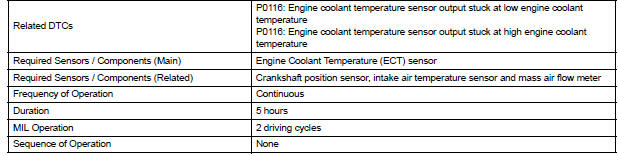
TYPICAL ENABLING CONDITIONS
All:

ECT sensor cold start monitor:
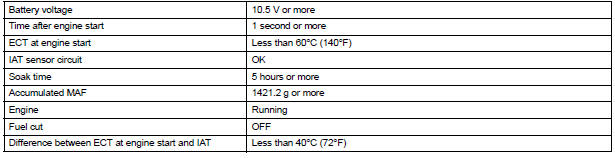
ECT sensor soak monitor:

TYPICAL MALFUNCTION THRESHOLDS
ECT sensor cold start monitor:

ECT sensor soak monitor:

COMPONENT OPERATING RANGE

INSPECTION PROCEDURE
HINT:
- If any of DTC P0115, P0117, P0118 or P0125 are set simultaneously with DTC P0116, the ECT sensor may have an open or a short circuit. Troubleshoot those DTCs first.
- Read freeze frame data using the intelligent tester. The ECM records vehicle and driving condition information as freeze frame data the moment a DTC is stored. When troubleshooting, freeze frame data can be helpful in determining whether the vehicle was running or stopped, whether the engine was warmed up or not, whether the air-fuel ratio was lean or rich, as well as other data recorded at the time of a malfunction.
1 CHECK ANY OTHER DTCS OUTPUT (IN ADDITION TO DTC P0166)
- Connect the intelligent tester to the DLC3.
- Turn the ignition switch to the ON position.
- Turn the tester on.
- Enter the following menus: DIAGNOSIS / ENHANCED II / DTC INFO / CURRENT CODES.
- Read the DTC.
Result

2 INSPECT THERMOSTAT
- Remove the thermostat.
- Check the valve opening temperature of the thermostat.
Standard: 80 to 84C (176 to 183F)
HINT: In addition to the above check, confirm that the valve is completely closed when the temperature is below the standard.
- Reinstall the thermostat
REPLACE ENGINE COOLANT TEMPERATURE SENSOR
Test yourself
A quick Toyota Sienna quiz: every answer comes with an explanation and a link to the manual page.