Only use new brake fluid conforming to VW standard (VW 501 14).
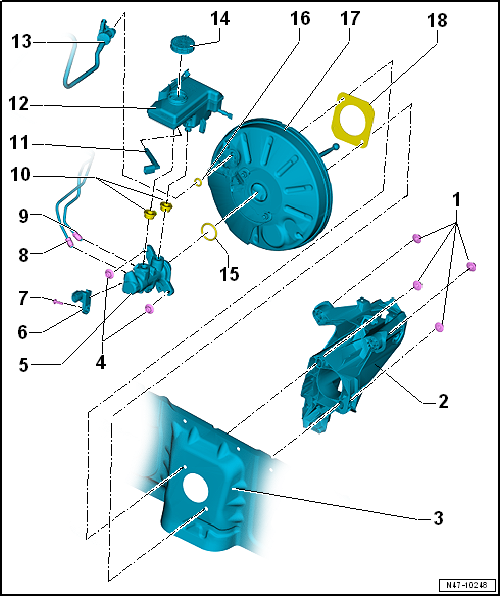
1 -
Self-locking hexagon nut
Always renew after removing
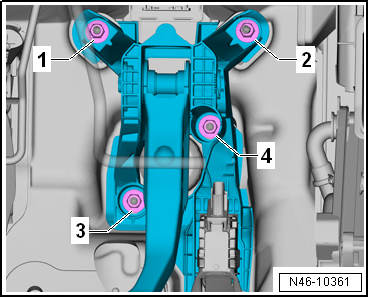
Bolting sequence → Fig.
25 N·m
2 -
Pedal cluster with mounting bracket
3 -
Plenum chamber bulkhead
4 -
Self-locking hexagon nut
Always renew after removing
23 N·m
5 -
Brake master cylinder
Cannot be repaired. If faulty, renew as a complete unit.
Removing and installing → Chapter
6 -
Brake light switch -F-
Removing and installing → Chapter
7 -
Bolt
8 N·m
8 -
Brake line
From secondary piston circuit of brake master cylinder to hydraulic unit.
14 N·m
9 -
Brake line
From primary piston circuit of brake master cylinder to hydraulic unit.
14 N·m
10 -
Sealing plug
Moisten with brake fluid and press into brake fluid reservoir.
11 -
Brake fluid level warning contact --F34--
12 -
Brake fluid reservoir
Securing bolt, 8 N·m
13 -
Vacuum hose
With non-return valve
Fit in brake servo
On some vehicles with petrol engines, vacuum sender -G608- is installed in brake servo → Chapter
14 -
Cap
15 -
Seal
Vacuum hose for brake servo
16 -
Sealing ring
Between brake master cylinder and brake servo
17 -
Brake servo
Functional check:
With engine switched off, depress brake pedal firmly several times (to exhaust vacuum in unit).
Now step on and hold brake pedal with medium pressure and start engine. If the brake servo is functioning properly, the brake pedal will be felt to go down as the servo takes effect.
Replace completely in the event of a fault (before doing so, check brake servo vacuum system) → Chapter
Removing and installing → Chapter
18 -
Seal
Renew
Bonded (only when originally assembled at factory)
Bonded joint at brake servo and plenum chamber bulkhead does not have to be renewed
Bolting sequence:
?
Test yourself
A quick Volkswagen Golf quiz: every answer comes with an explanation and a link to the manual page.
 Note