Ignition switch
Ignition key positions
The ignition key is used to start and stop the engine.
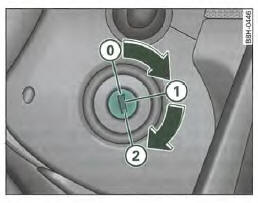
Fig. 144 Ignition key positions
Position
This is the position in which you insert the key into the ignition switch.
To lock the steering when the key is removed, turn the steering wheel until the steering lock pin engages audibly. Always lock the steering when you leave the vehicle. This makes it more difficult to steal the vehicle.
Ignition on / glow plug preheating
If the ignition key cannot be turned to this position, or can only be turned with difficulty, turn the steering wheel in both directions to relieve the steering lock. On diesel engine vehicles, this position is also used for glow plug preheating.
Starting the engine
Turn the key to this position to start the engine. High-power electrical consumers are temporarily switched off.
After the engine starts, the ignition key returns to the position
Before each starting attempt, you must return the ignition key to the position : the starter repeat-start interlock located in the ignition switch prevents the starter from being damaged while the engine is running.
Ignition off
Turn the ignition key to this position.
CAUTION!
- Only remove the ignition key from the ignition lock when the vehicle is stationary! Otherwise the steering lock pin may engage suddenly - risk of accident!
- If you leave the vehicle - even for a short time - always remove the ignition key, especially if children are in the vehicle. Otherwise children could start the engine or operate electrical equipment (such as the power windows) - risk of accident!
Note
If the battery has been disconnected and then reconnected, you must wait approximately 5 seconds with the ignition key in position (1) before starting the engine.
Vehicles with automatic transmission: After switching off the ignition, the ignition key can only be removed if the selector lever is in position "P" (parking brake). The selector lever is locked after the ignition key is removed.
Test yourself
A quick Audi A4 quiz: every answer comes with an explanation and a link to the manual page.