Acoustic parking aid
Rear parking assist
The rear parking aid warns you of obstacles behind the vehicle.
Description
Using ultrasonic sensors, the rear acoustic parking aid (4-channel system) measures the distance between the vehicle and an obstacle. These sensors are located in the rear bumper.
The sensor measuring range starts at approximately:

Activation
The parking aid system is activated when you engage reverse gear. A short audible signal confirms activation.
Reverse gear
The acoustic system is activated if it detects an obstacle within the measuring range of the parking aid sensors.
As the distance between the vehicle and the obstacle decreases, the frequency of the signals increases.
When the distance is less than 0.30 m, the audible signal becomes continuous. You should then stop reversing.
Be aware that small obstacles that have already been signaled by an audible tone may no longer be detected once they leave the sensor measuring range.
Trailer mode
If you are towing a trailer with a vehicle equipped at the factory with a towing hitch, the parking aid sensors are not activated when you engage reverse gear, and the acoustic system does not sound.
Possible malfunctions
If you hear an audible signal for a few seconds when switching on the ignition, this means the parking aid system is faulty. If the fault is still present when you switch off the ignition, no new warning signal sounds when you try to activate the system again. Have the malfunction rectified.
If the system is faulty, no audible signal sounds when you engage reverse gear.
For the parking aid to function properly, keep the sensors clean and free of frost.
CAUTION!
- The sensors have blind spots in which objects cannot be detected. Pay particular attention to small children and animals, as in some cases the sensors cannot detect them - risk of accident.
- The parking aid system does not in any way replace the driver's attentiveness. The driver remains fully responsible when parking the vehicle or carrying out similar manoeuvres.
 Warning!
Be aware that small obstacles that have already been signaled by an audible tone may no longer be detected once they leave the sensors' field of view. Objects such as fence chains, trailer drawbars, thin painted bars or fences may, depending on the circumstances, not be detected by the system - risk of damage.
Front and rear parking aid
The parking aid warns you of obstacles in front of and behind the vehicle.
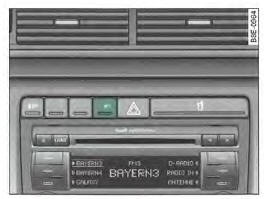
Fig. 147 Partial view of the centre console, parking aid system control
Description
Using ultrasonic sensors, the front and rear acoustic parking aid (8-channel system) measures the distance between the vehicle and an obstacle. The 8 sensors are located in the front and rear bumpers (2 in the centre, 2 on the sides).
The sensor measuring range starts at approximately:

Activation
The parking aid system is activated automatically when you engage reverse gear. A short audible signal confirms activation.
You can also activate the parking aid system manually by pressing the P"A control on the centre console => fig. 147. A short audible signal also confirms manual activation. The indicator light built into the control comes on at the same time.
You must activate the parking aid system manually if you are parking forward or approaching an obstacle at the front and want to be warned of the distance to that obstacle.
Deactivation
The parking aid system deactivates automatically when the vehicle speed exceeds approximately 15 km/h. It also deactivates when you switch off the engine.
You can switch off the parking aid system manually using the control => fig. 147.
Audible signals
The distance is indicated by audible signals from the signal emitters located at the front and rear. The volume and tone of the signals can be changed on request by a specialist workshop.
Reverse gear
When the vehicle reverses, the acoustic system is activated if it detects an obstacle within the field of view of the parking aid sensors. As the distance between the vehicle and the obstacle decreases, the frequency of the signals increases.
When the distance is less than 0.30 m, the audible signal becomes continuous. You should then stop reversing.
Be aware that small obstacles that have already been signaled by an audible tone may no longer be detected once they leave the sensor measuring range.
Forward travel
Same principle as for reverse, however with a slightly reduced measuring range at the front.
Parking manoeuvres
If you change gears while parking (e.g. switching between forward and reverse), the audible signals are temporarily switched off. As soon as the system detects an obstacle approaching, the audible signal sounds again.
Trailer mode
If you tow a trailer with a vehicle equipped with a factory-fitted towing device, the rear sensors of the parking aid are not activated when you engage reverse, and the audible warning does not sound. The front parking aid remains operational.
Possible malfunctions
If you hear a continuous warning tone for a few seconds and the indicator light in the control unit flashes when you engage reverse or activate the parking aid using the control, the parking aid is faulty. If the fault is still present when you switch off the ignition, no new warning tone sounds; only the indicator light flashes when you try to activate the system again. Have the malfunction rectified.
If there is a fault in the system, no audible signal sounds when you activate the parking aid.
For the parking aid to function properly, keep the sensors clean and free of frost.
CAUTION!
- The sensors have blind spots in which objects cannot be detected. Pay particular attention to small children and animals, as in some cases the sensors cannot detect them - risk of accident.
- The parking aid system does not in any way replace the driver's attentiveness. The driver remains fully responsible when parking the vehicle or carrying out similar manoeuvres.
 Warning!
Be aware that small obstacles that have already been signaled by an audible tone may no longer be detected once they leave the sensors' field of view. Objects such as fence chains, trailer drawbars, thin painted bars or fences may, depending on the circumstances, not be detected by the system - risk of damage.
Test yourself
A quick Audi A4 quiz: every answer comes with an explanation and a link to the manual page.