Starting the engine
The jumper cable must be connected in the correct order!
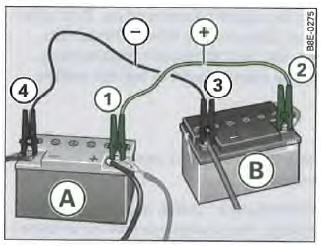
Fig. 251 Jump starting with another vehicle's battery: A: discharged battery, B: battery supplying the current
Connect the positive terminals with the (+) cable (red)
- Attach one end to the (+) terminal (1) => Fig. 251 of the discharged battery (A).
- Attach the other end to the (+) terminal (2) of the battery supplying the current (B).
Connect the negative terminals with the (-) cable (black)
- Attach one end to the (-) terminal (3) of the battery supplying the current (B).
- Attach the other end to the (-) terminal (4) of the discharged battery (A).
Starting the engine
- Start the engine of the vehicle supplying the current and let it idle.
- Then start the engine of the vehicle with the discharged battery.
- If the engine does not start: stop cranking after 10 seconds and repeat after approx. 30 seconds.
- Once the engine is running, disconnect the cables in exactly the reverse order.
Your car's battery vents to the outside, so battery gases are directed outside the vehicle.
Make sure the connected clamps have sufficient metal-to-metal contact.
CAUTION!
- The uninsulated parts of the clamps must never touch each other. In addition, the jumper cable connected to the positive battery terminal must not contact live vehicle components. Risk of short circuit.
- Route the jumper cables so they cannot become wrapped around rotating parts in the engine compartment.
- Do not lean over the batteries. Risk of burns!
- Battery cell caps must be tightened securely.
- Keep the battery away from sources of ignition. Risk of explosion!
 Warning!
The jumper cable connection procedure described above applies when jump starting your own vehicle. If you are helping another vehicle start, do not connect the negative (-) cable to the negative terminal of the discharged battery (Fig. 251, (4)). Instead, connect it to a solid metal part bolted to the engine block, or to the engine block itself. If the battery of the disabled vehicle is not vented to the outside, the explosive gas may cause an explosion.
Test yourself
A quick Audi A4 quiz: every answer comes with an explanation and a link to the manual page.