New wheels and tires
Choose new wheels and tires carefully
- Use only tires of the same type and the same size (rolling circumference) on all four wheels, and, where possible, with the same tread pattern.
- Avoid replacing tires individually; replace them at least in pairs per axle.
- Never use tires whose actual size exceeds the dimensions of the tire brands approved by Audi.
- If you plan to later equip your vehicle with tires/wheels other than those fitted at the factory, check with your Audi dealer before buying new wheels or tires.
Tires and wheels (disc wheels) are important components. Wheels and tires approved by Audi are precisely matched to your vehicle type and contribute greatly to good handling and outstanding driving qualities.
The wheel/tire sizes to be used on your vehicle are listed in the vehicle documents (for example the European Certificate of Conformity or COC 2I). Vehicle documents differ from country to country.
21 COC = certificate of conformity
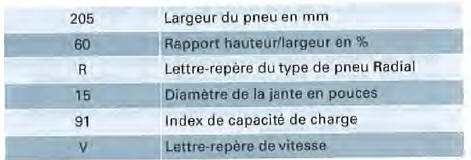
Knowing the tire characteristics will help you choose suitable tires. Radial-ply tires have the following markings on their sidewalls:
205 / 60 R 15 91 V
These numbers and letters mean:
The date of manufacture is also shown on the tire sidewall (possibly only on the inner side of the wheel):
DOT... 1006...
means, for example, that the tire was manufactured in the 10th week of the year 2006.
Please note that even if the dimensions marked on the tires, such as the nominal size 205/60 R 15 91 V, are identical, the actual dimensions of different tire types may deviate from these nominal values, and tire circumferences can vary considerably from one brand to another.
When replacing tires, make sure the actual tire dimensions do not exceed the specifications of the tire brands approved by Audi.
Using other tires may reduce the safety clearance designed for wheel rotation. Under certain conditions, the tires, chassis or body components and cables may be damaged by friction, which can seriously compromise the safety of the vehicle A. In addition, using tires with the nominal size
maximum permitted can invalidate the vehicle's certificate of conformity.
The actual tire specifications approved by Audi are suitable for your vehicle. If you want to fit another tire type to your vehicle, ask the tire dealer for a certificate from the tire manufacturer confirming that this tire type is suitable for your vehicle. Keep this certificate in a safe place.
If you want to know which tires you can safely fit to your vehicle, contact your Audi dealer.
On all-wheel-drive vehicles, all four wheels must always be fitted with tires of the same brand, the same type and the same tread pattern, so that the drivetrain is not damaged by the constant differences in wheel rotation speed. For this reason, only a standard wheel fitted with the same tire type as the other wheels on the vehicle may be used as a spare wheel. You may also use the emergency spare wheel supplied by the factory.
If the spare wheel differs from the vehicle's wheels, for example when winter tires or wide tires are fitted, use the spare wheel only in an emergency, for a limited distance and while driving carefully. Replace it with a standard wheel as soon as possible.
We recommend having all work on tires or wheels carried out by a specialist workshop. It has the special tools and spare parts required for this work, as well as the necessary expertise. It is also familiar with the problems involved in disposing of used tires.
Tire pressure monitoring system*
Your vehicle is equipped with a tire pressure monitoring system. If you replace the wheels on your vehicle or fit winter tires, make sure the new wheels are fitted with sensors compatible with your vehicle's tire pressure monitoring system. Otherwise, you will not be able to use this system. If you fit wheels without
a tire pressure monitoring system, a warning lamp will light up in the instrument cluster.
CAUTION!
- Make sure the tires you have selected provide the safety clearance designed for wheel rotation. Replacement tires must not be selected based on nominal size alone, because even if the nominal size is identical, the actual size can differ considerably from one manufacturer to another. Reduced safety clearance for wheel rotation can damage the tires or the vehicle and therefore compromise road safety - risk of accident! In addition, using tires and wheels not approved for your vehicle type can invalidate the vehicle's certificate of conformity, which authorizes its use on public roads.
- Ask an Audi workshop or a specialist workshop whether run-flat tires can be fitted to your vehicle. Using tires not approved for your vehicle type invalidates the vehicle's certificate of conformity, which authorizes its use on public roads. In addition, your vehicle may be damaged or involved in an accident.
- Only use tires that are more than 6 years old in exceptional cases, and drive carefully.
- If you fit or have fitted wheel trims later, make sure there is sufficient airflow to keep the braking system cool.
 Environment
Worn tires must be disposed of in accordance with legal requirements.
Note
- Do not use used tires if you do not know how they have been used.
- For technical reasons, wheels from other vehicles normally cannot be used. This also applies, where relevant, to wheels from the same vehicle type.
Test yourself
A quick Audi A4 quiz: every answer comes with an explanation and a link to the manual page.