Mobility System
The Mobility System in the BMW 5 Series (VII generation) is a practical aid for temporarily repairing small tire damage. It contains a sealant and a compressor, which together allow limited continued driving. The application follows clear step-by-step instructions, from filling to checking the pressure. However, the system does not replace a professional tire change. It is especially important to use the system only for suitable damage and over limited distances. Caution is advised on longer journeys, as the compressor can overheat. An overview of storage, handling and safety aspects makes this function a valuable companion in an emergency.
Principle
The Mobility System can temporarily seal minor tire damage to allow continued driving. For this, liquid sealant is pumped into the tire, which hardens and closes the damage from the inside.
The compressor can be used to check the tire inflation pressure.
General
- Observe the notes on using the Mobility System on the compressor and the sealant container.
- Use of the Mobility System may be ineffective for tire damage of approximately 4 mm or larger.
- If the tire cannot be made roadworthy, contact a manufacturer service partner, another qualified service partner or a specialist workshop.
- Leave foreign objects that have penetrated the tire in place, if possible.
- Peel the speed limit label off the sealant container and stick it onto the steering wheel.
- Using sealant can damage the RDC wheel electronics. In this case, have the electronics replaced at the next opportunity.
Overview
Storage
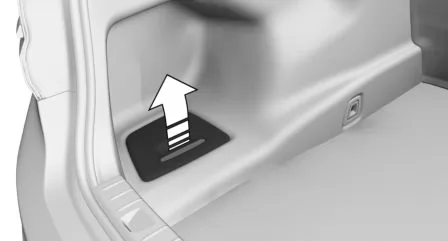
The Mobility System is located in the left storage compartment of the luggage compartment.
Sealant container
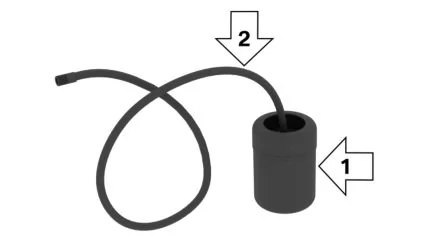
- Sealant container, arrow 1.
- Filling hose, arrow 2.
Observe the expiry date on the sealant container.
Compressor
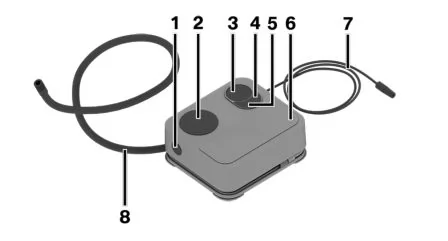
- Unlocking the sealant container
- Holder for sealant container
- Tire inflation pressure display
- Reduce tire inflation pressure
- On/off switch
- Compressor
- Plug/cable for power socket
- Connecting hose
Filling with sealant
Safety notes
DANGER If the exhaust pipe is blocked or ventilation is inadequate, harmful exhaust gases can enter the vehicle.
The exhaust gases contain carbon monoxide, which is colorless and odorless but toxic. In enclosed spaces, exhaust gases can also accumulate outside the vehicle. There is a risk of death. Keep the exhaust pipe clear and ensure adequate ventilation.
NOTICE If operated for too long, the compressor can overheat. There is a risk of property damage. Do not run the compressor for longer than 10 minutes.
Filling
- Shake the sealant container.
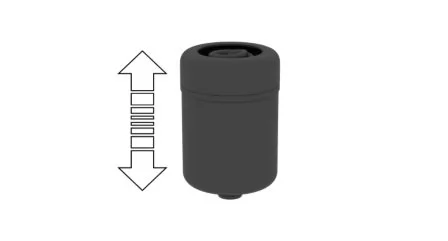
2. Pull the filling hose completely out of the cover of the sealant container. Do not kink the hose.
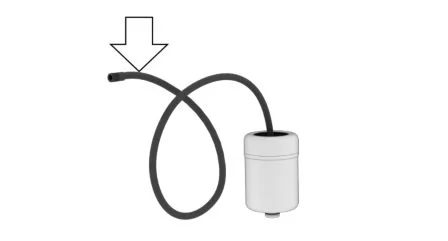
3. Push the sealant container into the holder on the compressor housing until it audibly clicks into place.
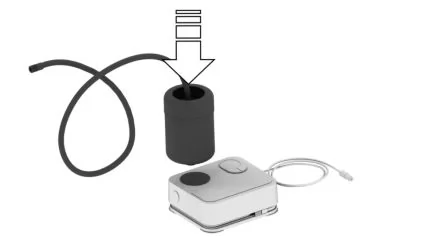
4. Screw the filler hose of the sealant container onto the valve of the defective tire.
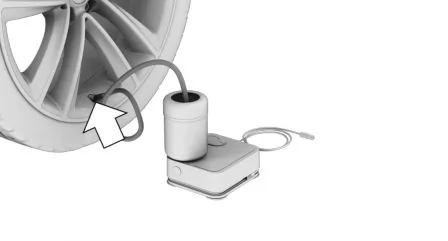
5. With the compressor switched off, plug the connector into the socket in the vehicle interior.
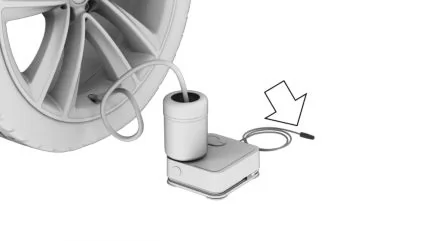
6. With the vehicle in ready mode or the engine running, switch on the compressor.
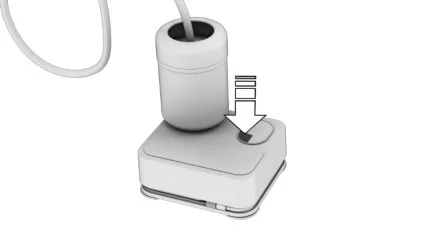
Run the compressor for a maximum of 10 minutes to inject the sealant and reach a tire pressure of approx. 2.5 bar.
When the sealant is injected, the tire pressure may briefly rise to approx. 5 bar.
Do not switch off the compressor during this phase.
Check and adjust tire pressure
Check
- Switch off the compressor.
- Read the tire pressure on the tire pressure display.
To continue driving, a tire pressure of at least 2 bar must be reached.
Remove the sealant container and stow it
- Unscrew the filler hose of the sealant container from the tire.
- Press the red release button.
- Remove the sealant container from the compressor.
- Pack the empty sealant container to prevent soiling of the luggage compartment.
Minimum inflation pressure not reached
- Unplug the connector from the socket in the vehicle interior.
- Drive forward and backward 10 m to distribute the sealant inside the tire.
- Screw the connecting hose of the compressor directly onto the tire valve.
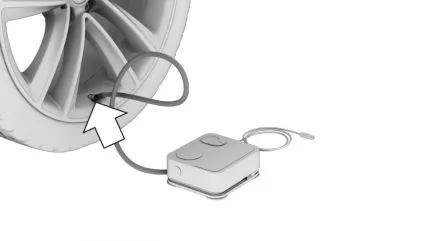
- Plug the connector into the socket in the vehicle interior.
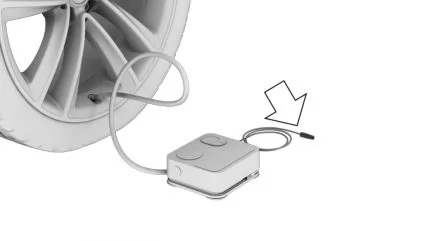
- With the vehicle in ready mode or the engine running, switch on the compressor.
If a tire pressure of at least 2 bar cannot be reached, contact a manufacturer service partner, another qualified service partner or a specialist workshop.
Once the tire inflation pressure reaches at least 2 bar, see Minimum pressure reached.Minimum inflation pressure reached
- Stow the Mobility System in the vehicle.
- Drive approx. 10 km immediately so that the sealant distributes evenly inside the tire.
Do not exceed a speed of 80 km/h.
If possible, do not fall below 20 km/h.Adjust
- Stop at a suitable location.
- Screw the connecting hose of the compressor directly onto the tire valve.
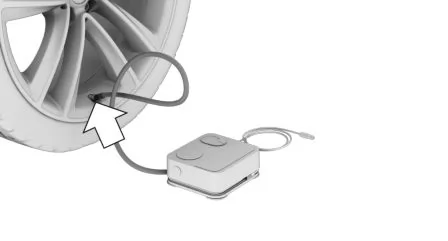
- Plug the connector into the socket in the vehicle interior.
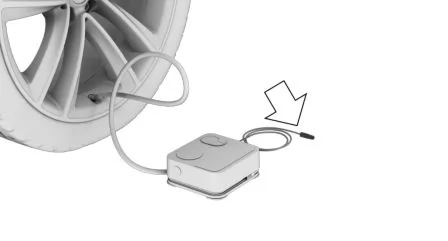
- Correct the tire pressure to at least 2.0 bar.
- To increase pressure: with the vehicle in ready mode or the engine running, switch on the compressor.
- To reduce pressure: press the button on the compressor.
- Detach the connecting hose of the compressor from the tire valve.
- Unplug the connector from the socket in the vehicle interior.
- Stow the Mobility System in the vehicle.
Continue driving
Do not exceed the maximum permitted speed of 80 km/h.
Re-initialize the Tire Puncture Warning.
Re-initialize Tire Pressure Control, see page 305.
Have the defective tire and the sealant container of the Mobility System replaced soon.
The Mobility System of the BMW 5 Series G30/G31 offers a clever emergency solution for minor tire damage and helps you continue driving to the next workshop. With sealant and compressor, the tire can be temporarily sealed and reinflated, a valuable aid in the event of a flat tire.
Particularly practical is the integration of safety labels and the notes on correct use, such as leaving foreign objects in the tire. The protection of the wheel electronics is also taken into account: after use, the electronics should be checked and replaced if necessary.
FAQQuestion 1: Can the Mobility System be used for every tire puncture?
Answer: No, for damage larger than 4 mm it is generally ineffective. In that case, a specialist workshop should be visited.
Question 2: Why must the compressor not run for longer than 10 minutes?
Answer: To prevent overheating and possible damage to the compressor.
Test yourself
A quick BMW 5 quiz: every answer comes with an explanation and a link to the manual page.