Description of system components
The transmitter module
The transmitter module transmits the following as an RF signal:
- a pressure measurement,
- an identification code,
- a function code.
The transmitter module has 2 operating modes:
- driving,
- stationary.
The transmitter module remains in Stationary mode until the start of driving is detected.
The transmitter module remains in Driving mode for the entire driving period and up to 30 seconds after the vehicle stops.
Pressure measurement sampling
Pressure is sampled:
- every 10 to 15 seconds in Driving mode,
- every 15 to 16 minutes in Stationary mode.
Transmission
Transmitter module operation:
- every minute once speed is greater than or equal to 20 km/h,
- every 60 to 65 minutes when stationary,
- up to 5 seconds maximum if the sampled pressure is abnormal.
The transmitter sends an RF signal to the receiver integrated into the steering wheel switch module, using a 45-bit transmission frame broken down as follows:
- 4 start bits (forced high for the entire duration),
- 1 separator bit (forced low for the entire duration),
- 5 function code bits (this code describes the mode the sensor is in).
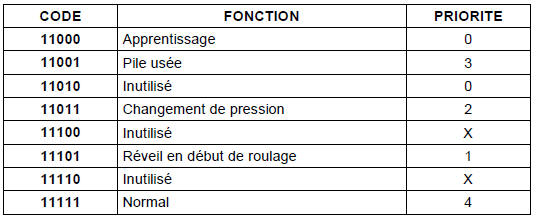
- 1 separator bit,
- 24 tyre identification code bits,
- 8 pressure value bits,
- 2 checksum bits (to verify frame consistency).
This frame is repeated eight times in succession within 1 second, with variable spacing between the words.
RF Receiver
The RF Receiver integrated into the steering wheel switch module performs the following functions:
- receives the tyre pressure status information,
- decodes the RF signal,
- checks the consistency of the frame received from the transmitter module,
- validates the frame,
- retransmits the decoded information to the BSI via the VAN CAR 1 network.
The RF Receiver integrated into the steering wheel switch module receives the tyre pressure status information:
- 10 s after the key is turned to the +APC position if the vehicle is stationary,
- immediately if the vehicle speed is not zero.
The BSI
The BSI performs the following functions:
- filters the information from the steering wheel switch module via the VAN CAR 1 network,
- determines the tyre position status,
- determines the tyre pressure status,
- determines the warning level,
- controls the warning lamps on the instrument cluster and the buzzer integrated into the steering wheel switch module, and informs the driver of the tyre status on the multifunction display by alphanumeric message.
Analysis of the frame by the BSI allows it to deliver the defined position and pressure states based on the information it contains.
Based on these states, the BSI then determines the type of alert:
- pressure alert (relating to the tyre pressure status),
- absence alert (relating to the tyre position status).
The BSI then warns the driver via the instrument cluster and the multifunction display, over the VAN CONFORT network, of an abnormal tyre pressure condition (underinflation or puncture) or of unmonitored wheels.
STATUS |
DRIVER INFORMATION |
||
INSTRUMENT CLUSTER |
MULTIFUNCTION DISPLAY | INTEGRATED BUZZER | |
| Low tire pressure | Orange warning lamp. “Service” indication |
Low tyre pressure indication | Type 2 tone |
| Flat tire | Red warning lamp. “Stop” indication |
Punctured tyre indication | Type 2 tone |
| module not detected | Missing tyre module indication | Type 2 tone | |
Test yourself
A quick Citroen C5 Aircross quiz: every answer comes with an explanation and a link to the manual page.