Brake Lines and Hoses, Front Disc Brake Pads, and Rear Drum Brake Shoes and Wheel Cylinders
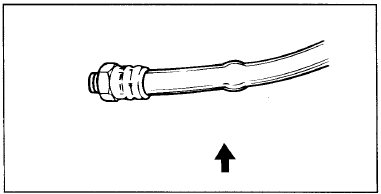
BRAKE LINES AND HOSES
1. Check all brake lines and hoses for damage, wear (abrasion), cracks, corrosion, leaks, kinks, and twists.
2. Check that the brake lines and hoses are securely retained by their clips.
3. Check that the brake lines are routed at a sufficient distance from sharp edges and corners, moving parts, and the exhaust system.
FRONT DISC BRAKE PADS
Check the brake pad linings for excessive wear and oil contamination of the friction surface. If replacement is necessary, always replace the complete set of brake pads.
If a squealing or screeching noise occurs during braking, check that the brake pad wear indicator is not contacting the brake disc. If the wear indicator is touching the brake disc, the brake pads must be replaced.
The front brake pads on the left and right wheels must be replaced at the same time.
Never separate the brake pad set or mix brake pads from different sets. Always replace all brake pads at the same time as a complete set.
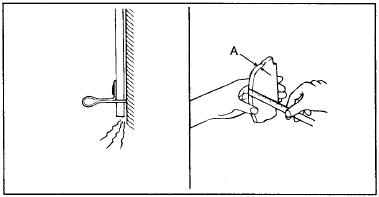
Minimum brake pad lining thickness: 2 mm
REAR DRUM BRAKE SHOES AND WHEEL CYLINDERS
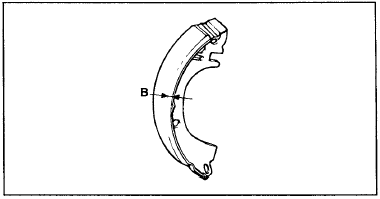
1. Remove the brake drum and check the thickness of the brake shoe linings. Check the automatic adjuster by hand, and make sure it operates smoothly and its gears engage correctly. To ensure smooth operation of the automatic adjuster, apply a very thin layer of specified grease to the friction surfaces of the adjuster, the adjuster shaft, and the adjuster lever pivot.
2. Check the wheel cylinder boots for leaks. Visually check the boots for cuts, tears, or cracks caused by heat. (A small amount of brake fluid may remain under the boot after assembly and is not necessarily a sign of leakage.) Minimum brake shoe lining thickness: 0.8 mm
Test yourself
A quick Hyundai Elantra CN7 quiz: every answer comes with an explanation and a link to the manual page.