Compression Test
1. Before measuring compression, check the engine oil level and condition. Also check that the starter and battery are in good condition.
2. Start the engine and warm it up to a coolant temperature of 80 - 95 °C.
3. Turn off the engine. Disconnect the high-voltage spark plug wires.
4. Remove the spark plugs.
5. Crank the engine with the starter to remove foreign particles from the cylinders.
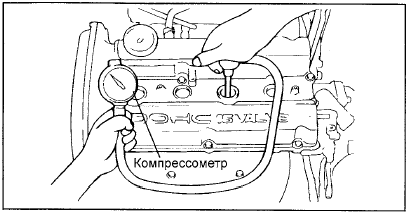
6. Install the compression gauge into the spark plug hole.
7. Fully depress the accelerator pedal to fully open the throttle valve.
8. Crank the engine with the starter and read the compression gauge.
Nominal value: 1500 kPa Minimum allowable value: 1400 kPa 9. Repeat steps 6 - 8 for all remaining cylinders and check that the difference in compression between cylinders is less than the maximum allowable value.
Limit value: not more than 100 kPa 10. If compression in any cylinder is outside the specified range, or the difference in compression between cylinders exceeds the limit, pour a small amount of engine oil into the spark plug hole of that cylinder and repeat steps 6 through 9.
1) If compression increases after adding oil, the cause is wear or damage to the piston rings and/or cylinder bore.
2) If compression does not increase after adding oil, the cause is a burnt or damaged valve seat, or gas (pressure) leakage through the cylinder head gasket.
Tightening torque Spark plug: 20 - 30 N·m
Test yourself
A quick Hyundai Elantra CN7 quiz: every answer comes with an explanation and a link to the manual page.