Power Steering System Air Bleeding
1. Fill the power steering reservoir with the recommended fluid up to the "MAX" mark.
2. Raise the front wheels of the vehicle.
3. Disconnect the high-tension leads from the ignition coils. Crank the engine with five or six short starter engagements over 15-20 seconds while turning the steering wheel fully to the left and right.
1. During air bleeding, continuously add fluid and make sure the level does not drop below the lower position of the filter.
2. If air is bled with the engine running, air will be drawn in and enter the power steering fluid.
Therefore, bleed the air from the system only while cranking the engine with the starter.
4. Connect the high-tension leads to the ignition coils, then start the engine and let it idle.
5. Turn the steering wheel from lock to lock until air bubbles disappear from the power steering reservoir.
Do not hold the steering wheel at full lock (turned fully) for more than 10 seconds.
6. Make sure the fluid is clear, without cloudiness, and that the level in the reservoir is between the "MAX" and "MIN" marks on the reservoir wall.
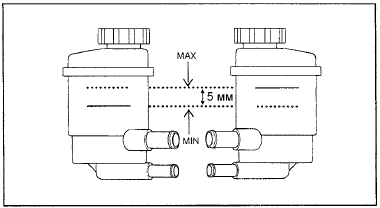
7. Make sure the fluid level changes only slightly in the reservoir when the steering wheel is turned left and right.
1. If the fluid level changes by more than 5 mm, repeat the power steering system air bleeding procedure.
2. If the fluid level rises sharply after the engine is stopped, air has not been completely removed from the system.
3. If air is not completely removed from the power steering system, rattling noises will occur from the power steering pump and the flow control valve. This will shorten the service life of the pump and other system components.
Test yourself
A quick Hyundai Elantra CN7 quiz: every answer comes with an explanation and a link to the manual page.