Jump Starting
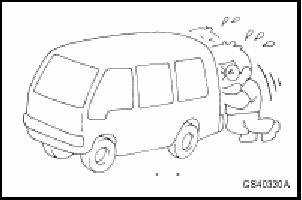
If the engine will not start due to a discharged battery, the battery of another vehicle can be used to start the engine with jumper cables.
 CAUTION:
Do not attempt to start the engine by towing or pushing the vehicle.
Observe the following precautions:
1. Both batteries must be 12 volts. The capacity (Ah) of the battery supplying current must not be significantly lower than the capacity of the discharged battery.
2. Use only jumper cables designed for heavy-duty use.
3. A discharged battery may be frozen. A frozen battery must be thawed before connecting jumper cables.
4. The two vehicles must not be in contact; otherwise, current may flow when the positive terminal is connected.
5. Properly connect the discharged battery to the electrical system of the vehicle.
6. Start the engine of the vehicle supplying current.
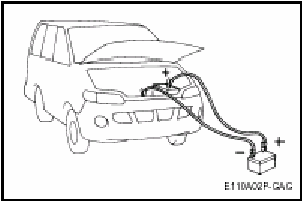
7. Connect the jumper cables as follows:
• Connect one end of one jumper cable to the positive terminal of the discharged battery, and the other end to the positive terminal of the auxiliary battery.
• Connect one end of the other jumper cable to the negative terminal of the auxiliary battery, and the other end to an engine block of the vehicle with the discharged battery, at the point farthest from the battery.
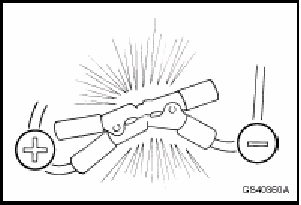
CAUTION:
a) Do not allow the jumper cable clamps to contact each other.
b) Do not connect the jumper cable to the negative terminal of the discharged battery. The battery produces explosive gas, and a spark produced when disconnecting from the negative terminal may ignite this gas and cause an explosion.
c) Take care that the jumper cable does not get caught in the cooling fan, etc.
8. Start the engine as described in "Starting the Engine".
9. After the engine has started, disconnect the cables in the reverse order.
Test yourself
A quick Hyundai H1 quiz: every answer comes with an explanation and a link to the manual page.