Driving Your Vehicle
Dual Clutch Transmission Operation
In this manual: Driving Your Vehicle
~4min read
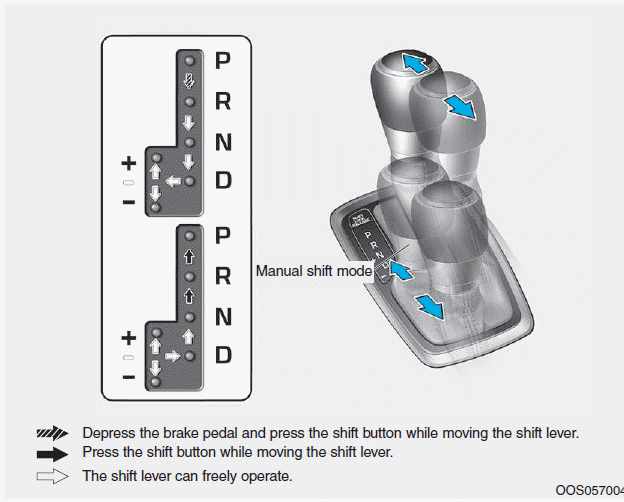
The Dual Clutch Transmission (DCT) has seven forward gears and one reverse gear. The individual gears are selected automatically when the shift lever is in the D (Drive) position.
- The Dual Clutch Transmission (DCT) can be considered an automatic version of a manual transmission. It gives the feel of driving a manual transmission while providing the ease of a fully automatic transmission.
- When D (Drive) is selected, the transmission shifts automatically through the gears, as in a conventional automatic transmission. Unlike a conventional automatic transmission, you may sometimes feel the shifts and hear the actuators engage the clutches and change gears.
- The dual clutch transmission includes a dry-type dual clutch mechanism, which improves acceleration performance and fuel efficiency during driving. However, it differs from a conventional automatic transmission in that it does not include a torque converter. Instead, the shift from one gear to the next is controlled by clutch slip, especially at lower speeds.
As a result, shifts may sometimes be more noticeable, and slight vibration may be felt as the transmission input shaft speed matches the engine shaft speed. This is a normal condition of the dual clutch transmission. - A dry-type clutch transmits torque more directly and provides a direct drive feel, which may differ from a conventional automatic transmission. This may be more noticeable when starting from a stop or driving at low speeds with frequent stops.
- When accelerating rapidly from a low vehicle speed, engine speed may rise suddenly due to clutch slip while the dual clutch transmission selects the appropriate gear. This is a normal condition.
- When accelerating from a stop on a slope, press the accelerator pedal smoothly and gradually to avoid a feeling of shudder or jerking.
- Shifts may be more noticeable, and slight vibration may be felt as the transmission shaft speed matches the engine shaft speed. This is a normal condition of the dual clutch transmission.
- A dry-type clutch transmits torque more directly and provides a direct drive feel, which may differ from a conventional automatic transmission. This may be more noticeable when starting from a stop or driving at low speeds with frequent stops.
- When accelerating rapidly from a low vehicle speed, engine speed may rise suddenly due to clutch slip while the dual clutch transmission selects the appropriate gear. This is a normal condition.
- When accelerating from a stop on a slope, press the accelerator pedal smoothly and gradually to avoid a feeling of shudder or jerking.
- When driving at low vehicle speed, if you release the accelerator pedal quickly, you may feel engine braking before the transmission shifts gears. This engine braking feel is similar to driving a manual transmission at low speed.
- When driving downhill, you can move the shift lever to the Manual shift mode position and downshift to control vehicle speed without excessive use of the brake pedal.
- Clicking sounds may be heard when the engine is started and stopped while the system performs a self-check. This is a normal sound for a dual clutch transmission.
- During the first 1,500 km (1,000 miles), you may feel that the vehicle is not smooth when accelerating at low speed. During this break-in period, the shift quality and performance of your new vehicle are continuously being optimized.
WARNING
To reduce the risk of serious injury or death:
- ALWAYS check the area around the vehicle for people, especially children, before shifting into D (Drive) or R (Reverse).
- Before leaving the driver's seat, always make sure the shift lever is in P (Park), then apply the parking brake and turn the ignition switch to the LOCK/OFF position. Unexpected and sudden vehicle movement may occur if these precautions are not observed.
- Do not use aggressive engine braking (downshifting from a higher gear to a lower gear) on slippery roads. This may cause the tires to lose traction and result in an accident.
NOTICE
- Always come to a complete stop before shifting to D (Drive) or R (Reverse).
- Do not shift into N (Neutral) while the vehicle is in motion.
Test yourself
A quick Hyundai Kona quiz: every answer comes with an explanation and a link to the manual page.
Was this page helpful?