Curtain Airbag (if equipped)
The curtain airbags are located on both sides of the roof, above the doorways of the front and rear doors.
They are designed to protect the heads of occupants seated in the front seats and the outboard rear seats in certain types of side impacts.
The curtain airbags deploy only in certain types of side impacts, depending on the severity, direction, speed and point of impact.
The curtain airbags are not designed to deploy in all types of side impacts, frontal impacts or rear impacts, or in most rollover situations.
WARNING
• To ensure the greatest effectiveness of the side airbag system (side airbags and curtain airbags) and to prevent injury during airbag deployment, the driver and passengers in the front seat and outboard rear seats must sit upright and wear their seat belts properly.
It is very important that children ride in an appropriate child restraint installed in the rear seat.
• When placing children in the outboard rear seats, use an appropriate child restraint for them.
Install the child restraint as far away from the door as possible and secure it properly.
• Do not allow passengers to lean their head or body against the door, rest their arms on it, extend their arms out of the window, or place any objects between the doors and occupants when seated in seats equipped with side airbags and/or curtain airbags.
• Never attempt to open or repair any component of the side airbag and curtain airbag system. This work must be performed only by an authorized HYUNDAI dealer.
Failure to follow the above instructions may result in injury or death to vehicle occupants in the event of a traffic accident.
Why did the airbag not deploy in a collision? (Conditions under which the airbag deploys and does not deploy) There are many types of traffic accidents in which additional airbag protection is not expected.
These include rear-end impacts, cases where the vehicle is second or third in a chain of colliding vehicles, and collisions that occur at low speed. In other words, do not be surprised if the airbags did not deploy and the vehicle is damaged or even not repairable.
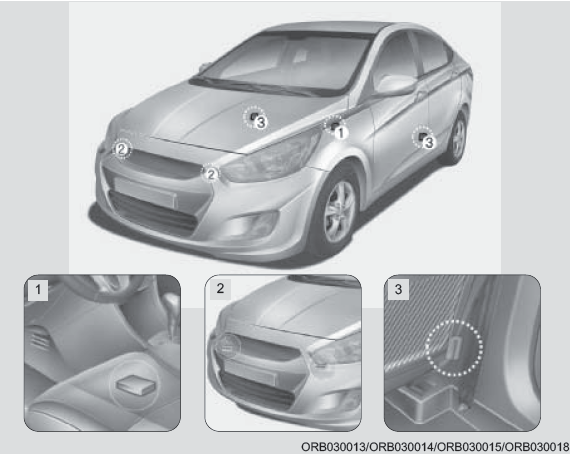
Airbag System Impact Sensors
(1) SRS Control Unit (SrScm)
(2) Frontal Impact Sensor
(3) Side Impact Sensor
WARNING
• Do not strike the areas where the airbags or sensors are located, or subject them to impact from foreign objects.
This may cause unintended airbag deployment, which may result in serious injury or death.
• If the mounting position or angle of the sensors is changed in any way, the airbags may deploy when they should not, or fail to deploy when needed. Either may result in serious injury or death.
For this reason, do not perform vehicle maintenance work in the areas where the airbag system sensors are installed. Inspection and repair must be performed by an authorized HYUNDAI dealer.
• If the sensor mounting angles change due to deformation of the front bumper, body, or B- or C-pillars where the sensors are located, problems may occur. Inspection and repair must be performed by an authorized HYUNDAI dealer.
• This vehicle was designed to absorb impact and deploy the airbag(s) in certain collisions. Installing non-genuine bumper guards or replacing the bumper with a third-party bumper may significantly reduce the crash protection performance of the vehicle and the airbag system.

Airbag Deployment Conditions
Front airbags
The front airbags are designed to deploy in a frontal collision depending on its severity, speed or direction of impact. In general, the direction of the collision should be along the vehicle's centerline, with a possible slight deviation to the left or right.
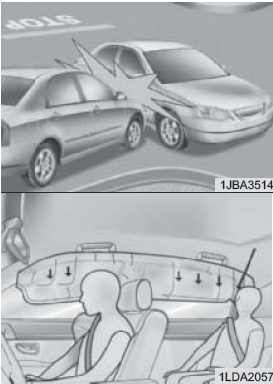
Side Airbags and Curtain Airbags (if equipped)
The side airbags and curtain airbags are designed to deploy when the side impact sensors detect an impact, depending on the severity, speed or direction of the impact from a side collision.
Although the front airbags (driver and front passenger airbags) are designed to deploy only in frontal collisions, they may also deploy in other types of collisions if the frontal crash sensors detect an impact of significant severity. Side airbags and curtain airbags are designed to deploy only in side collisions, but they may also deploy in other types of collisions if the side impact sensors detect an impact of significant severity.
If the vehicle underbody strikes bumps or foreign objects on a rough road, the airbags may deploy. Use caution when driving on poor-quality roads and on surfaces not intended for vehicular traffic to avoid unintended airbag deployment.
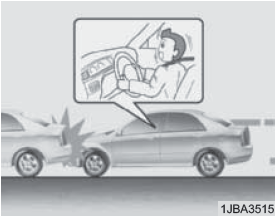
Conditions in which airbags will not deploy • Airbags may not deploy in certain low-speed collisions.
They are not designed to deploy in such cases, since they cannot provide additional protection beyond that provided by the seat belts in such collisions.
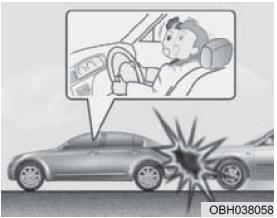
• Front airbags are not designed to deploy in a rear-end collision, since the force of such an impact causes occupants to move rearward. In such a case, airbag deployment would not provide any additional protection.
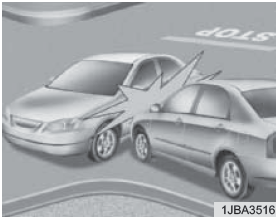
• Front airbags may not deploy in side collisions, since occupants move in the direction of the impact. Therefore, deployment of the front airbags in such situations will not provide additional protection to these occupants.
However, side airbags and curtain airbags may deploy depending on the impact force, vehicle speed and direction of the impact.
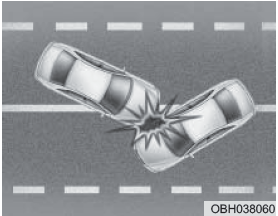
• In an angled collision, the force of the impact may cause occupants to move in a direction in which the airbags cannot provide additional protection. For this reason, the sensors may not send a deployment command to the airbags.

• Immediately before a collision, drivers typically apply the brakes hard. This causes the front of the vehicle to dip down, so that it passes under a vehicle with a higher ground clearance. Airbags may not deploy in such "submarining" because the deceleration level may be significantly lower than the specified value.
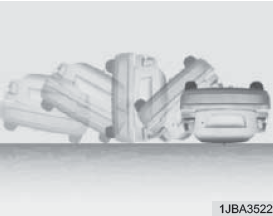
• Airbags may not deploy in accidents in which the vehicle rolls over, and will not be able to protect occupants of the vehicle.
However, side airbags and curtain airbags may deploy when the vehicle rolls over as a result of a side collision, if the vehicle is equipped with such passive safety devices.
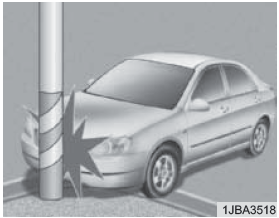
• Airbags may not deploy when the vehicle strikes objects such as poles or trees. In this case, the impact is concentrated on a limited area, and its full force is not detected by the sensors.
Test yourself
A quick Hyundai Solaris quiz: every answer comes with an explanation and a link to the manual page.