KIBS Servicing Precautions
There are a number of important precautions that should be followed servicing the KIBS.
- This KIBS is designed to be used with a 12 V sealed battery as its power source. Do not use any other battery except for a 12 V sealed battery as a power source.
- Do not reverse the battery cable connections. This will damage the KIBS hydraulic unit.
- To prevent damage to the KIBS parts, do not disconnect the battery cables or any other electrical connections when the ignition switch is ON or while the engine is running.
- Take care not to short the leads that are directly connected to the battery positive (+) terminal to the chassis ground.
- Do not turn the ignition switch to ON while any of the KIBS electrical connectors are disconnected. The KIBS hydraulic unit memorizes service codes.
- Do not spray water on the electrical parts, KIBS parts, connectors, leads and wiring.
- If a transceiver is installed on the motorcycle, make sure that the operation of the KIBS is not influenced by electric wave radiated from the antenna. Locate the antenna as far as possible away from the KIBS hydraulic unit.
- Whenever the KIBS electrical connections are to be disconnected, first turn off the ignition switch.
- The KIBS parts should never be struck sharply, as with a hammer, or allowed to fall on a hard surface. Such a shock to the parts can damage them.
- The KIBS parts cannot be disassembled. Even if a fault is found, do not try to disassemble and repair the KIBS parts, replace it.
- The KIBS has many brake lines, pipes, and leads. And the KIBS cannot detect problems with the conventional braking system (brake disc wear, unevenly worn brake pad, and other mechanical faults). To prevent trouble, check the brake lines and pipes for correct routing and connection, the wiring for correct routing, and the brakes for proper braking power. Be sure to check for fluid leakage, and bleed the brake line thoroughly.
- Connect the KIBS Kawasaki Self-Diagnosis System connector cover to the original position when the cover is disconnected.
NOTICE
When the KDS connector cover with a lead is connected to the KIBS Kawasaki Self-Diagnosis System connector by mistake, the fuse of the KIBS blows and its function will not work.
WARNINGAir in the brake lines diminish braking performance and can cause an accident resulting in injury or death. If any of the brake line fittings, including the KIBS hydraulic unit joint nuts, or the bleed valve is opened at any time, the air must be bled completely from the brake line. If the brake lever has a soft or "spongy" feeling mushy when it is applied, there might be air in the brake lines or the brake may be defective. Do not operate the vehicle and service the brake system immediately.
NOTICE
Do not ride the motorcycle with air in the brake line, or the KIBS could malfunction.
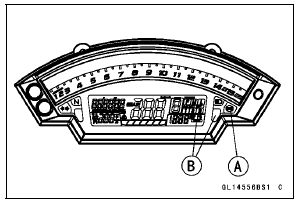
- The ABS indicator light (LED) [A] and KIBS indicator light (LED)/KIBS symbol [B] may light if the tire pressure is incorrect, a non-recommended tire is installed, or the wheel is deformed. If the indicator light lights, remedy the problem and clear the service code.
WARNING
Use of non-recommended tiresmay cause malfunctioning of KIBS and can lead to extended braking distance resulting in an accident causing serious injury or death. Always use recommended standard tires for this motorcycle.
- The ABS indicator light (LED) may come on if the engine is run with the motorcycle on a stand and the transmission in gear. If the indicator light comes on, just turn the ignition switch OFF, then clear service code b 42, which indicates a “Faulty front wheel rotation sensor”.
- When the KIBS operates, the KIBS makes noise and the rider feels the reaction force on the brake lever and brake pedal. This is a normal condition. It informs the rider that the KIBS is operating normally.
- Service codes detected once by the KIBS hydraulic unit will be memorized in the KIBS hydraulic unit.
- A fully charged battery is a must for conducting reliable self-diagnosis. Test run themotorcycle at a speed of more than 20 km/h to see that the ABS and KIBS indicator lights (LED) do not come on. Finally, test run the motorcycle at a speed of more than 30 km/h and brake suddenly to see that the motorcycle stops without loss of steering control and the KIBS operates normally (The reaction force generated is felt in the brake lever and pedal.). This completes the final inspection.
Test yourself
A quick Kawasaki Ninja ZX-10R quiz: every answer comes with an explanation and a link to the manual page.