Releasing the Parking Brake
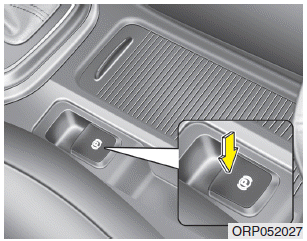
To release the EPB (Electronic Parking Brake), press the EPB switch under the following conditions:
- Turn the ignition key or Engine Start/Stop button to the ON position.
- Press the brake pedal.
Make sure the brake warning light turns off.
To release the EPB (Electronic Parking Brake) automatically:
- Vehicle with manual transmission
1. Start the engine.
2. Fasten the driver's seat belt.
3. Close the driver's door, hood, and tailgate.
4. Depress the clutch pedal with the gear engaged.
5. Depress the accelerator pedal while releasing the clutch pedal. - Vehicle with automatic transmission
1. Start the engine.
2. Fasten the driver's seat belt.
3. Close the driver's door, hood, and tailgate.
4. Depress the accelerator pedal when the shift lever is in R (Reverse) or D (Drive). - Shift lever in P (Park)
With the engine running, depress the brake pedal and shift from P (Park) to R (Reverse) or D (Drive). - Shift lever in N (Neutral)
With the engine running, depress the brake pedal and shift from N (Neutral) to R (Reverse) or D (Drive). Make sure the brake warning light turns off.
✽ NOTICE
- For your safety, you can apply the EPB even when the ignition switch or the Engine Start/Stop button is in the OFF position, but you cannot release it.
- For safety, depress the brake pedal and release the parking brake manually using the EPB switch when driving downhill or when driving the vehicle in reverse.
✽ NOTICE - Manual Transmission
A vehicle towing a trailer on a hill or slope may roll slightly backward when starting. To prevent this, follow the instructions below.
1. Depress the clutch pedal and select a gear.
2. Continue pulling up the EPB switch.
3. Depress the accelerator pedal and slowly release the clutch pedal.
4. If the vehicle starts moving with sufficient power, release the EPB switch.
Do not perform the above procedure on level ground. The vehicle may suddenly move forward.
CAUTION
- If the parking brake indicator remains illuminated even though the EPB has been released, we recommend having the system checked by an authorized Kia dealer.
- Do not drive the vehicle with the EPB applied. This may cause excessive wear of the brake pads and brake discs.
The EPB (Electronic Parking Brake) may be applied automatically when:
- The EPB overheats
- Requested by other systems
- If you attempt to drive off by depressing the accelerator pedal with the EPB applied, the EPB does not release automatically, a warning chime sounds and a message ("Release Parking Brake") appears.
- If the driver's seat belt is not fastened and any door, the hood, or the tailgate is open, a warning chime sounds and a message appears.
- If a problem occurs with the vehicle, a warning chime may sound and a message may appear.
If the situation described above occurs, depress the brake pedal and release the EPB by pressing the EPB switch.
WARNING
- To prevent unintentional movement when stopping and leaving the vehicle, do not use the shift lever in place of the parking brake. Apply the parking brake and make sure the shift lever is securely set to the P (Park) position.
- Never allow anyone who is not familiar with the vehicle to touch the parking brake. Unintentional release of the parking brake may result in serious injury.
- Always make sure the parking brake is fully applied when parking all vehicles to prevent unintended vehicle movement that may injure passengers or pedestrians.
CAUTION
- A clicking sound may be heard when the EPB is operated or released. This is normal and indicates that the EPB is functioning properly.
- When leaving the keys with a valet or parking attendant, make sure to tell him/her how to operate the EPB.
- The EPB may be damaged if you drive with the EPB applied.
- When releasing the EPB automatically by depressing the accelerator pedal, depress it slowly.
Test yourself
A quick Kia Carens RP quiz: every answer comes with an explanation and a link to the manual page.