System Limitations
The FCA system is designed to monitor the vehicle ahead through radar signals and camera recognition to warn the driver of an imminent collision and, if necessary, apply emergency braking. In certain situations, the radar sensor or camera may not be able to detect the vehicle ahead. In these cases, the FCA system may not operate. The driver should pay special attention to the following situations, where FCA operation may be limited:
Vehicle Recognition
- The radar or camera is contaminated with foreign matter.
- Heavy rain or snow.
- Electromagnetic interference is present.
- Something in the travel path deflects radar waves.
- The vehicle ahead has a narrow body (e.g., motorcycles and bicycles).
- The driver's view is unclear due to backlight, reflected light, or darkness.
- The camera cannot capture the full image of the vehicle ahead.
- The vehicle ahead is a special vehicle, such as a heavily loaded truck or trailer.
- External brightness changes significantly, such as entering or exiting a tunnel.
- The vehicle's movement is unstable.
- Recognition by the radar/camera sensor is limited.
- The driver's view is poorly illuminated (either too dark, or too much reflection or backlight blocking the field of view).
- Strong uneven reflection from the radar sensor is present.
- The vehicle ahead moves erratically.
- The vehicle is driving near areas containing metallic objects, such as construction zones, railways, etc.
- Light is reflected toward the vehicle (including headlights from an oncoming vehicle).
- Moisture on the windshield is not completely removed or is frozen.
- Foggy weather.
- The vehicle ahead does not illuminate its taillights, has no taillights, has an asymmetric rear lamp, or has taillights that are misaligned.
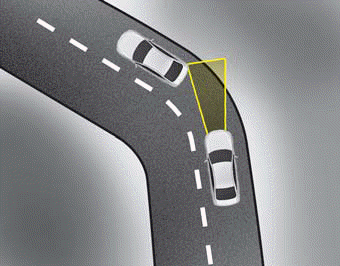
- Driving on curves
FCA performance may be limited when driving on curves. FCA may not recognize a vehicle ahead even if it is in the same lane. It may issue a warning message and warning signal prematurely, or it may not issue a warning message or warning signal at all. When driving on a curve, be careful, maintain a safe braking distance, and if necessary, press the brake pedal to reduce vehicle speed to maintain a safe distance.
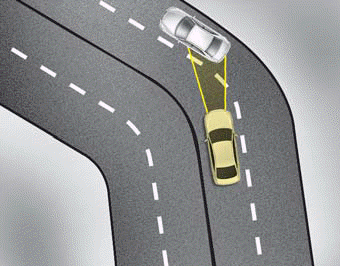
The FCA system may recognize a vehicle in an adjacent lane while driving on a curved road. In this situation, the system may apply the brakes. Always pay attention to the road and driving conditions while driving. If necessary, press the brake pedal to reduce vehicle speed and maintain a safe distance. In addition, when necessary, you can depress the accelerator pedal so that the system does not unnecessarily decelerate your vehicle. Always check traffic conditions around the vehicle.
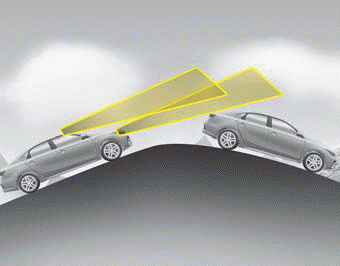
- Driving on slopes
FCA performance may be limited when driving uphill or downhill on a slope, and it may not recognize a vehicle ahead in the same lane. It may issue a warning message and warning signal prematurely, or it may not issue a warning message and warning signal at all.
When FCA suddenly recognizes a vehicle ahead while overtaking on a slope, you may experience sudden deceleration.
Always look ahead while driving uphill or downhill on a slope and, if necessary, press the brake pedal.
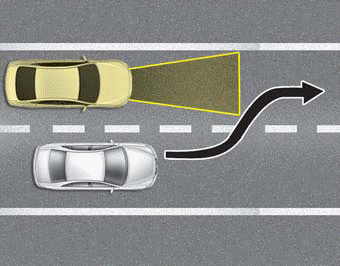
- Lane change
When a vehicle changes lanes in front of you, the FCA system may not immediately detect the vehicle, especially if the vehicle changes lanes abruptly. In this situation, maintain a safe braking distance and, if necessary, press the brake pedal to reduce vehicle speed and maintain a safe distance.
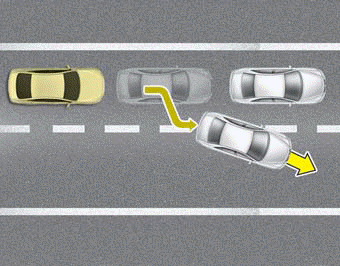
When driving in stop-and-go traffic, if the vehicle ahead stops and moves out of the lane, the FCA system may not immediately detect the new vehicle now in front of you. In this situation, maintain a safe braking distance and, if necessary, press the brake pedal to reduce vehicle speed and maintain a safe distance.
- Vehicle Recognition
If the vehicle ahead is carrying a load that extends rearward beyond the cab, or when the vehicle ahead has increased ground clearance, additional attention is required. The FCA system may not be able to recognize a load extending from the vehicle. In these cases, you must maintain a safe braking distance from the rearmost object and, if necessary, press the brake pedal to reduce your driving speed.
Test yourself
A quick Kia Forte BD quiz: every answer comes with an explanation and a link to the manual page.