Battery
Battery care on the Kia Opirus is a safety-relevant aspect of vehicle maintenance. This chapter emphatically points out the hazards posed by hydrogen gas and sulfuric acid, including specific protective measures such as wearing gloves and eye protection. Step-by-step instructions for charging, maintaining and disconnecting the battery are also provided. An overview of systems that must be reset after a power interruption is included as well. This keeps your Kia Opirus ready to start and safe to operate at all times.
CAUTION - Hazards Posed by Batteries
 Always read the following instructions before performing any work on the battery.
 Hydrogen, a highly explosive gas, is always present in the battery cells and could be ignited.
 Always keep batteries away from children, as batteries contain extremely corrosive sulfuric acid. Do not allow battery acid to contact your skin, eyes, or clothing, or the vehicle paint.
 Wear safety goggles when charging a battery or working near a battery. When working in enclosed spaces, ensure adequate ventilation.
- When lifting a battery with a plastic case, applying strong pressure to the case can cause battery acid to escape and cause injury. Lift the battery using a battery carrier or hold it with both hands at opposite corners.
- Never attempt to charge a battery while the battery cables are connected.
- The electronic ignition system operates on high voltage. Never touch ignition system components when the ignition is on or the engine is running.
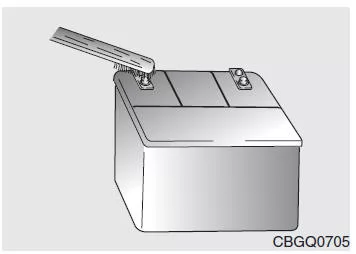
For Optimal Battery Maintenance
- Always make sure the battery is securely mounted.
- Keep the battery surface clean and dry.
- Keep the battery terminals and cable clamps clean and coated with terminal grease, and make sure the battery cable clamps are tight.
- Rinse off spilled battery acid with water immediately.
- Disconnect the battery cables if the vehicle will not be used for an extended period.
Systems that must be set or adjusted (reset) after the battery has been discharged or disconnected.
- Driver's seat memory system (see Chapter 3)
- Power windows (see Chapter 3)
- Clock (see Chapter 3)
- Air conditioning control (see Chapter 4)
- Audio system (see Audio System Owner's Manual)
- Sunroof (see Chapter 3)
Observe the following precautions when charging a battery.
- The battery must be removed and placed in a well-ventilated area.
- Monitor the battery while charging. Stop charging or reduce the charging current if the cells are gassing heavily (boiling), or if the electrolyte temperature in any cell exceeds 49°C.
- Wear safety goggles when approaching the battery.
- Disconnect the charger leads from the battery in the following order.
- Turn off the charger's main switch.
- Disconnect the negative charger lead from the battery.
- Disconnect the positive charger lead from the battery.
NOTE
- Turn off the engine and switch off all electrical loads before servicing or charging the battery.
- When disconnecting the battery cables, disconnect the negative cable first and reconnect it last.
The battery of the Kia Opirus 2003–2011 requires special care in handling and maintenance. Regularly checking the state of charge and the terminals prevents starting problems and extends battery life.
Observing the safety instructions protects against accidents and damage. The Kia Opirus stands out with a well-designed battery system that provides reliable support.
When replacing or charging the battery, always work properly to avoid damaging the electrical system and electronics.
Test yourself
A quick Kia Opirus quiz: every answer comes with an explanation and a link to the manual page.