Blind-Spot Detection (BSD) System (if equipped)
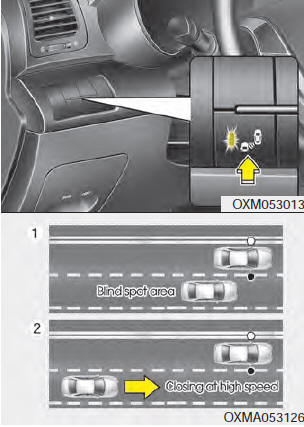
The BSD (Blind-Spot Detection) system uses a radar sensor to warn the driver while driving.
It detects the rear of the vehicle and provides information to the driver.
➀ BSD (Blind-Spot Detection)
The warning range depends on the speed of your vehicle. However, if your vehicle speed is about 10 km/h or less than the other vehicle, the warning does not operate.
➁ LCA (Lane Change Assist)
A warning appears when a vehicle approaches your vehicle at high speed.
WARNING
- Always check road conditions while driving for unexpected situations, even when the BSD (Blind-Spot Detection) system is operating.
- Never use the BSD system as a substitute for careful driving. Drivers must always use their mirrors and look over their shoulder to detect other vehicles when changing lanes. The BSD system is designed only to supplement safe driving practices.
Operating Conditions
The indicator on the switch will illuminate when the BSD (Blind-Spot Detection) system switch is pressed with the ignition ON. The system is activated when the vehicle speed exceeds 30 km/h.
If the ignition switch is turned off and then on again, the system returns to its previous state.
When the system is not in use, turn the system off by pressing the switch.
When the system is turned on, the warning light on the outside rearview mirror illuminates for 3 seconds.
Warning Type
The system is activated when:
1. The system is turned on.
2. Vehicle speed is above 30 km/h.
3. Other vehicles are detected behind.
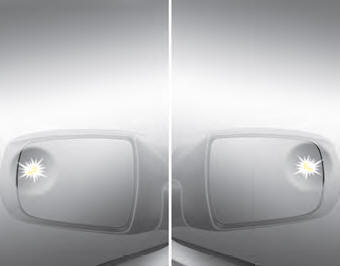
If a vehicle is detected within the system boundaries, a yellow warning lamp will illuminate inside the outside rearview mirror glass.
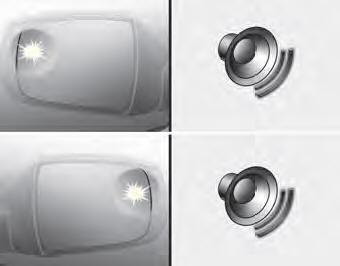
The second-stage warning is activated when:
1. Stage 1 warning is activated.
2. The turn signal is on for a lane change or the hazard warning lights are on.
When the second warning stage is activated, the warning lamp illuminates on the outside rear view mirror housing and an audible warning sounds.
Detection Sensor
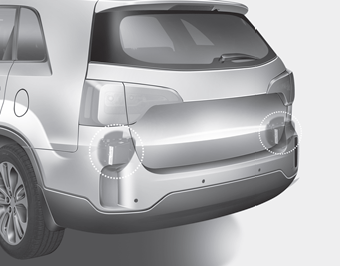
The sensors are located on the inside of the rear bumper.
Always keep the rear bumper clean for the system to function properly.
Warning Message
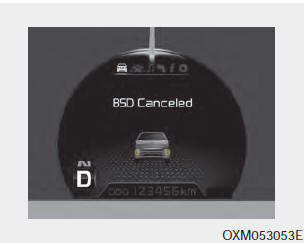
A warning message will appear to notify the driver if there are foreign substances on or near the rear bumper, or if the area near the rear bumper is hot. The indicator light on the switch will turn off and the system will be deactivated automatically.
Remove any foreign objects from the rear bumper.
If the system does not operate normally even after removing the foreign object, take your vehicle to an authorized Kia dealer and have the system inspected.
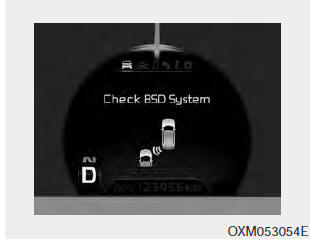
If the system does not operate properly, a warning message will appear and the indicator light on the switch will turn off.
The system will turn off automatically. Have your vehicle inspected at an authorized Kia dealer.
WARNING
- The warning lamp on the outside rear view mirror housing will illuminate whenever the system detects a vehicle behind you. To avoid an accident, do not rely solely on the warning lamp and neglect to check the surroundings of the vehicle.
- Drive safely even if the vehicle is equipped with a BSD (Blind-Spot Detection) system. Do not rely solely on the system; check yourself before changing lanes. The system may not warn the driver under some conditions, so always check the surroundings while driving.
CAUTION
- The system may not operate properly if the bumper has been replaced or if repair work has been performed near the sensor.
- The detection area varies depending on the width of the road. If the road is narrow, the system may detect other vehicles in an adjacent lane.
- Conversely, if the road is very wide, the system may not detect other vehicles.
- The system may turn off due to strong electromagnetic waves.
Malfunction
The driver should be careful in the following situations, when the system may not assist the driver and may operate incorrectly.
- Curved roads, toll gates, etc.
- The sensor area is covered with rain, snow, mud, etc.
- The rear bumper near the sensor is covered or obstructed by foreign objects such as a sticker, bumper guard, bicycle carrier, etc.
- The rear bumper is damaged or the sensor is misaligned.
- The vehicle height is changed or altered, such as when the luggage compartment is loaded with heavy items or when tire pressure is abnormal, etc.
- Due to bad weather, such as heavy rain or snow.
- A stationary object, such as a guardrail, is nearby.
- A large amount of metallic objects, such as structures, is located in the area near the vehicle.
- A large vehicle, such as a bus or truck, is nearby.
- A motorcycle or bicycle is nearby.
- A flat trailer or a vehicle-like object is nearby.
- The vehicle starts moving at the same time as a vehicle next to it and accelerates.
- Another vehicle passes very quickly.
- When changing lanes.
- When driving down or up a steep road with a different lane height.
- Another vehicle is following very closely or approaching very closely from behind.
- When the temperature near the bumper is high.
- When a trailer or vehicle is attached.
The outside rearview mirror may not warn the driver if:
- The outside rear view mirror housing is covered with foreign substances.
- The window is blocked by foreign objects.
- The windows are heavily tinted.
Test yourself
A quick Kia Sorento Owner's Manual quiz: every answer comes with an explanation and a link to the manual page.