Driving with a Trailer
Towing a trailer requires some experience. Before setting out on open roads, you should become familiar with your trailer. Get to know the handling and braking feel with the additional weight of the trailer. And always keep in mind that the vehicle you are driving is now much longer and far less responsive than it is on its own.
Before starting, check the hitch and trailer platform, safety chains, electrical connector(s), lights, tires, and mirror adjustment. If the trailer has electric brakes, start your vehicle and trailer, then manually activate the trailer brake controller to make sure the brakes work. This also allows you to check the electrical connection at the same time.
During the trip, check periodically that the cargo is securely fastened and that the trailer lights and brakes are still working.
Following Distance
Stay behind the vehicle ahead at a distance at least twice as great as when driving your vehicle without a trailer. This can help you avoid situations requiring sudden braking and sharp turns.
Passing
When towing a trailer, you will need a greater distance to pass.
Also, because of the increased length of the vehicle, you will need to drive much farther past the passed vehicle before you can return to your lane. Due to the additional load on the engine when driving uphill, the vehicle may also need more time to complete the passing maneuver than on level ground.
Backing Up
Hold the bottom of the steering wheel with one hand. Then, to move the trailer to the left, simply move your hand to the left. To move the trailer to the right, move your hand to the right. Always reverse slowly and, if possible, have someone guide you.
Making Turns
When turning with a trailer, make wider turns than usual. Do this so your trailer does not strike soft shoulders, curbs, road signs, trees, or other objects near the edge of the road. Avoid jerky and abrupt maneuvers. Signal well in advance before turning or changing lanes.
Turn Signals When Towing a Trailer
When towing a trailer, your vehicle must be equipped with a different turn signal flasher and additional wiring. The green arrows on the instrument panel will flash whenever you signal a turn or lane change. When connected correctly, the trailer lights will also flash to warn other drivers that you are about to turn, change lanes, or stop.
When towing a trailer, the green arrows on the instrument panel will flash even if the trailer bulbs have burned out. As a result, you may think that drivers behind you can see your signals when in fact they cannot. It is important to check from time to time that the trailer lights are still working. You should also check the indicators every time you disconnect and then reconnect the wiring.
Do not connect the trailer lighting system directly to your vehicle's lighting system. Use only an approved trailer wiring harness.
An authorized Kia dealer can help you install the wiring harness.
WARNING
Failure to use an approved trailer wiring harness may result in damage to the vehicle's electrical system and/or personal injury.
Driving on Downhill Grades
Reduce speed and shift to a lower gear before starting down a long or steep grade. If you do not shift to a lower gear, you may have to brake so hard that the brakes overheat and stop working effectively.
On a long grade, shift to a lower gear and reduce speed to approximately 45 mph (70 km/h) to reduce the possibility of engine and transmission overheating.
If your trailer weighs more than the maximum trailer weight without trailer brakes and your vehicle has an automatic transmission, you should drive in D (Drive) when towing the trailer.
Driving in D (Drive) when towing a trailer minimizes heat build-up and extends the service life of your transmission.
CAUTION
- When towing a trailer on steep grades (over 6%), pay particular attention to the engine coolant temperature gauge to make sure the engine is not overheating. If the coolant temperature gauge needle moves toward the "H" (HOT) position, stop as soon as it is safe to do so and let the engine idle until it cools. You may continue after the engine has cooled sufficiently.
- You must determine your driving speed based on trailer weight and the uphill grade to reduce the possibility of engine and transmission overheating.
Parking on Hills
As a general rule, if a trailer is attached to your vehicle, you should not park your vehicle on a hill. People may be seriously or fatally injured, and your vehicle and trailer may be damaged if they unexpectedly roll down the slope.
However, if you ever have to park your trailer on a hill, here is how to do it:
WARNING! Parking on a hill.
Parking a vehicle with a trailer on a hill may result in serious injury or death if the trailer detaches or the brakes fail.
1. Drive the vehicle into the parking space. Turn the steering wheel toward the curb (to the right if facing downhill, to the left if facing uphill).
2. If the vehicle has a manual transmission, shift into neutral. If the vehicle has an automatic transmission, shift into P (Park).
3. Apply the parking brake and turn off the engine.
4. Place wheel chocks under the trailer wheels on the downhill side.
5. Start the engine, hold the brakes, shift to neutral, release the parking brake, and slowly release the brakes until the trailer wheel chocks take the load.
6. Reapply the brakes, apply the parking brake again, and shift the vehicle into R (Reverse) for a manual transmission or P (Park) for an automatic transmission.
7. Turn off the vehicle and release the vehicle brakes, but leave the parking brake set.
WARNING! Parking Brake
Leaving the vehicle if the parking brake is not firmly set may be dangerous. If the engine is left running, the vehicle may suddenly move. You or others could be seriously or fatally injured.
When you are ready to drive away after parking on a hill
1. With a manual transmission in neutral or an automatic transmission in P (Park), apply the brakes and keep the brake pedal depressed until you:
- Start the engine;
- Shift into gear; and • Release the parking brake.
2. Slowly release the brake pedal.
3. Drive slowly until the trailer is on the wheel chocks.
4. Stop and ask someone to lift and remove the wheel chocks.
Trailer Towing Maintenance
Your vehicle will require maintenance more often if you tow a trailer regularly.
Important items to pay particular attention to include engine oil, transmission fluid, axle lubricant, and engine coolant. Brake condition is another important item to check frequently. Each item is covered in this manual, and the Index will help you find them quickly. If you tow a trailer, it is a good idea to review these sections before setting out on a trip.
Do not forget to maintain your trailer and hitch as well. Follow the maintenance schedule that came with your trailer and inspect it periodically.
It is preferable to perform an inspection at the start of each day of driving. Most importantly, all hitch nuts and bolts must be tightened.
CAUTION
- Due to the higher load when towing a trailer in hot conditions or while driving uphill, the engine may overheat. If the coolant temperature gauge indicates overheating, turn off the air conditioner and stop the vehicle in a safe place to cool the engine.
- When towing, check the transmission fluid more frequently.
If you decide to tow a trailer
The following are important points if you decide to tow a trailer:
- Consider using a sway control. You can ask the hitch seller about sway control systems.
- Do not tow a trailer during the first 1200 miles (2000 km) to ensure proper break-in of the engine. Failure to observe this caution may result in serious engine or transmission damage.
- When towing a trailer, be sure to consult an authorized Kia dealer for more information about additional requirements, such as a towing package, etc.
- Always drive at a moderate speed (less than 60 mph). (100 km/h).
- On long uphill grades, do not exceed a speed of 70 km/h or the specified towing speed limit, whichever is lower.
- The chart contains important considerations related to weight:
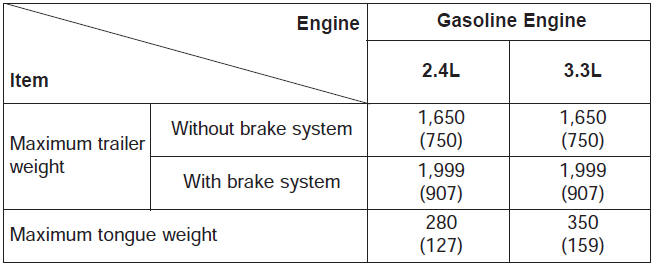
To determine the trailer weight rating for your vehicle, you should read the information in the "Trailer Weight" section later in this section.
Trailer Weight
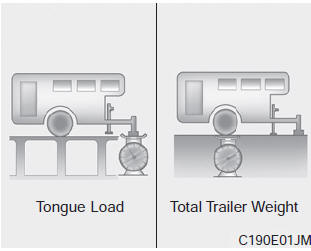
What is the maximum safe trailer weight? It should never weigh more than the maximum trailer weight with trailer brakes. But even this may be too heavy.
This depends on how you plan to use your trailer. For example, speed, altitude, road grades, outside air temperature, and how often you tow a trailer with your vehicle are all important.
The ideal trailer weight may also depend on the special equipment installed on your vehicle.
Tongue Weight
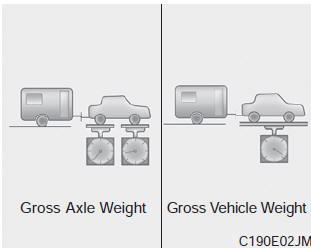
The tongue load of any trailer is an important value to measure, because it affects the Gross Vehicle Weight (GVW).
This weight includes the curb weight of the vehicle, any cargo you may carry in it, and the people who will ride in the vehicle. If you are towing a trailer, you must add the tongue load to the gross vehicle weight, because your vehicle will also carry this weight.
Trailer tongue weight should be no more than 10% of the total loaded trailer weight, within the maximum allowable trailer tongue weight. After you have loaded the trailer, weigh the trailer, then the tongue weight separately, to check whether the weights are correct. If not, you can correct them by moving some items within the trailer.
WARNING! Trailer
- Never load a trailer so that it is heavier at the rear than at the front. The front should carry approximately 60% of the total trailer load; the rear should carry approximately 40% of the total trailer load.
- Never exceed the maximum trailer weight or towing equipment rating. Improper loading can damage your vehicle and/or personal property. Check the weight and load at a commercial scale or at a highway patrol station equipped with scales.
- An improperly loaded trailer can cause loss of vehicle control.
Test yourself
A quick Kia Sorento Owner's Manual quiz: every answer comes with an explanation and a link to the manual page.