For Safe Operation of AWD
WARNING - AWD
Road or off-road conditions requiring all-wheel drive mean that all vehicle systems are subject to greater stress than in normal road conditions. Slow down and be prepared for changes in surface composition and traction under your tires. If you have any doubt about the safety of the conditions you face, stop and consider how best to proceed. Do not exceed the capabilities of yourself or your vehicle for safe operation.
Do not attempt to drive through deep standing water or mud, as the engine may stall and the exhaust pipes may become flooded under these conditions. Do not drive down steep slopes, as this requires exceptional skill to maintain control of the vehicle.
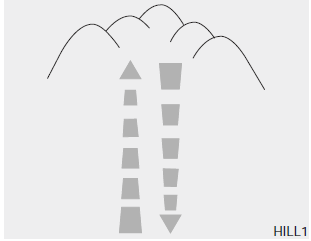
When driving up or down a slope, keep the vehicle as straight as possible. Use extreme caution when climbing or descending steep slopes, as the vehicle may roll over depending on the grade, terrain, and water or mud conditions.
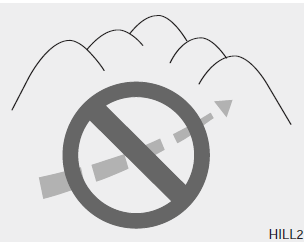
WARNING - Hills
Driving across the contour of steep hills can be extremely dangerous. This danger may arise from small changes in wheel angle that can destabilize the vehicle, or even if the vehicle remains stable under load, it may lose that stability if the vehicle stops moving forward. Your vehicle may roll over without warning and without time for you to correct the error, which may result in serious injury or death.
- You must deliberately make an effort to learn how to take turns in an all-wheel drive vehicle. Do not rely on your driving experience with conventional all-wheel drive vehicles when selecting a safe cornering speed in AWD mode. To begin with, drive more slowly in AWD.
- Drive carefully off-road, because your vehicle may be damaged by rocks or tree roots. Familiarize yourself with the off-road conditions where you intend to drive before starting to drive.
WARNING - 4WD
Reduce speed when cornering. The center of gravity of all-wheel drive vehicles is higher than that of conventional vehicles, which increases the likelihood of rollover when you turn corners too quickly.
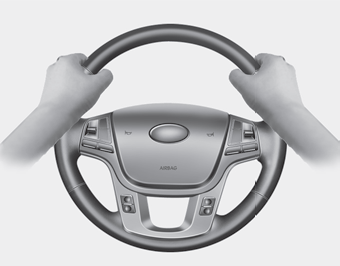
WARNING - Steering Wheel
Do not hold the steering wheel by its inner spokes when driving off-road. You could injure your hand if the steering wheel kicks back sharply or jerks from hitting an object on the ground. You could lose control of the steering wheel.
- Always hold the steering wheel firmly when driving off-road.
- Make sure all passengers are wearing their seat belts.
WARNING - Wind Hazard
When driving in strong winds, the higher center of gravity of the vehicle reduces your ability to control the steering and requires you to drive more slowly.
If you must drive through water, stop the vehicle, set the transfer case to AWD LOCK, and drive at a speed of less than 8 km/h.
WARNING - Driving Through Water
Drive slowly. If you drive too fast through water, water may enter the engine compartment and wet the ignition system, causing your vehicle to stall suddenly. Do not stop. If this happens and your vehicle is on an incline, your vehicle may roll over.
✽ NOTICE
- Do not drive through water if the water level is above the underbody of the vehicle.
- Check the brakes after you have driven out of mud or water. Press the brake pedal several times while driving slowly until normal braking force returns.
- Shorten the scheduled maintenance interval if you drive in off-road conditions such as sand, mud, or water. Always wash the vehicle thoroughly after off-road use, especially after cleaning the underbody.
- Because torque is always transmitted to all 4 wheels, the performance of an all-wheel drive vehicle depends greatly on the condition of the tires. Be sure to equip the vehicle with four tires of the same size and type.
- An all-wheel drive vehicle must not be towed by a conventional tow truck. Make sure the vehicle is loaded onto a flatbed truck for transport.
WARNING - AWD
- Avoid high speeds when cornering.
- Do not make sudden steering movements, such as quick lane changes or rapid, sharp turns.
- The risk of rollover increases significantly if you lose control of your vehicle at high speed.
- An unbelted person is much more likely to be killed in a collision than a person wearing a seat belt.
- Loss of control often occurs when two or more wheels slide off the paved road and the driver turns to get back onto the road. If your vehicle leaves the paved road, do not turn sharply. Instead, brake before steering back onto the roadway.
CAUTION - Mud or Snow
If one of the front or rear wheels begins to spin in mud, snow, etc., the vehicle can sometimes be moved by pressing the accelerator pedal harder; however, avoid running the engine at high rpm continuously, as this may damage the all-wheel drive system.
WARNING - Kia Sorento Jack Vehicle
When an all-wheel drive vehicle is raised on a jack, never start the engine or allow the wheels to rotate. There is a danger that the rotating wheels may contact the ground, causing the vehicle to slip off the jack and move forward.
Reducing the Risk of Rollover
This multipurpose passenger vehicle is classified as a sport utility vehicle (SUV). An SUV has higher ground clearance and a narrower track, which make it more capable of operating in a wide variety of off-road conditions. Its design features give it a higher center of gravity than conventional vehicles.
An advantage of higher ground clearance is a better view of the road, which allows you to anticipate problems. An SUV is not designed to take turns at the same speeds as conventional passenger cars, nor are low-profile sport vehicles designed to perform satisfactorily off-road. Because of this risk, the driver and passengers are strongly advised to wear seat belts. In a rollover, an unbelted person is more likely to be killed than a person wearing a seat belt. There are steps the driver can take to reduce the risk of rollover.
Avoid sharp turns, excessive speed and/or sudden maneuvers, do not load a roof rack with heavy cargo, and never modify your vehicle in any way.
WARNING - Rollover
As with other sport utility vehicles (SUVs), failure to operate this vehicle properly may result in loss of control, a crash, or rollover.
- Trucks have a considerably higher rollover rate than other types of vehicles.
- Design features (greater ground clearance, narrower track, etc.) give this vehicle a higher center of gravity than conventional vehicles.
- The vehicle is not designed to take turns at the same speeds as conventional vehicles.
- Avoid sharp turns and sudden maneuvers.
- In a rollover crash, an unbelted person is significantly more likely to die than a person wearing a seat belt. Make sure everyone in the vehicle is properly belted.
WARNING
Your vehicle is equipped with tires and wheels designed to provide safe driving and handling capability. Do not use tire and wheel sizes and types different from those originally installed on your vehicle. This may affect the safety and operation of your vehicle and may result in steering failure, rollover, and serious injury. When replacing tires, make sure all four tires are of the same size, type, tread, brand, and load rating. If you decide to equip your vehicle with any tire/wheel combination not recommended by Kia for off-road driving, you must not use these tires for highway driving.
All-wheel drive vehicles must be tested on a special four-wheel dynamometer.
✽ NOTICE
Never apply the parking brake while performing these checks.
Do not test an all-wheel drive vehicle on a chassis dynamometer with all wheels driven. If 2WD roll testing is required, use a tester and perform the following steps:
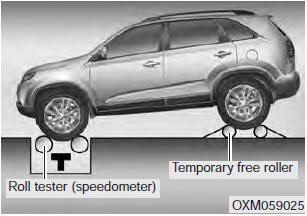
1. Check the tire pressure recommended for your vehicle.
2. Place the front wheels on the roller tester for speedometer checking, as shown in the illustration.
3. Release the parking brake.
4. Place the rear wheels on the temporary free roller as shown in the illustration.
WARNING - Dynamometer Testing
Stay clear of the front of the vehicle when the vehicle is in gear on the dynamometer. This is very dangerous, as the vehicle may jump forward and cause serious injury or death.
Test yourself
A quick Kia Sorento Owner's Manual quiz: every answer comes with an explanation and a link to the manual page.