Tire Sidewall Labeling
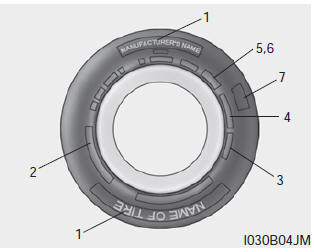
This information identifies and describes the basic characteristics of the tire and provides the Tire Identification Number (TIN) for safety standard certification. The TIN can be used to identify the tire in case of a recall.
1. Manufacturer or Brand Name
The manufacturer or brand name is displayed.
2. Tire Size Designation
The tire size is molded on the sidewall of the tire. This information is needed when selecting replacement tires for your vehicle. The following explains the meaning of the letters and numbers in the tire size designation.
Example of a tire size designation:
(These numbers are for example only; the tire size designation on your tire may vary depending on your vehicle.)
P235/65R17 108T
P - Applicable vehicle type (tires with the "P" prefix are intended for use on passenger cars or light trucks; however, not all tires have this marking).
235 - Tire width in millimeters.
65 - Aspect ratio. Tire sidewall height as a percentage of tire width.
R - Tire construction code (radial).
17 - Wheel rim diameter in inches.
108 - Load index, a numeric code associated with the maximum load the tire can carry.
T - Speed rating symbol. For more information, refer to the speed rating table in this section.
Wheel Size Designation
Wheels are also marked with important information that you will need if you ever replace one. The following explains the meaning of the letters and numbers in the wheel size designation.
Example of wheel size designation: 7.0JX17
7.0 - Wheel rim width in inches.
J - Rim contour designation.
17 - Wheel rim diameter in inches.
Tire Speed Ratings
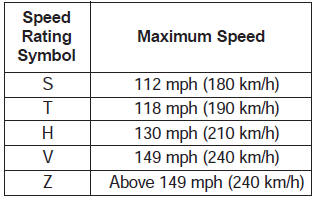
The table below lists many of the speed ratings currently used for passenger car tires. The speed rating is part of the tire size designation on the tire sidewall. This symbol corresponds to the maximum safe operating speed for that tire.
3. Tire Age Check (TIN: Tire Identification Number)
Replace any tire that is more than 6 years old from its manufacture date, including the spare tire. The manufacture date can be found on the tire sidewall (or on the inside of the wheel) in the DOT code.
The DOT code is a series of numbers and English letters on the tire. The date of manufacture is indicated by the last four digits (characters) of the DOT code.
DOT: XXX XXX OOOO
The first part of the DOT code indicates the plant code number, tire size, and tread pattern, while the last four digits indicate the week and year of manufacture.
For example:
DOT XXXX XXXX 1613 means the tire was manufactured in the 16th week of 2013.
WARNING - Tire Age
Tires age over time, even if they are not used. Regardless of remaining tread depth, we recommend replacing tires after approximately six (6) years of normal service. Heat from hot climates or frequent heavy loading conditions can accelerate the aging process. Failure to follow this warning may result in sudden tire failure, which may cause loss of control and an accident resulting in serious injury or death.
4. Tire Ply Composition and Material
The number of plies or layers of rubber-coated fabric in the tire. Tire manufacturers must also specify the materials in the tire, including steel, nylon, polyester, and others.
The letter "R" means radial ply construction; the letter "D" means diagonal or bias construction; and the letter "B" means belted bias construction.
5. Maximum Permissible Inflation Pressure
This number is the maximum air pressure that may be applied to the tire. Do not exceed the maximum permissible inflation pressure. Refer to the tire and loading information label for the recommended inflation pressure.
6. Maximum Load Rating
This number indicates the maximum load in kilograms and pounds that the tire can carry. When replacing tires on the vehicle, always use a tire with the same load capacity as the original factory-installed tire.
7. Uniform Tire Quality Grading
Quality grades can be found, where applicable, on the tire sidewall between the tread shoulder and the maximum section width.
For example:
TREADWEAR 200 TRACTION AA TEMPERATURE A
Tire Tread Wear
Treadwear is a comparative rating based on the wear rate of the tire when tested under controlled conditions on a specified government test course. For example, a tire graded 150 would wear one and a half (1½) times as well as a tire graded 100 on the government test course.
Relative tire performance depends on actual conditions of use, however, and may vary significantly from the norm due to differences in driving habits, service practices, and differences in road characteristics and climate.
These markings are molded onto the sidewalls of passenger car tires.
Tires available as standard or optional equipment on your vehicle may vary with respect to rating.
Traction - AA, A, B and C
Traction grades, from highest to lowest, are AA, A, B, and C. These grades represent the tire's ability to stop on wet pavement, measured under controlled conditions on specified government test surfaces of asphalt and concrete. A tire marked C may have poor traction performance.
WARNING
The traction grade assigned to this tire is based on straight-line braking traction tests and does not include acceleration, cornering, hydroplaning, or peak traction characteristics.
Temperature — A, B and C
Temperature grades: A (the highest), B and C, representing the tire's resistance to the generation of heat and its ability to dissipate heat when tested under controlled conditions on a specified indoor test wheel.
Sustained high temperature can cause the tire materials to degrade and reduce tire service life, and excessive temperature may lead to sudden tire failure. Grade C corresponds to a performance level that all passenger car tires must meet under Federal Motor Vehicle Safety Standard No. 109. Grades B and A represent higher levels of performance on the laboratory test wheel than the minimum required by law.
WARNING - Tire Temperature
The temperature grade for this tire is established for a tire that is properly inflated and not overloaded. Excessive speed, underinflation, or excessive load, either alone or in combination, can cause heat buildup and possible sudden tire failure. This may result in loss of vehicle control and serious injury.
Tire Terminology and Definitions Air Pressure :
The amount of air inside the tire pushes outward on the tire. Air pressure is expressed in pounds per square inch (psi) or kilopascals (kPa).
Accessory Weight:
This is the total weight of optional accessories. Some examples of optional accessories are automatic transmission, power seats, and air conditioning.
Aspect Ratio:
The ratio of the tire height to its width.
Belt:
A layer of rubber-coated cord located between the plies and the tread. Cords may be made of steel or other reinforcing materials.
Bead:
The tire bead consists of steel wires wrapped in steel cords that hold the tire on the rim.
Bias Ply Tire:
A pneumatic tire in which the plies are laid alternately at an angle of less than 90 degrees to the centerline of the tread.
Cold Tire Pressure:
The air pressure in the tire, measured in pounds per square inch (psi) or kilopascals (kPa), before the tire has built up heat from driving.
Curb Weight:
This is the weight of the vehicle with standard and optional equipment, including maximum fuel, oil, and coolant, but without passengers and cargo.
DOT Marking:
The code molded into the tire sidewall indicates that the tire complies with the Federal Motor Vehicle Safety Standards of the U.S. Department of Transportation. The DOT code includes the Tire Identification Number (TIN), an alphanumeric designation that may also identify the tire manufacturer, manufacturing plant, brand, and date of manufacture.
Gross Vehicle Weight Rating (GVWR):
Gross Vehicle Weight
GAWR FRT:
Total load on the front axle.
GAWR RR:
Total load on the rear axle.
Intended Outboard Sidewall:
The side of an asymmetrical tire that must always face outward when mounted on the vehicle.
Kilopascal (kPa):
The metric unit for air pressure.
Load Index:
An assigned number in the range from 1 to 279 that corresponds to the load carrying capacity of the tire.
Maximum Inflation Pressure:
The maximum air pressure to which a cold tire may be inflated. The maximum air pressure is molded onto the sidewall.
Maximum Load Rating:
The load rating of the tire at the maximum permissible inflation pressure for that tire.
Maximum Loaded Vehicle Weight:
The sum of the curb weight, payload, vehicle capacity weight, and production option weight of the vehicle.
Normal Occupant Weight:
The number of occupants for which the vehicle is designed multiplied by 150 lbs (68 kg).
Occupant Distribution:
Designated seating positions.
Outboard Sidewall:
The side of an asymmetrical tire that has a specific side that faces outward when mounted on the vehicle. The outboard sidewall carries white lettering or manufacturer, brand, and/or model name markings that are raised or deeper than the same moldings on the inboard sidewall.
Passenger (P-Metric) Tire:
A tire used on passenger cars, some light trucks, and multipurpose vehicles.
Recommended Inflation Pressure:
The tire pressure recommended by the vehicle manufacturer, shown on the tire placard.
Radial Tire:
A pneumatic tire in which the cords extending to the beads are laid at 90 degrees to the centerline of the tread.
Rim:
A metal support for the tire to which the tire beads are attached.
Sidewall:
The part of the tire between the tread and the bead.
Speed Rating:
An alphanumeric code assigned to a tire that indicates the maximum speed at which the tire can carry a load.
Traction:
The friction between the tire and the road surface. Traction provided.
Tread:
The part of the tire that contacts the road.
Tread Wear Indicators:
Narrow bands, sometimes called "wear bars," that appear across the tread of the tire when only 2/32 inch of tread remains.
UTQGS:
Uniform Tire Quality Grading Standards, a tire information system that provides consumers with ratings for traction, temperature, and treadwear. Ratings are determined by tire manufacturers using government-prescribed test procedures. The ratings are molded onto the tire sidewall.
Vehicle Capacity Weight:
The number of designated seating positions multiplied by 150 lbs (68 kg), plus the rated cargo and luggage load.
Maximum Loaded Vehicle Load on Tire:
The load on an individual tire due to the curb weight of the vehicle and optional equipment, plus the maximum number of passengers and cargo weight.
Normal Loaded Vehicle Load on Tire:
The load on an individual tire, determined by distributing to each axle its share of the curb weight, accessory weight, and normal occupant weight and driver weight, divided by 2.
Vehicle Placard:
A label permanently attached to the vehicle showing the original equipment tire size and recommended tire inflation pressure.
All-Season Tires
Kia equips some models with all-season tires to provide good performance for year-round use, including snowy and icy road conditions.
All-season tires are marked ALL SEASON and/or M+S (mud and snow) on the tire sidewall. Winter tires have better snow traction than all-season tires and may be more suitable in some areas.
Summer Tires
Kia equips some models with summer tires to provide superior performance on dry roads. Summer tire performance is significantly reduced on snow and ice. Summer tires do not carry the M+S (Mud and Snow) traction rating on the tire sidewall.
If you plan to drive your vehicle in snowy or icy conditions, Kia recommends the use of winter tires or all-season tires on all four wheels.
Winter Tires
If you equip your vehicle with winter tires, they must be the same size and have the same load rating as the original tires. Winter tires should be installed on all four wheels; otherwise, poor handling may result.
Winter tires must be inflated to 4 psi (28 kPa) above the standard tire pressure shown on the driver's side door pillar tire label, or to the maximum pressure molded on the tire sidewall, whichever is lower.
Do not drive faster than 120 km/h if your vehicle is equipped with winter tires.
Tire Chains
Snow chains, if necessary, should be installed on the front wheels.
Make sure the chains are installed in accordance with the manufacturer's instructions.
To minimize tire and chain wear, do not use traction chains when they are no longer needed.
WARNING - Snow or Ice
- When driving on snow- or ice-covered roads, drive at a speed of less than 30 km/h.
- Use SAE class "S" or wire chains.
- If you hear noise caused by the chains contacting the body, retighten the chains to avoid contact with the vehicle body.
- To prevent body damage, retighten the chains after driving 0.3–0.6 mile (0.5–1.0 km).
- Do not use traction chains on vehicles with aluminum wheels. If unavoidable, use a cable-type chain.
- Use wire chains with a diameter of less than 0.59 in (15 mm) to prevent damage to the chain connection.
Radial Ply Tires
Radial-ply tires provide longer tread life, resistance to road hazards, and a smoother ride at high speeds. The radial tires used on this vehicle have a belted construction and have been selected to complement the ride comfort and handling characteristics of your vehicle.
Radial-ply tires have the same load capacity as bias-ply or belted-bias tires of the same size and with the same recommended inflation pressure. Mixing radial-ply tires with bias-ply or belted-bias tires is not recommended. Any combination of radial-ply and bias-ply or belted-bias tires used on the same vehicle seriously degrades vehicle handling. The best rule to follow: always use identical radial-ply tires as a set of four.
Tires with a longer service life may be more susceptible to uneven tread wear. It is very important to observe the tire replacement interval specified in this section in order to achieve the tread life potential of these tires. Cuts and punctures in radial-ply tires can only be repaired in the tread area due to sidewall flexing. Consult your tire dealer for radial tire repair.
Test yourself
A quick Kia Sorento Owner's Manual quiz: every answer comes with an explanation and a link to the manual page.