Tires and Wheels
Tire Care
For proper maintenance, safety, and maximum fuel economy, always maintain the recommended tire pressure and remain within the load and weight distribution recommended for your vehicle.
Recommended Cold Tire Pressure
Check the pressure of all tires (including the spare) when the tires are cold. "Cold tires" means the vehicle has not been driven for at least three hours or has been driven less than one mile (1.6 km).
The recommended tire pressure must be maintained for best ride, vehicle handling, and minimum tire wear.
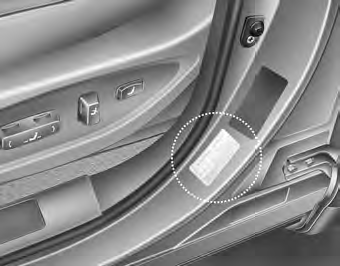
All specifications (sizes and pressures) can be found on the label attached to the driver's side center pillar.
WARNING - Insufficient Tire Pressure
Severe under-inflation (70 kPa (10 psi) or more) can cause excessive heat build-up, resulting in tire failure such as ruptures, tread separation and other tire defects, which may lead to loss of vehicle control, causing serious injury or death. This risk is much higher on hot days and during prolonged high-speed driving.
CAUTION
- Underinflation also causes excessive wear, poor handling, and reduced fuel economy. Wheel damage may also occur. Keep tire pressure at the proper level. If a tire frequently needs air, have it checked by an authorized Kia dealer.
- Overinflation causes a harsh ride, excessive wear at the center of the tire tread, and a greater likelihood of damage from road hazards.
CAUTION
- Warm tire pressure is normally 4–6 psi (28 to 41 kPa) higher than cold tire pressure. Do not release air from warm tires to adjust pressure, or the tires will be underinflated.
- Always install the tire valve caps. Without the valve cap, dirt or moisture may enter the valve core and cause air leakage. If a valve cap is missing, install a new one as soon as possible.
WARNING! Tire Inflation
Over-inflation or under-inflation may shorten tire life, adversely affect vehicle handling, and cause sudden tire failure. This may result in loss of vehicle control and possible injury.
CAUTION - Tire pressure
Always observe the following:
- Check tire pressure when the tires are cold. (After the vehicle has been parked for at least three hours or driven no more than one mile (1.6 km) since starting.)
- Check the spare tire pressure every time you check the pressure of the other tires.
- Never overload your vehicle. Be careful not to overload the vehicle with luggage in the luggage compartment, if your vehicle is so equipped.
- Worn or old tires can cause accidents. If your tread is severely worn or if your tires have been damaged, replace them.
Tire Pressure Check
Check the tires at least once a month or more often. Also check the spare tire pressure.
How to Check
Use a quality tire pressure gauge to check tire pressure. You cannot tell if your tires are properly inflated just by looking at them. Radial tires may appear properly inflated even when under-inflated.
Check tire pressure when the tires are cold. "Cold" means the vehicle has been parked for at least three hours or driven no more than 1 mile (1.6 km).
Remove the valve cap from the tire valve stem. Press the tire pressure gauge firmly onto the valve to measure the pressure. If the cold tire pressure matches the recommended tire pressure and the load information label, no further adjustment is necessary. If the pressure is low, add air until the recommended pressure is reached.
If you have overinflated the tire, release air by pressing the metal pin in the center of the tire valve. Check the tire pressure again with a tire pressure gauge. Be sure to reinstall the valve caps on the valve stems. They help prevent leaks by keeping out dirt and moisture.
WARNING
- Check your tires regularly for proper inflation, as well as for wear and damage. Always use a tire pressure gauge.
- Tires with pressure that is too high or too low wear unevenly, causing poor handling, loss of vehicle control, and sudden tire failure, which can lead to accidents, injury, or even death. The recommended cold tire pressure for your vehicle can be found in this manual and on the tire label located on the driver's side center pillar.
- Worn tires can cause an accident. Replace tires that are worn, show uneven wear, or are damaged.
- Do not forget to check the spare tire pressure. Kia recommends that you check the spare tire each time you check the pressure of the other tires on your vehicle.
Tire Rotation
To equalize tread wear, it is recommended to rotate the tires every 7,500 miles (12,000 km) or sooner if wear is uneven. During rotation, check the tires for proper balance.
When rotating the tires, check them for uneven wear and damage. Abnormal wear is usually caused by incorrect tire pressure, incorrect wheel alignment, wheel imbalance, hard braking, or sharp cornering. Look for bulges or protrusions on the tread or sidewall of the tires.
Replace the tire if you find any of these conditions. Replace the tire if fabric or cord is visible. After rotation, be sure to adjust the front and rear tire pressures to specification and check the wheel nut tightening torque.
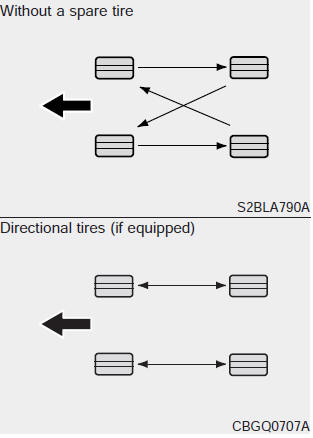
Check disc brake pads for wear every time the tires are rotated.
✽ NOTICE
Radial tires with a directional tread pattern should only be rotated front to rear, never side to side.
WARNING
- Do not use the compact spare tire (if equipped) for tire rotation.
- Never mix bias-ply and radial tires. This may cause unusual handling characteristics that could result in death, serious injury, or property damage.
Wheel Alignment and Tire Balance
The wheels of your vehicle were carefully aligned and balanced at the factory to ensure maximum tire life and the best overall performance.
In most cases, you will not need to realign the wheels again. However, if you notice abnormal tire wear or your vehicle pulls to one side, wheel alignment may need to be adjusted.
If you notice the vehicle vibrating when driving on a smooth road, the wheels may need to be rebalanced.
CAUTION
Incorrect wheel weights may damage your vehicle's aluminum wheels. Use only approved wheel weights.
Test yourself
A quick Kia Sorento Owner's Manual quiz: every answer comes with an explanation and a link to the manual page.