Catalytic Converter
Description and Operation
Description
The gasoline engine catalytic converter is a three-way catalyst. It oxidizes carbon monoxide (CO) and hydrocarbons (HC), and separates oxygen from nitrogen oxides (NOx).
Catalytic Converter (CCo)
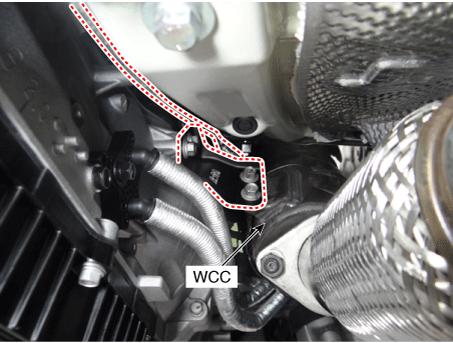
Repair Procedures
Removal
Remove the engine cover.
(Refer to Engine Mechanical System - Engine Cover)
Disconnect the negative battery cable.
Remove the engine compartment under cover (front).
(Refer to Engine Mechanical System - "Engine Room Cover")
Drain the engine coolant.
(Refer to Engine Mechanical System - Engine Coolant)
Remove the air intake hose.
(Refer to Engine Mechanical System - "Air Cleaner")
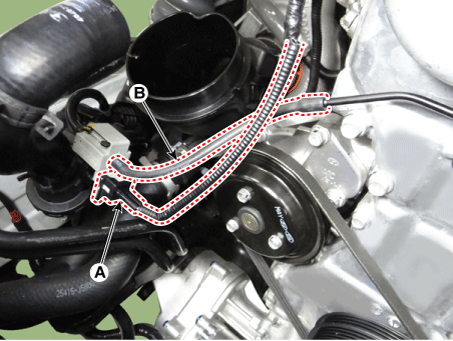
Disconnect the recirculation valve connector (A) and the vacuum hose (B).
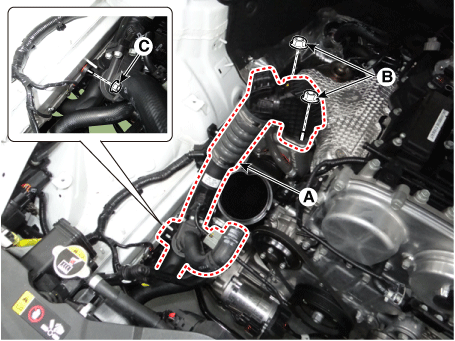
Remove the intake hose and intercooler tube assembly (A).
Tightening Torque
Nuts (B):
14,7–19.6 N·m
Nut (C):
14,7–19.6 N·m
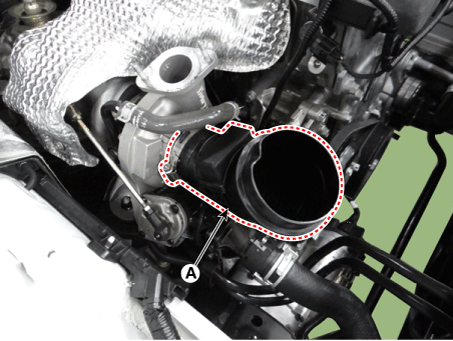
Remove the turbocharger intake hose (A).
Tightening torque:
4.9–6.9 N·m (0.5–0.7 kgf·m, 3.6–5.1 ft-lbf, 43.4–60.8 in-lbf)
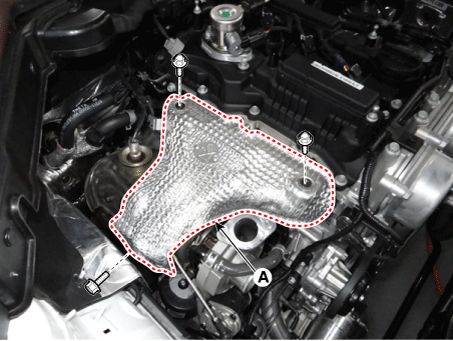
Remove the heat shield (A).
Tightening torque: 7.8–11.8 N·m
Remove the heated oxygen sensor.
(Refer to Engine Control/Fuel System - "Heated Oxygen Sensor (HO2S)").
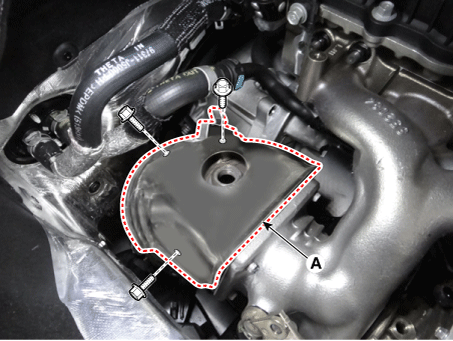
Remove the heat shield (A) of the warm-up catalytic converter (WCC).
Tightening torque: 18.6 – 24 N·m
Remove the front muffler.
(Refer to Engine Mechanical System - Muffler)
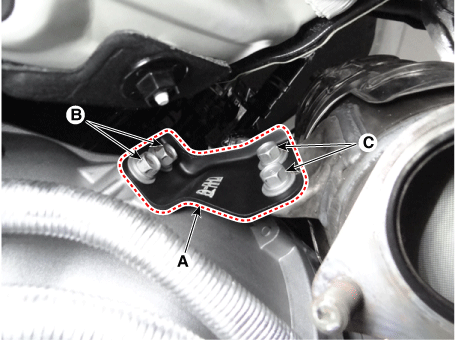
Remove the bracket (A) of the warm-up catalytic converter (WCC).
Tightening Torque
Bolts (B):
18,6–28 N·m
Bolts (C):
52,0–58 N·m
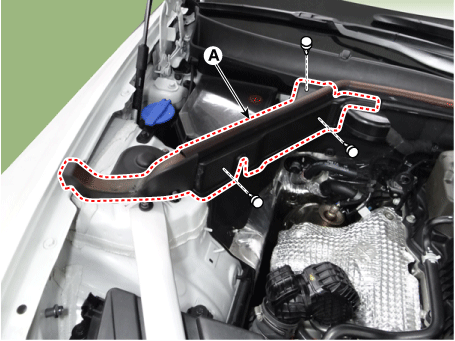
Remove the right hood seal cover (A).
Disconnect the heater hose (A).
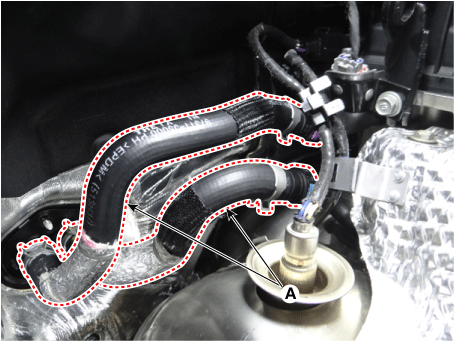
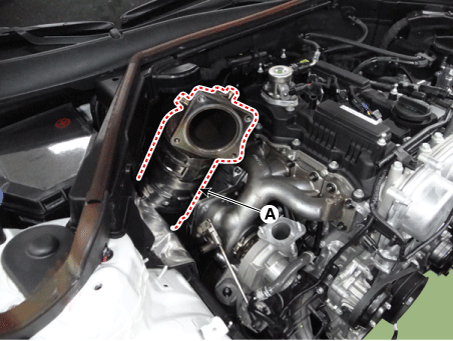
Remove the warm-up catalytic converter (WCC) (A) and the gasket.
Tightening Torque: 49.0–54 N·m

Installation
Install in the reverse order of removal.
Test yourself
A quick Kia Stinger CK quiz: every answer comes with an explanation and a link to the manual page.