Air Conditioning Refrigerant / Compressor
Repair Procedures
Refrigerant System Service Basics (R-134a)
Refrigerant Recovery
Use only UL-listed service equipment certified to comply with SAE J2210 when removing HFC-134a (R-134a) from the air conditioning system.
In case of accidental system discharge, ventilate the work area before resuming service.
Additional health and safety information may be obtained from refrigerant and lubricant manufacturers.
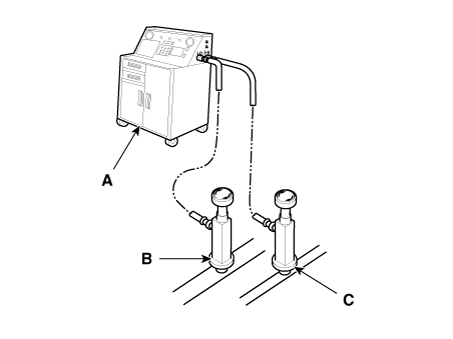
Connect the R-134a recovery/recycling/charging system (A) to the high-pressure service port (B) and the low-pressure service port (C) as shown, following the equipment manufacturer's instructions.
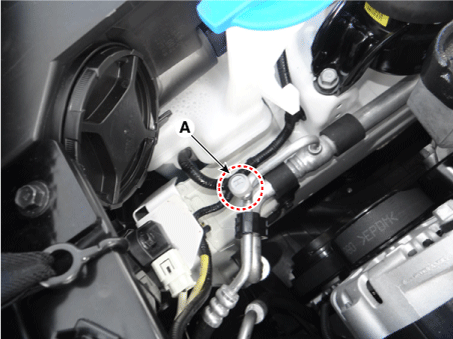
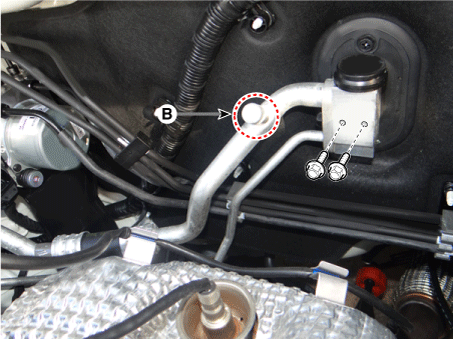
Measure the amount of refrigerant oil removed from the air conditioning system after the recovery process is complete. Be sure to add the same amount of new refrigerant oil back into the air conditioning system before charging.
System Evacuation
Use only UL-listed service equipment certified to comply with SAE J2210 when removing HFC-134a (R-134a) from the air conditioning system.
In case of accidental system discharge, ventilate the work area before resuming service.
Additional health and safety information may be obtained from refrigerant and lubricant manufacturers.
When the air conditioning system has been opened to the atmosphere, for example during installation or repair, it must be evacuated using an R-134a recovery/recycling/charging system. (If the system has been open for several days, replace the receiver/drier and evacuate the system for several hours.)
Connect the R-134a recovery/recycling/charging system (A) to the high-pressure service port (B) and the low-pressure service port (C) as shown, following the equipment manufacturer's instructions.
If the low pressure does not drop below 93.3 kPa (700 mmHg, 27.6 inHg) within 10 minutes, there may be a leak in the system. Partially charge the system and check for leaks. (Refer to Refrigerant Leak Check.)
Remove the low-pressure valve from the low-pressure service port.
System Charging
Use only UL-listed service equipment certified to comply with SAE J2210 when removing HFC-134a (R-134a) from the air conditioning system.
In case of accidental system discharge, ventilate the work area before resuming service.
Additional health and safety information may be obtained from refrigerant and lubricant manufacturers.
Connect the R-134a recovery/recycling/charging system (A) to the high-pressure service port (B) and the low-pressure service port (C) as shown, following the equipment manufacturer's instructions.
Add the same amount of new refrigerant oil to the system as was removed during recovery. Use only the specified refrigerant oil. Charge the system with R-134a or R-1234yf refrigerant. Do not overcharge the system, as this may damage the compressor.
Specified Amount: 450 ± 25 g (15.7 ± 0.8 oz)
Refrigerant Leak Test
Always perform a leak test with an electronic leak detector whenever a refrigerant leak occurs and when performing service operations that involve disconnecting, loosening, or connecting fittings.
If a refrigerant leak is detected, perform the following steps:
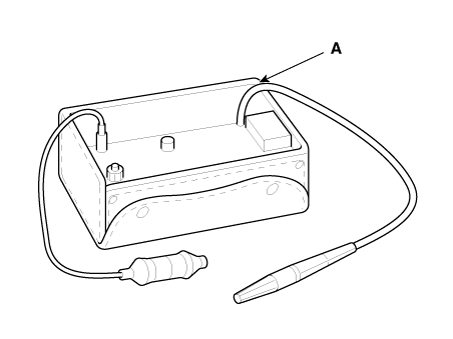
Check the tightening torque of the connection fittings, and if they are too loose, tighten them to the specified torque. Check for gas leaks with a leak detector (A).
If the leak continues even after tightening the fitting, drain the refrigerant from the system, disconnect the fittings, and check their sealing surfaces for damage. Always replace them, even if the damage is minor.
Check the compressor oil and add oil if necessary.
Charge the system and recheck for leaks. If no leaks are found, evacuate and recharge the system again.
Refrigerant System Service Basics (R-1234yf)
Refrigerant Identification
Do not mix HFO-1234yf (R-1234yf) in the vehicle with other refrigerants, such as R-12, R-134a, etc.
Use only service equipment that is UL listed and certified to meet SAE standards for recovery and recycling of R-1234yf from the air conditioning system. Do not use service equipment for other refrigerants, such as R-12, R-134a, etc.
Check which refrigerant is in the system if there is concern that the system has been tampered with in any way, and check the type and quantity of refrigerant that should be in the air conditioning system, and possible problems resulting from accidental or intentional mixing of refrigerants.
It is recommended to use a SAE-certified refrigerant identifier to prevent incorrect recovery and the resulting spread of contaminated refrigerant, which could damage other air conditioning systems and service equipment. Contaminated refrigerant (a mixture of more than one refrigerant or non-system refrigerant) in recovery/recycling equipment may lead to potential contamination of more refrigerant.
Some types of electronic leak detectors (heated diode or corona discharge), as well as motors, switches and controls on recovery and recycling machines, can produce sparks that may serve as ignition sources in the presence of refrigerants classified by ASHRAE as flammable (A2 or A3), Standard 34-2006.
Mixing refrigerants in the air conditioning system may result in higher than expected system pressure, damage to the system and components, diagnostic trouble codes, and/or other potential hazards to people and the environment.
In the event of mixing with another refrigerant, recover the contaminated refrigerant from the air conditioning system and dispose of it in accordance with all applicable national, regional or local regulations. Flush the interior of the air conditioning system with special flushing agent and charge with new refrigerant.
Refrigerant Recovery
Use only service equipment that is UL listed and certified to meet SAE standards for removal of HFO-1234yf (R-1234yf) from the air conditioning system.
In the event of an accidental system discharge, ventilate the work area before resuming service.
Additional health and safety information may be obtained from refrigerant and lubricant manufacturers.
Connect the R-1234yf recovery/recycling/charging system (A) to the high-pressure service port (B) and the low-pressure service port (C) as shown, following the equipment manufacturer's instructions.
Measure the amount of refrigerant oil removed from the air conditioning system after the recovery process is complete. Be sure to add the same amount of new refrigerant oil back into the air conditioning system before charging.
System Evacuation
Use only service equipment that is UL listed and certified to meet SAE standards for removal of HFO-1234yf (R-1234yf) from the air conditioning system.
In the event of an accidental system discharge, ventilate the work area before resuming service.
Additional health and safety information may be obtained from refrigerant and lubricant manufacturers.
When the air conditioning system has been opened to the atmosphere, for example during installation or repair, it must be evacuated using an R-1234yf recovery/recycling/charging system. (If the system has been open for several days, replace the receiver/drier and evacuate the system for several hours.)
Connect the R-1234yf recovery/recycling/charging system (A) to the high-pressure service port (B) and the low-pressure service port (C) as shown, following the equipment manufacturer's instructions.
If the low pressure does not exceed 87.7 kPa (658 mmHg, 25.9 inHg) after 5 minutes, there is probably a leak in the system. Partially charge the system and check for leaks (refer to "Refrigerant Leak Check").
Remove the low-pressure valve from the low-pressure service port.
System Charging
Use only service equipment that is UL listed and certified to meet SAE standards for removal of HFO-1234yf (R-1234yf) from the air conditioning system.
In the event of an accidental system discharge, ventilate the work area before resuming service.
Additional health and safety information may be obtained from refrigerant and lubricant manufacturers.
Connect the R-1234yf recovery/recycling/charging system (A) to the high-pressure service port (B) as shown, following the equipment manufacturer's instructions.
Add the same amount of new refrigerant oil to the system as was removed during recovery. Use only the specified refrigerant oil. Charge the system with R-134a or R-1234yf refrigerant. Do not overcharge the system, as this may damage the compressor.
Specified Amount: 450 ± 25 g (15.7 ± 0.8 oz)
Refrigerant Leak Test
Always perform a leak test using an electronic leak detector whenever a refrigerant leak is suspected, and after service operations that involve disassembling or loosening or connecting fittings.
If a refrigerant leak is detected, perform the following steps:
Check the torque at the connection fittings and, if it is too loose, tighten to the specified torque. Check for refrigerant leakage using a leak detector (A).
If the leak continues even after tightening the fitting, drain the refrigerant from the system, disconnect the fittings, and inspect their seating surfaces for damage. Always replace them, even if the damage is minor.
Check the compressor oil and add oil if necessary.
Charge the system and recheck for leaks. If no leaks are found, evacuate and recharge the system again.
Inspection
Compressor
Engine Speed Check
Turn on the air conditioner control switch.
Check the engine speed.
When the compressor is operating, the engine speed should be as follows.
[U2 1.4 T-GDI]
Item Specification Idle Speed (rpm) A/C OFF Neutral, N, P Range 850 ± 100 rpm 1st Creep Range 900 ± 100 rpm A/C ON Neutral, N, P Range 850 ± 100 rpm 1st Creep Range 900 ± 100 rpm
[KAPPA 1.0 T-GDI]
Item Specification Ignition Timing (°) TDC 0° ± 10° Idle Speed (rpm) A/C OFF 850 ± 100 (Neutral, N, P Range) A/C ON 850 ± 100
[KAPPA 1.2 MPI]
Ignition Timing BTDC 6° ± 10° Idle Speed A/C OFF Neutral, N, P Range 660 ± 100 rpm D Range 660 ± 100 rpm A/C ON Neutral 660 ± 100 rpm D, N, P Range 660 ± 100 rpm
[KAPPA 1.4 MPI]
Ignition Timing BTDC 6° ± 10° Idle Speed A/C OFF Neutral, N, P Range 660 ± 100 rpm D Range 660 ± 100 rpm A/C ON Neutral 660 ± 100 rpm D, N, P Range 660 ± 100 rpm
Noise Check
Turn on the air conditioner control switch.
Check the compressor from the engine compartment.
A knocking noise is heard when the compressor is operating.
Test yourself
A quick Kia Rio YB quiz: every answer comes with an explanation and a link to the manual page.