Before Driving. Driving the Vehicle
The Lexus GS (4th generation, L10, 2016–2020) combines state-of-the-art driving technology with the highest safety standards. This chapter describes in detail how to start, move off, park and drive under various conditions, from steep slopes to driving in rain. Particular attention is given to driver assistance systems such as Hill-start Assist Control, Drive-start Control and the Brake Override System, which support safe driving. It also provides comprehensive guidance on breaking in a new vehicle, correct use of the parking brake, and avoiding damage from improper operation. This ensures the Lexus GS remains reliable and safe both in the city and on long-distance trips.
Observe the following procedures for safe driving:
Starting the engine
Driving
- With the brake pedal depressed, shift the shift lever to "D".
- Release the parking brake if it is in manual mode.
- Slowly release the brake pedal and gently depress the accelerator pedal to accelerate the vehicle.
Stopping
- With the shift lever in "D", depress the brake pedal.
- Apply the parking brake if necessary.
If the vehicle will be stopped for an extended period, shift the shift lever to "P" or "N".
Parking the Vehicle
- With the shift lever in "D", depress the brake pedal.
- Shift the shift lever to "P".
- Apply the parking brake if it is in manual mode.
- Press the engine switch to turn off the engine.
- Lock the door and make sure you have the electronic key with you.
When parking on a slope, chock the wheels if necessary.
Starting on a Steep Incline
- Make sure the parking brake is applied, and shift the shift lever to "D".
- Gently depress the accelerator pedal.
- Release the parking brake.
When Starting on an Incline
Hill-start Assist Control is available.
Driving in the Rain
- Drive with particular care in rain, as visibility is reduced, windows may fog up, and roads become slippery.
- Drive carefully as soon as it begins to rain. The road surface is especially slippery at this moment.
- Never drive at high speed on expressways in rain, as a layer of water may form between the road surface and the tires, impairing steering and braking.
Engine Speed While Driving
Under the following conditions, the engine speed may increase while driving. The automatic upshift control or a downshift operation is responsible for this, as it adapts to driving conditions. This does not indicate sudden acceleration.
- Driving uphill or downhill is detected
- The accelerator pedal is released
- The brake pedal is depressed while Sport mode is activated
Engine power reduction (Brake Override System)
- If the accelerator pedal and the brake pedal are depressed at the same time, engine power may be reduced.
- While the system is operating, a warning message is shown on the multi-information display.
Prevention of jerky starts (Start Control)
- If you perform the following unusual operation, engine power may be reduced.
- With Start Control active, the vehicle may have difficulty leaving a spot covered with mud or fresh snow. In this case, deactivate the TRC system to turn off Start Control so the vehicle can drive out of the mud or fresh snow.
Breaking In Your New Lexus
To extend the life of your vehicle, the following precautions are recommended:
- During the first 300 km: Avoid sudden braking.
- During the first 800 km: Do not tow a trailer.
- During the first 1000 km:
Parking Brake with Combined Disc/Drum Brake
Your vehicle has a parking brake with a combined disc/drum brake.
With this type of brake system, the brake shoes must be adjusted manually at regular intervals, or when replacing the parking brake shoes and/or drum.
Have the brake shoe adjustment performed only by a Lexus dealer or authorized repairer, or another qualified repair facility with the appropriate equipment.
Driving Abroad
Observe the regulations of the applicable road traffic code and make sure the correct fuel is available.
Brake Pads and Discs (Front and Rear Brakes*)
The brake pads and discs are designed for use under extreme load conditions.
Therefore, depending on speed, braking force, and environmental conditions (temperature, humidity, etc.), brake noise may occur.
*: GS200t only for Switzerland, Czech Republic, Hungary, Slovakia, Poland, Estonia, Latvia, Lithuania, and GS F
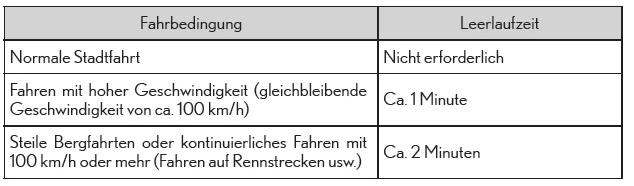
Idling Time Before Engine Shutdown (GS200t)
To prevent damage to the turbocharger, let the engine idle for a while immediately after driving at high speed or after driving uphill.
WARNING
Observe the following precautions.
Otherwise, fatal or serious injuries may result.
When starting the vehicle
Always keep your foot on the brake pedal when the vehicle is stopped with the engine running. This prevents the vehicle from creeping.
While driving
- Do not drive off unless you know where the brake and accelerator pedals are, to avoid pressing the wrong pedal.
- Do not drive over or park near flammable materials. The exhaust system and exhaust gases can become extremely hot. The hot components may cause a fire if flammable materials are nearby.
- Do not turn off the engine during normal driving. Turning off the engine while driving does not cause a loss of steering or braking control, but the power steering and brake booster will no longer operate. This makes the vehicle harder to steer and brake, so pull over and stop the vehicle as soon as it is safe to do so. However, in an emergency, such as when it is impossible to stop the vehicle normally, proceed as follows:
- Use engine braking (by downshifting) to maintain a safe speed when driving down steep hills. Continuous braking may cause the brakes to overheat, which reduces their effectiveness.
- Do not adjust the steering wheel position, seat, or inside or outside mirrors while driving. Otherwise, you may lose control of the vehicle.
- Always make sure passengers do not extend their arms, head, or other body parts out of the vehicle.
WARNING
Observe the following precautions.
Otherwise, fatal or serious injuries may result.
When driving on slippery road surfaces
- Sudden braking, accelerating, and steering may cause tire slip and make it impossible to control the vehicle.
- Sudden acceleration, engine braking caused by a gear change, or changes in engine speed may cause the vehicle to skid, which may result in an accident.
- After driving through puddles, lightly depress the brake pedal to make sure the brakes are working properly. Wet brake pads may cause brake malfunction. If the brakes have become wet on one side only and do not work properly, steering may be affected.
When operating the shift lever
- Do not let the vehicle roll backward while the shift lever is in a drive position, and do not let it roll forward while the shift lever is in "R". Otherwise, the engine may stall or the brake and steering functions may be impaired, which may result in an accident or vehicle damage.
- Do not shift the shift lever to "P" while the vehicle is moving. Otherwise, the transmission may be damaged and you may lose control of the vehicle.
- Do not shift the shift lever to "R" while the vehicle is moving forward. Otherwise, the transmission may be damaged and you may lose control of the vehicle.
- Do not shift the shift lever to "D" while the vehicle is moving backward. Otherwise, the transmission may be damaged and you may lose control of the vehicle.
- If you shift the shift lever to "N" while driving, the engine is disconnected from the transmission. Engine braking is not available in "N".
- Never operate the shift lever while the accelerator pedal is depressed. If the shift lever is shifted to any position other than "P" or "N", sudden unintended acceleration may occur, which could result in an accident causing death or serious injury.
WARNING
Observe the following precautions.
Otherwise, fatal or serious injuries may result.
When squealing or scraping noises occur (brake pad wear indicator) (GS350/GS200t)
Have the brake pads inspected and replaced as soon as possible by a Lexus dealer or
a service center or another qualified and properly equipped repair shop.
If the pads are not replaced in time, the brake disc may be damaged.
Front and rear brakes*: Slight wear of brake pads and discs results in higher braking force. As a result, the discs may wear faster than conventional brake discs. Therefore, Lexus recommends having the disc thickness measured whenever the brake pads are replaced.
Driving the vehicle with excessively worn brake pads and/or brake discs is dangerous.
*: GS200t only for Switzerland, Czech Republic, Hungary, Slovakia, Poland, Estonia, Latvia, Lithuania
When the brake pad wear warning message appears (GS F)
Have the brake pads inspected and replaced as soon as possible by a Lexus dealer or a service center or another qualified and properly equipped repair shop.
If the pads are not replaced in time, the brake disc may be damaged.
Slight wear of brake pads and discs results in higher braking force. As a result, the discs may wear faster than conventional brake discs. Therefore, Lexus recommends having the disc thickness measured whenever the brake pads are replaced.
Driving the vehicle with excessively worn brake pads and/or brake discs is dangerous.
WARNING
Observe the following precautions.
Otherwise, fatal or serious injuries may result.
When the vehicle is stationary
- Do not raise the engine speed. If the shift lever is in any position other than "P" or "N", sudden unintended acceleration may occur, which may result in an accident.
- To prevent accidents caused by the vehicle rolling, always keep the brake pedal depressed while the engine is running, and apply the parking brake if necessary.
- When the vehicle is stopped on a slope, always depress the brake pedal to prevent the vehicle from rolling forward or backward, and apply the parking brake properly if necessary.
- Avoid revving or racing the engine. Revving the engine while the vehicle is stationary may cause the exhaust system to overheat, and a fire may start if flammable materials are nearby.
When the vehicle is parked
- Do not leave eyeglasses, lighters, aerosol cans, or beverage cans in the vehicle when it is parked in the sun. Otherwise, the following may occur:
- Never leave a lighter in the vehicle. If a lighter is left in the glove box or on the vehicle floor, it may be accidentally ignited when loading luggage or adjusting the seat, and cause a fire.
- Do not attach adhesive decals to the windshield or windows. Do not place containers such as air fresheners on the instrument panel or dashboard. Adhesive decals or containers can act like magnifying lenses and cause a fire in the vehicle.
- Do not leave a door or window open if the curved glass is coated with a metallized film (for example, silver-colored). Reflected sunlight could cause the glass to act like a magnifying lens, creating a risk of fire.
- Always apply the parking brake, shift the selector lever to "P", switch off the engine and lock the vehicle. Do not leave the vehicle unattended while the engine is running.
- Do not touch the exhaust pipes while the engine is running or immediately after switching off the engine. Otherwise, you may suffer burns.
WARNING
Observe the following precautions.
Otherwise, fatal or serious injuries may result.
Sleeping in the Vehicle
Always switch off the engine. Otherwise, you may accidentally move the selector lever or press the accelerator pedal, which may cause an accident or a fire due to engine overheating. In addition, exhaust gases may accumulate and enter the vehicle if it is parked in a poorly ventilated area, which may result in death or serious health injury.
When Braking
- Drive with particular care when the brakes are wet. When the brakes are wet, braking distance increases. In addition, one side of the vehicle may brake differently from the other side. Furthermore, the parking brake may not be able to hold the vehicle adequately.
- If the power brake system is not working, do not follow other vehicles closely, and avoid driving uphill and sharp curves where braking is required. In this case, you can still brake, but you must press the brake pedal harder than usual. In addition, braking distance increases. Have the brakes repaired immediately.
- If the engine stalls, do not press the brake pedal several times in succession. Each press of the brake pedal uses up some of the brake booster's vacuum reserve.
- The brake system consists of 2 separate hydraulic systems. If one system fails, the other continues to work. In this case, you must press the brake pedal harder than usual and braking distance increases. Have the brakes repaired immediately.
When the Vehicle Is Stuck
Do not spin the wheels excessively if one of the wheels is not touching the ground or if the vehicle is stuck in sand, mud, etc. This may damage powertrain components or cause the vehicle to suddenly move forward or backward and cause an accident.
NOTEWhile driving
- Never press the accelerator and brake pedals at the same time while driving, as this may reduce engine output.
- Do not use the accelerator or press the accelerator and brake pedals at the same time to hold the vehicle in position on a slope.
When Parking the Vehicle
Always shift the selector lever to "P". Otherwise, the vehicle may roll away or suddenly accelerate if the accelerator pedal is pressed by mistake.
Avoiding Damage to Vehicle Parts
- Do not hold the steering wheel at the end of its travel for extended periods.
This may cause damage to the power steering motor.
- Drive over bumps as slowly as possible to avoid damage to the wheels, underbody, etc.
- GS200t: Immediately after driving at high speed or after driving uphill, let the engine idle for a while. Stop the engine only after the turbocharger has cooled down.
Otherwise, the turbocharger may be damaged.
If a Tire Punctures While Driving
A flat or damaged tire may lead to the following situations. Hold the steering wheel firmly and depress the brake pedal slowly to reduce speed.
- It may be difficult to maintain control of the vehicle.
- The vehicle produces unusual noises or vibrations.
- The vehicle leans unusually strongly to one side.
Procedure if a Tire Punctures
Flooded Roads
Never drive on roads flooded after heavy rain, etc., as this may cause the following serious damage to your vehicle:
- Engine stalls
- Short circuit in electrical components
- Engine damage due to water intrusion
If the vehicle has been driven through flooded roads or was submerged, have a Lexus dealer or authorized service shop, or another qualified workshop with suitable equipment, check the following:
- Brake operation
- Changes in the quantity and condition of the oil and other fluids used in the engine, transmission, transfer case (4WD models), differential, etc.
- Lubrication condition of the propeller shaft, bearings and suspension joints (where accessible), and operation of all joints, bearings, etc.
The Lexus GS GRL1 offers well-designed safety features for every driving situation. From clear start-up and parking instructions to warning systems for starting and braking, every detail is designed to ensure maximum control. Driving in rain or on slippery roads is also supported by helpful tips.
The combination of advanced technology such as the Brake Override System and Start Control makes the fourth-generation Lexus GS a benchmark for safety. Drivers benefit from clearly structured recommendations for everyday use and demanding driving situations.
This makes every trip with the Lexus GS GRL1 not only comfortable but also especially safe, a true premium sedan for responsible drivers.
Test yourself
A quick Lexus GS quiz: every answer comes with an explanation and a link to the manual page.