Before driving. Trailer towing (vehicles with trailer towing package)
The Lexus GS (4th gen, L10, 2016–2020) with the trailer towing package is prepared for safe trailer towing. The chapter provides clear specifications for maximum towing capacity, tongue load and axle load to ensure driving stability and braking performance. Notes on loading, tire pressure and special maintenance round off the topic. Special recommendations concern the use of original towing equipment, anti-sway couplings and additional mirrors. In this way, the Lexus GS becomes a reliable towing vehicle that combines comfort and safety, even under demanding conditions.
Your vehicle is primarily intended for carrying passengers.
Towing a trailer affects the vehicle's handling, performance, braking, service life and fuel consumption. Your personal safety and satisfaction depend heavily on using the correct equipment properly and driving carefully. For your own safety and the safety of others, do not overload the vehicle or the trailer.
For safe trailer towing, it is important to drive with extreme care and take the characteristics and operating conditions of the trailer into account.
Damage or malfunctions resulting from commercial trailer use are not covered by the Lexus warranty.
Before towing a trailer, ask your Lexus dealer or service center, or another qualified and suitably equipped specialist workshop, for further information, as legal regulations for towing differ from country to country.
Weight Limits
Before towing, check the maximum towing capacity, the gross vehicle weight rating (GVWR), the maximum axle load rating and the maximum tongue weight rating.
Trailer Hitch/Hitch Receiver
Lexus recommends using a Lexus trailer hitch/hitch receiver for your vehicle. Other suitable products of comparable quality may also be used.
Important Points for Trailer Loading
Gross Trailer Weight and Tongue Weight
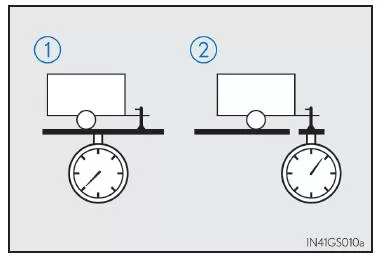
- Gross trailer weight.
The weight of the trailer itself plus its cargo must not exceed the maximum towing capacity.
Excessive weight is a hazard. When towing a trailer, use an anti-sway hitch or a stabilizer (sway control device).
- Maximum tongue weight.
Distribute the trailer cargo so that the tongue weight is greater than 25 kg or 4% of the towing capacity. The tongue weight must not exceed the specified value.
Specification Label (Manufacturer's Label)
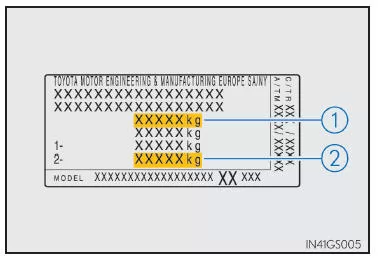
- Gross vehicle weight rating.
The total of driver and passenger weight, hitch weight, cargo weight, curb weight and tongue weight must not exceed the gross vehicle weight rating by more than 100 kg. Excessive weight is a hazard.
- Maximum rear axle load rating.
The weight on the rear axle must not exceed the maximum axle load rating by 15% or more. Excessive weight is a hazard.
The towing capacity values were obtained through tests at sea level.
Note that engine output and towing capacity decrease at high altitudes.
WARNING
If the gross vehicle weight rating or the maximum axle load rating is exceeded
Do not exceed the legal speed limit for towing in built-up areas or 100 km/h, whichever is lower.
Failure to observe this precaution may result in an accident causing death or serious injury.
Installation Positions for Trailer Hitch/Hitch Receiver and Ball Mount
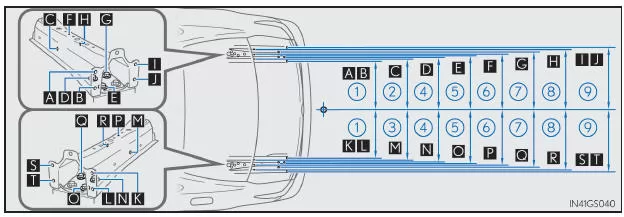
- 436 mm
- 455 mm
- 454 mm
- 475 mm
- 476 mm
- 500 mm
- 520 mm
- 543 mm
- 560 mm
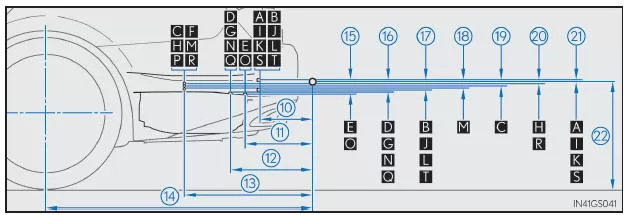
- 289 mm
- 322 mm
- 374 mm
- 592 mm
- 1201 mm
- 61 mm
- 56 mm
- 37 mm
- 27 mm
- 18 mm
- 12 mm
- 8 mm
- 401 mm*1 / 408 mm*2 / 410 mm*3
*1: 225/50R17 tire *2: 235/45R18 tire *3: 235/40R19 tire or 265/35R19 tire
Tire Notes
- When towing a trailer, increase the tire pressure by 20.0 kPa (0.2 kgf/cm2 or bar) above the recommended value.
- Increase the trailer tire pressure according to the gross trailer weight and in accordance with the values recommended by the trailer manufacturer.
Trailer Lighting
- For installing trailer lighting, please contact a Lexus dealer or service center, or another qualified and suitably equipped specialist workshop, as improper installation may damage the vehicle's lights. Observe applicable laws when installing trailer lighting.
- Each time the trailer is connected, check that the turn signals and brake lights function correctly. Direct wiring to your vehicle may damage the electrical system and impair correct light operation.
Break-in Notice
Lexus recommends not towing with vehicles that have new powertrain components during the first 800 km.
Safety Checks Before Towing
- Make sure the maximum load limit of the trailer hitch/hitch receiver and ball mount is not exceeded. Remember that the trailer tongue weight must be added to the weight on the vehicle. Also make sure the total weight on the vehicle does not exceed the weight limits.
- Make sure the trailer cargo is secured.
- Additional outside mirrors should be installed if the following traffic cannot be adequately seen with the standard mirrors. Always adjust the extension arms of these mirrors on both sides of the vehicle so they provide an optimal view of the road behind the vehicle.
Vehicle Maintenance
- When the vehicle is used for towing, vehicle maintenance must be performed more frequently, because, unlike normal driving, a greater load is placed on the vehicle.
- After approximately 1,000 km of towing, retighten all bolts that secure the ball mount and the trailer hitch/hitch receiver frame.
If the rear bumper reinforcement is made of aluminum
Make sure the steel bracket does not come into direct contact with this area.
When steel and aluminum come into contact, a corrosion-like reaction occurs that weakens the affected area and can subsequently lead to damage. Apply anti-corrosion agent to the parts that will contact each other when installing a steel bracket.
Notes
Your vehicle handles differently when towing a trailer. To avoid accidents, serious injury, or death, observe the following when driving with a trailer:
Checking the Trailer Connections and Lights
Check the connection between the trailer and the lights before starting out, and stop the vehicle after a short distance to check the connection again.
Driving Practice with a Trailer Attached
- Practice turning, stopping, and reversing with the trailer attached in an area with little or no traffic.
- When reversing with a trailer attached, hold the steering wheel at the point closest to you and turn clockwise to steer the trailer to the left, or counterclockwise to steer the trailer to the right. Make only small steering inputs to avoid overcorrecting. Have someone guide you when reversing to avoid an accident.
Increased Vehicle-to-Vehicle Distance
At a speed of 10 km/h, keep a distance from the vehicle ahead of you that is at least equal to the total length of the vehicle and trailer. Avoid sudden braking, which can cause the vehicle to skid. You could lose control of the vehicle.
This is especially important on wet or slippery roads.
Sudden Acceleration, Steering, or Cornering
Taking sharp corners with a trailer attached can cause the trailer to collide with your vehicle. Brake early when approaching a corner, and take it slowly and carefully to avoid sudden braking.
Important Points for Cornering
The trailer wheels cut closer to the inside of a turn than the vehicle wheels. To allow for this, take turns with a wider radius than usual.
Important Points for Stability
Vehicle movement caused by uneven road surfaces and strong crosswinds affects handling. The vehicle can also be made to sway by buses or large trucks passing you.
When driving beside such vehicles, check your rearview mirror regularly. If such vehicle movement occurs, immediately begin reducing speed smoothly by slowly applying the brake. Always keep the steering wheel straight while braking.
Passing Other Vehicles
Consider the total length of your vehicle and trailer, and make sure there is enough vehicle-to-vehicle distance before changing lanes.
Transmission Information
To make use of engine braking, do not drive in "D" range on long, steep downhill grades. When driving in M mode, the transmission shift range position must be set to "4" or lower.
If the Engine Overheats
Towing a loaded trailer up a long, steep grade at temperatures above 30°C may cause the engine to overheat.
If the engine coolant temperature gauge indicates that the engine is overheating, immediately turn off the air conditioner, leave the road, and stop the vehicle in a safe place.
When Parking the Vehicle
Always place wheel chocks under the wheels of both the vehicle and the trailer.
Firmly apply the parking brake and shift the shift lever to "P".
WARNING
Follow all instructions described in this section. Failure to do so may result in an accident causing serious injury or death.
Precautions for Towing a Trailer
When towing a trailer, be careful not to exceed weight limits.
How to Avoid Accidents and Injuries
- Do not tow a trailer if a temporary spare tire is installed on your vehicle.
- Do not tow a trailer if a tire has been repaired with the tire sealant and inflator kit.
- Do not use Cruise Control (if equipped), Dynamic Radar Cruise Control (if equipped), or Dynamic Radar Cruise Control with Full-Speed Range (if equipped) when towing a trailer.
Driving Speed When Towing a Trailer
Observe the legally mandated maximum speeds for towing a trailer.
Before descending from mountains or long downhill grades
Reduce speed and downshift. However, never downshift suddenly during a steep or long descent.
Operating the Brake Pedal
Do not press the brake pedal too often or hold it down for extended periods.
This may cause the brakes to overheat, reducing braking performance.
NOTEVehicles with Tire Sealant and Inflator Kit (if equipped)
Do not tow a trailer or provide towing assistance if a tire repaired with the tire sealant and inflator kit is installed. The load on the tire could cause unexpected damage to it.
For vehicles equipped with a trailer hitch, the Lexus GS GRL1 provides clear guidelines for safe use. The weight distribution and towing capacity information helps maintain driving stability even under load. Using genuine parts is recommended to ensure safety and warranty compliance.
Careful driving and regular inspection of all connections are especially important. This keeps the Lexus GS 2016–2020 a reliable companion when towing a trailer.
Test yourself
A quick Lexus GS quiz: every answer comes with an explanation and a link to the manual page.