If the vehicle battery is discharged
The jump-starting instructions for the Lexus GS L10 describe how to safely jump-start a vehicle with a discharged battery. Detailed illustrations and step-by-step instructions help avoid mistakes and minimize the risk of damage or injury. The chapter also provides tips on caring for and maintaining the battery to prevent problems in the future. This keeps the Lexus GS always ready to start and reliable.
If the vehicle battery is discharged, the engine may be started using the following procedure.
You can also contact a Lexus dealer or repairer, or another qualified and properly equipped workshop.
If you have a set of jumper cables and a second vehicle with a 12 V battery, you can jump-start your vehicle. To do so, follow the steps below.

- Make sure you have the electronic key with you.
When connecting the jumper cables, the alarm may be triggered and the doors may lock, depending on the situation.
- Open the hood.
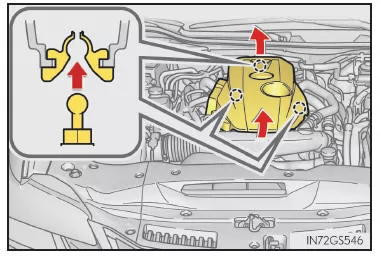
- GS200t/GS F: Remove the engine cover.
GS200t
GS F
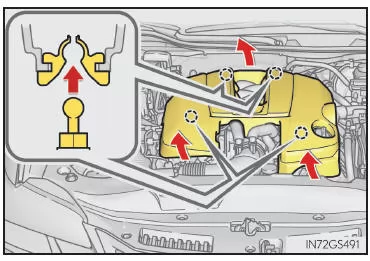
First lift the front of the engine cover to release the front clips, then lift the rear of the engine cover to release the rear clips.
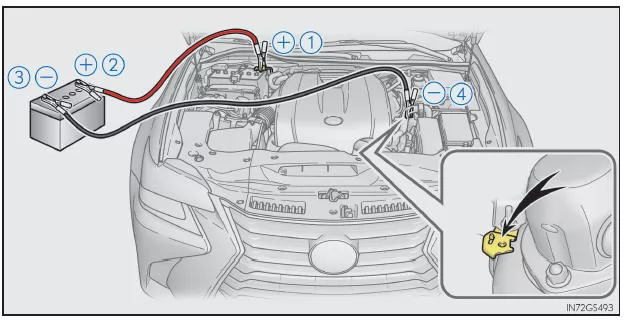
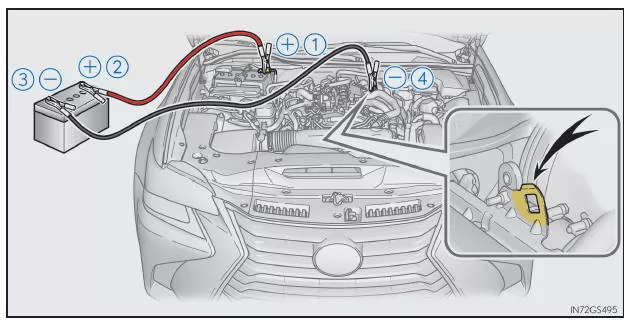
- Connect the jumper cables as described below:
GS350
GS200t
GS F

- Start the engine of the second vehicle. Slightly increase the engine speed and hold it for about 5 minutes to charge your vehicle's battery.
- With the engine switch off, open and close one of your vehicle's doors.
- Maintain the engine speed of the second vehicle and start your vehicle's engine by switching the engine switch to IGNITION ON mode.
- Once the engine of the vehicle being started is running, remove the jumper cables in the exact reverse order in which they were connected.
Once the engine is running, have the vehicle inspected as soon as possible by a Lexus dealer or authorized repairer, or another qualified repair facility with the appropriate equipment.
■ Starting the Engine with a Discharged Battery
The engine cannot be started by push-starting.
■ To Prevent Battery Discharge
- Turn off the headlights and audio system when the engine is off.
- Turn off all unnecessary electrical loads when the vehicle is driven at low speed for an extended period, e.g., in heavy traffic.
■ Charging the Battery
The energy stored in the battery gradually discharges due to natural self-discharge and the consumption of certain electrical devices, even when the vehicle is not in use. If the vehicle is left unused for an extended period, the battery may discharge and the engine may not start. (The battery is recharged automatically while driving.)
■ When Charging or Replacing the Battery
- In some cases, it may not be possible to unlock the doors with the smart access and start system if the battery is discharged. Use the remote control or the mechanical key to lock/unlock the doors.
- After charging the battery, the engine may not start on the first attempt; however, it will start normally after the second attempt. This is not a malfunction.
- The engine switch mode is stored by the vehicle. After the battery is reconnected, the system returns to the mode it was in before the battery was discharged. Turn the engine switch off before disconnecting the battery.
If you are unsure which mode the engine switch was in before the battery was discharged, take particular care when reconnecting the battery.
WARNING
■ Preventing Battery Fire or Battery Explosion
Observe the following precautions to prevent accidental ignition of flammable gas that may be emitted by the battery:
- Make sure both jumper cables are connected to the correct terminals and do not accidentally contact other terminals.
- Make sure the other end of the jumper cable connected to the positive (+) terminal never contacts other components or metal surfaces (brackets, unpainted metal, etc.) in the area.
- Prevent the "+" and "-" clamps of the jumper cables from contacting each other.
- Do not smoke near the battery, do not use matches or lighters, and avoid open flames.
■ Precautions When Handling the Battery
The battery contains toxic and corrosive electrolyte. In addition, battery accessories contain lead and lead compounds. Observe the following precautions when handling the battery:
- Always wear protective eyewear when working on the battery, and avoid getting battery fluid (acid) on your skin, clothing, or the vehicle body.
- Do not lean over the battery.
- If battery fluid contacts your skin or eyes, immediately flush the affected area with water and seek medical attention. Place a wet sponge or cloth on the affected area until medical help is available.
- Always wash your hands after touching the battery holder, battery terminals, and other battery parts.
- Keep children away from the battery.
■ When Handling Jumper Cables
Be careful that the jumper cables do not become entangled in the cooling fans or drive belt when connecting them.
The technical data of the Lexus GS GRL1 (2016–2020) provides a comprehensive overview of the performance of this sport sedan. Whether engine variants, dimensions, or weights, all values demonstrate the high technical standard of the 4th generation. Special highlights are the efficient engines and the balanced chassis, which perfectly combines dynamics and comfort.
With precise specifications for tire sizes, fuel tank capacity and driving performance, the Lexus GS is a prime example of well-considered engineering in the premium segment.
FAQWhich engine variants are available for the Lexus GS GRL1?
Depending on market and equipment, V6 gasoline engines, hybrid powertrains and high-performance models such as the GS F are available, among others.
What is the fuel tank capacity?
Fuel tank capacity is 66 to 66.5 liters, depending on model.
Test yourself
A quick Lexus GS quiz: every answer comes with an explanation and a link to the manual page.