If Your Vehicle Must Be Towed. If You Believe Something Is Wrong
This section explains practical towing procedures for the Lexus GS L10. All options are covered, from using a flatbed tow truck to the correct use of the emergency tow hooks. Important warnings help prevent damage to the drivetrain or body. Notes on safety chains, permissible speeds and the procedure for emergency towing are particularly useful, so the vehicle remains protected even in a breakdown.
If Your Vehicle Must Be Towed
If towing is required, we recommend having the vehicle towed by a Lexus dealer or authorized service workshop, another qualified and properly equipped repair shop, or a commercial towing service using a tow truck with a wheel-lift or a flatbed trailer.
Always use a safety chain when towing and observe the applicable legal regulations.
Situations in which you must contact a dealer before towing
The following symptoms may indicate a transmission problem. Contact a Lexus dealer or authorized service workshop, another qualified and properly equipped repair shop, or a commercial towing service before towing.
- The engine runs, but the vehicle does not move.
- The vehicle makes unusual noises.
Towing with a tow truck with a crane body
To avoid damage to the body, do not tow the vehicle with a tow truck with a crane body.
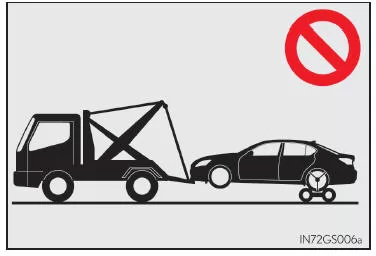
Towing with a wheel-lift tow truck
Forward
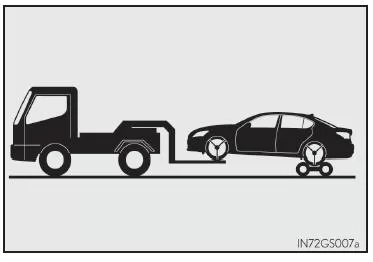
Use a dolly under the rear wheels.
Reverse
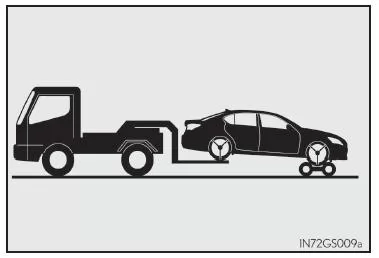
Use a dolly under the front wheels.
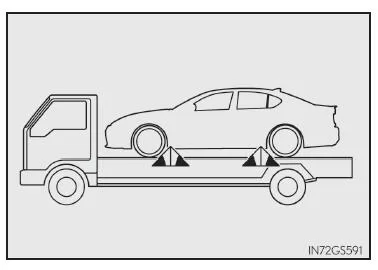
Transport on a flatbed trailer
If your vehicle is transported on a lowbed trailer, it must be secured at the points shown in the illustration.
GS350/GS200t

GS F
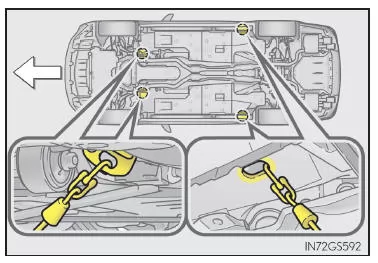
When using chains or wire ropes for securing, the angles shown shaded in the illustration must be 45 degrees.
Do not overtighten the tie-down straps, as this could damage the vehicle.
GS350/GS200t

GS F
Emergency Towing
If a tow truck is not available in an emergency, your vehicle can be towed temporarily using tow ropes or tow chains securely attached to the emergency tow hooks. This should only be done on paved roads for distances of no more than 80 km and at speeds below 30 km/h.
A driver must be in the vehicle to steer and brake. In addition, the wheels, drivetrain, axles, steering and brakes must be in proper working condition.
Emergency towing procedure
1. Remove the emergency tow hook.
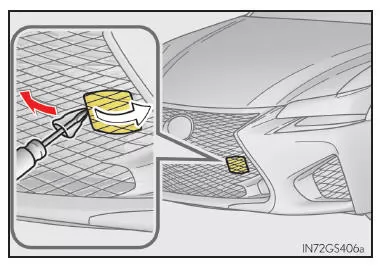
2. Remove the tow hook cover using a flat-head screwdriver.
To protect the body, place a cloth between the screwdriver and the body (see illustration).
GS350/GS200t (except F SPORT models)

GS350/GS200t (F SPORT models)

GS F
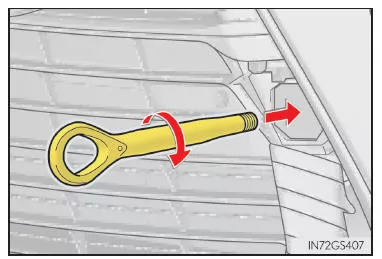
3. Insert the emergency tow hook into the hole and tighten it by hand.
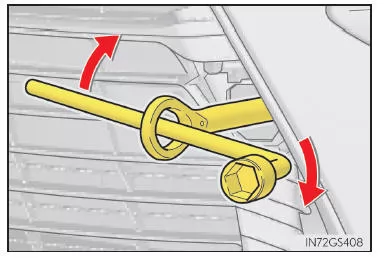
4. Fully tighten the emergency tow hook using a wheel nut wrench or a hard metal rod.
5. Attach the tow ropes or tow chains correctly to the emergency tow hook.
Take care not to damage the body.
6. Get into the vehicle being towed and start the engine.
If the engine cannot be started, set the engine switch to IGNITION ON mode.
7. Set the shift lever to "N" and release the parking brake.
■ When towing
With the engine off, the brake booster and power steering do not work, so more force is required to brake and steer.
■ Wheel nut wrench
The wheel nut wrench is stored in the luggage compartment.
WARNING
Observe the following precautions.
Otherwise, fatal or serious injuries may result.
■ When towing the vehicle
Models with two-wheel drive: Make sure that all four wheels are lifted off the ground when transporting the vehicle. If the wheels are in contact with the ground while towing the vehicle, the drivetrain or components connected to the drivetrain may be damaged, or an accident may occur due to a change in the vehicle's direction.
Models with all-wheel drive: Make sure that all four wheels are lifted off the ground when transporting the vehicle. If the wheels are in contact with the ground while towing the vehicle, the drivetrain or components connected to the drivetrain may be damaged, and the vehicle may be thrown off the tow truck.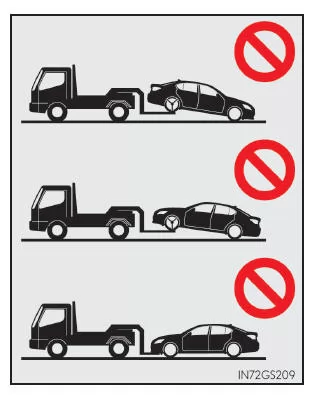
■ When towing
- When towing with tow ropes or tow chains, avoid sudden starts and similar actions so that the emergency tow hooks, ropes or chains are not overloaded. The emergency tow hooks, ropes or chains could be damaged, possibly causing falling fragments to strike people and resulting in serious injury.
- Do not turn off the engine switch. There is a risk that the steering wheel will lock and can no longer be turned.
■ Installing the emergency tow hooks on the vehicle
Make sure the emergency tow hooks are installed correctly.
If the emergency tow hooks are not installed correctly, they may come loose during towing.
NOTICE■ How to avoid vehicle damage when towing with a wheel-lift tow truck
- Do not tow the vehicle from the rear when the engine switch is off. The steering wheel lock is not strong enough to keep the front wheels straight.
- When lifting the vehicle, make sure there is sufficient ground clearance at the other end of the vehicle for towing. Without sufficient ground clearance, the vehicle may be damaged during towing.
■ How to avoid vehicle damage when towing with a boom-type (crane) tow truck
Never tow the vehicle with a boom-type (crane) tow truck, either from the front or the rear.
■ How to avoid vehicle damage during emergency towing: Never attach ropes or chains to suspension components.
If you think something is wrong
If you notice any of the following symptoms, your vehicle probably needs to be adjusted or repaired. Contact a Lexus dealer or authorized service center, or another qualified and properly equipped repair shop, as soon as possible.
Visible symptoms
- Fluid leaking under the vehicle. (It is normal for water to drip after using the air conditioning.)
- Tires look flat or show uneven tread wear
- The engine coolant temperature gauge needle stays higher than normal.
Audible symptoms
- Changes in exhaust noise
- Loud tire squealing when cornering
- Unusual suspension noises
- Knocking or other noises from the engine
Operating symptoms
- Misfiring, stalling or rough engine running
- Noticeable loss of power
- Vehicle pulls noticeably to one side when braking
- Vehicle pulls noticeably to one side when driving straight on a level road
- Loss of braking effectiveness, spongy feel, pedal nearly touches the floor
The topic of towing the Lexus GS GRL1 (4th generation) is described in detail to prevent vehicle damage. The recommended methods using a flatbed truck or wheel-lift tow truck, as well as the emergency tow hooks, ensure safe transport in the event of a breakdown. Clear warnings help minimize risks.
These well-designed details make the Lexus GS 2016–2020 a vehicle that delivers confidence even in exceptional situations.
FAQWhy should a flatbed truck be preferred?
A flatbed truck prevents damage to the drivetrain and body.
When may the emergency tow hook be used?
Only in true emergencies and for short distances of up to 80 km max. at low speed.
Test yourself
A quick Lexus GS quiz: every answer comes with an explanation and a link to the manual page.