Active Park Assistant
The Active Park Assistant of the Mercedes E-Class (4th generation, W212, 2009–2016) assists drivers when parking in and pulling out by steering and braking automatically. The system recognizes suitable parking spaces and helps you maneuver safely, even in tight situations. Notes on the limits of the function promote safe use of the assistant.
General Notes
The Active Park Assistant is an electronic parking aid using ultrasound. It measures the road space on both sides of your vehicle. A parking symbol shows you a suitable parking space. When parking, you can then be assisted by active steering and braking intervention. PARKTRONIC is also available to you .Info

Active braking intervention is only available in vehicles with automatic transmission.
Important Safety Notes
The active park assistant is only an aid. It cannot replace your attention to the immediate surroundings. You are always responsible for safe maneuvering, parking in and pulling out. Make sure that there are no persons, animals or objects in the path of travel.If PARKTRONIC is switched off, the active park assistant is also not available.
WARNING
When parking in and pulling out, the vehicle may swerve and may also enter the oncoming traffic lane. This can lead to collisions with other road users. Risk of accident!Watch out for other road users. If necessary, stop or cancel the parking maneuver with the active park assistant.
NOTE
If unavoidable, drive over obstacles such as curbs only at a shallow angle and slowly. Otherwise you may damage the rims and tires.The active park assistant may also display parking spaces that are not suitable for parking, e.g.
- in no-parking or no-stopping zones
- in front of driveways or entrances and exits
- on unsuitable ground.
- On narrow roads, drive as close as possible past the parking space.
- Parking spaces that are dirty or overgrown may not be detected or may not be measured correctly.
- Parking spaces in front of parked trailers whose drawbar protrudes into the parking area may not be detected as parking spaces or may not be measured correctly.
- Snowfall or heavy rain can lead to inaccurate measurement of the parking space.
- During the parking maneuver, also observe the PARKTRONIC warning display .
- You can intervene at any time to correct the steering. The active park assistant will then be terminated.
- If you are transporting a load that protrudes beyond the vehicle, you must not use the active park assistant.
- Do not use the active park assistant if snow chains are fitted.
- Always maintain the correct tire pressure. It has a direct effect on the parking behavior of the vehicle.
- lie parallel or perpendicular to the direction of travel
- are located on a straight road, i.e. not in curves
- lie on the same level as the road, e.g. not on sidewalks.
Detecting parking space
Objects located above the detection range of the active park assistant are not detected when measuring the parking space. They are then also not taken into account when calculating the parking maneuver, e.g. protruding cargo, overhangs or loading ramps of trucks.WARNING
If objects are located above the detection range, the- the active park assistant steers in too early
- do not stop the vehicle in front of these objects.
If objects are located above the detection range, stop and switch off the active park assistant.
Further information on the detection range .
The active park assistant does not support you with parking spaces perpendicular to the direction of travel if- two parking spaces are directly next to each other
- the parking space is directly next to a low boundary, e.g. a low curb
- you park forwards.
- the parking space is on a curb
- the parking space appears blocked to the system, e.g. by leaves or grass pavers
- the area required for maneuvering the vehicle is too small
- the parking space is bounded by an obstacle, such as a tree, post or trailer.
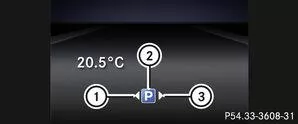
Parking space found (example)
 |
Parking space found on the left |
 |
Parking symbol |
 |
Parking space found on the right |
For a parking space to be detected by Active Park Assist, it must
- lie parallel or perpendicular to the direction of travel
- be at least 1.5 m wide for parking spaces parallel to the direction of travel
- be at least 1.0 m longer than your vehicle for parking spaces parallel to the direction of travel
- be at least 1.0 m wider than your vehicle for parking spaces perpendicular to the direction of travel.
At speeds below 30 km/h, the parking symbol is shown as the status indicator in the instrument cluster. When a parking space has been detected, an arrow pointing right or left is also displayed. By default, Active Park Assist only displays parking spaces on the passenger side. Parking spaces on the driver side are displayed as soon as you switch on the driver-side turn signal. To park on the driver side, the turn signal must remain on until you have confirmed the use of Active Park Assist with the button on the multifunction steering wheel. The system automatically determines whether the parking space is parallel or perpendicular to the direction of travel.
Parking
WARNINGIf you leave the vehicle while it is only being held by Active Park Assist, it may roll away if
- a fault occurs in the system or in the power supply
- the electrical system in the engine compartment, the battery or the fuses is tampered with
- the battery is disconnected
- the accelerator is pressed, e.g. by a vehicle occupant.
Always secure the vehicle against rolling away before you leave it.
Info
Vehicles with automatic transmission:
If PARKTRONIC can detect obstacles, the active park assistant brakes automatically when parking. You are responsible for braking in time. Bring the vehicle to a standstill while the desired parking space is indicated by the parking symbol with arrow.
Vehicles with manual transmission: Engage reverse gear.
Vehicles with automatic transmission: Shift to position R.
 .
To cancel the process: Press the buttonon the multifunction steering wheel or drive off.
To park with the assistance of Active Park Assist: Press the buttonon the multifunction steering wheel.
Release the multifunction steering wheel.
Reverse and always be ready to brake. When reversing, drive at approximately 10 km/h or slower. Otherwise Active Park Assist will be cancelled.Vehicles with manual transmission: Stop at the latest as soon as the continuous warning tone of PARKTRONIC sounds.Vehicles with manual transmission: The multifunction display shows the message Park Assist active. Engage forward gear. Observe surroundings.
Vehicles with automatic transmission: The multifunction display shows the message Park Assist active. Shift to D. Observe surroundings.
Vehicles with manual transmission: Once the vehicle is at a standstill, engage first gear.Vehicles with automatic transmission: Once the vehicle is at a standstill, shift to position D.
The multifunction display shows the message Park Assist active. Accelerate and brake. Observe surroundings.
Info
If you wait for the steering process to be completed before moving off, you will achieve the best parking result.Drive forward and always be ready to brake.
Vehicles with manual transmission: Stop at the latest as soon as a continuous warning tone of PARKTRONIC sounds.
Vehicles with automatic transmission: The multifunction display shows the message Park Assist active. Shift to R. Observe surroundings.
Further gear changes may be necessary.As soon as the parking maneuver is complete, the message Park Assist ended appears in the multifunction display and you hear a signal tone. The vehicle is now parked. The vehicle is held without you having to press the brake pedal. When you accelerate, the braking effect is released.
Active Park Assist no longer supports you with steering or braking interventions. When Active Park Assist has ended, you must always steer and brake yourself again. PARKTRONIC remains available to you.If necessary, adjust the final position by maneuvering.
Observe the warning displays of PARKTRONIC.
Parking notes:
- The final position of your vehicle in the parking space after the parking maneuver depends on various factors. These include the position and shape of the vehicles parked in front and behind, as well as local conditions. It may happen that Active Park Assist guides you too far or not far enough into the parking space. It may also guide you over or onto curbs. If necessary, cancel the parking process with Active Park Assist.
- You can also engage position D early. The vehicle will then steer differently and will not drive as far into the parking space. If the gear change takes place too early, the parking process is cancelled. A useful parking position is not possible from this position.
Pulling out
For Active Park Assist to support you when pulling out of a parking space,- the boundary of the parking space must be high enough at the front and rear. A curb, for example, is not sufficient.
- the boundary of the parking space must not be too wide, because your vehicle can be brought into the parking space by maneuvering at a maximum angle of 45° to the starting position.
- there must be at least 1.0 m of clearance for maneuvering.
If PARKTRONIC can detect obstacles, Active Park Assist brakes automatically when pulling out. You are responsible for braking in time.
Only if you have parked parallel to the direction of travel with Active Park Assist can it also support you when pulling out.
Start the engine.Release the parking brake.
switch on the turn signal in the direction of exit.Vehicles with manual transmission: Engage first gear or reverse gear.
Vehicles with automatic transmission: Shift the transmission to position D or R.
. Cancel the procedure: buttonon the multifunction steering wheel or drive off.
Park out with the assistance of Active Parking Assist: buttonon the multifunction steering wheel.
Release the multifunction steering wheel.
Drive off, and always be ready to brake. When parking out, do not exceed a speed of approximately 10 km/h. Otherwise, Active Parking Assist will be canceled.Vehicles with manual transmission: Stop at the latest when the continuous warning tone of PARKTRONIC sounds.
Vehicles with manual transmission: Depending on the message or requirement, engage first gear or reverse gear when the vehicle is stationary.Vehicles with automatic transmission: Depending on the message or requirement, shift the transmission to position D or R when the vehicle is stationary.
If you drive in reverse first after activation, the steering wheel is centered.
Follow the PARKTRONIC warning displays and drive forwards and backwards several times as needed.
Vehicles with manual transmission: Stop at the latest as soon as the continuous warning tone of PARKTRONIC sounds.
As soon as the parking-out procedure is complete, the steering wheel is centered. You will hear a tone and the message Parking assist finished. appears in the multifunction display. You must then steer immediately yourself and merge into the flowing traffic. PARKTRONIC remains available. You can steer yourself again before the parking-out procedure ends. This can be useful if you see that you can already pull out of the parking space.
Cancel Active Parking Assist
You can cancel Active Parking Assist at any time.Hold the multifunction steering wheel or steer yourself.
or
Press the PARKTRONIC button on the center console .
- a transmission position change is made too early
- transmission position P is selected
- parking is not possible with Active Parking Assist
- you are driving faster than 10 km/h
- a wheel spins, ESP is active or fails. The warning lamp then appears
 in the instrument cluster
If Active Parking Assist is canceled, you must always steer and brake yourself again.
Vehicles with automatic transmission: If a system fault has occurred, the vehicle is braked to a standstill. To continue driving, press the accelerator pedal again.Towing a trailer
On vehicles with a towing hitch, the minimum length of parking spaces increases slightly.If you have connected a trailer to your vehicle, you must not use Active Parking Assist. If the electrical connection between your vehicle and the trailer is established, Active Parking Assist is not available. PARKTRONIC is deactivated for the rear zone.
Active Parking Assist of the Mercedes E-Class W212 (model years 2009–2016) simplifies parking in and out through steering and braking interventions. In combination with PARKTRONIC, it ensures a high level of safety and comfort.
The intelligent technology detects suitable parking spaces and reliably assists the driver, even in tight situations.
Question: When is active braking intervention available?
Answer: Only on vehicles with automatic transmission, when PARKTRONIC can detect obstacles.
Question: What happens if the steering wheel is moved during the parking procedure?
Answer: Active Parking Assist is canceled, and the driver must steer and brake themselves.
Test yourself
A quick Mercedes-Benz E-Class quiz: every answer comes with an explanation and a link to the manual page.