Booster seats
Booster seat precautions
WARNING
If the booster seat and seat belt are not installed correctly, the risk of injury to the child increases greatly in a collision or sudden stop.
- Make sure the shoulder belt does not come near the child's face or neck, and that the lap portion does not rest against the abdomen.
- Make sure the shoulder belt is not placed behind the child or under the child's arm.
- Install a booster seat only in a seating position equipped with a three-point seat belt.

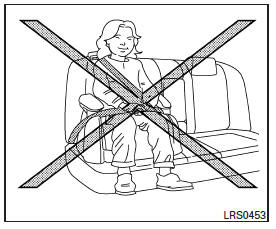
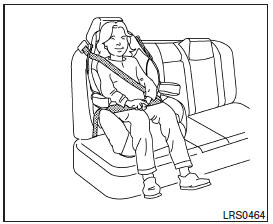
Several manufacturers offer booster seats in various sizes. Consider the following when choosing a booster seat:
- Only choose a booster seat that carries a label certifying that it meets Canadian Motor Vehicle Safety Standard 213 or United States Federal Motor Vehicle Safety Standard 213.
- Place the booster seat in your vehicle and make sure it is compatible with the seat and seat belt of your vehicle.
- Make sure the child's head is properly supported by the booster seat or the vehicle seat. The backrest must reach at least the level of the center of the child's ears. For example, if you choose a low-back booster seat 1 , the vehicle seatback must reach at least the level of the center of the child's ears. If the seatback is below the center of the child's ears, use a high-back booster seat.
- If the booster seat is compatible with your vehicle, seat the child in the booster seat and check the various adjustments to make sure the booster seat fits the child. Always follow all the instructions provided.
In Canada and the United States, the use of certified restraint systems is mandatory for babies and young children.
The guidelines in this section apply to installing a booster seat in the rear seats or on the front passenger seat.
Installing a booster seat
WARNING
Do not use the automatic locking mode of the three-point seat belt when using a booster seat with the seat belts.
Review the Warnings and Cautions in the "Child safety", "Child restraint systems" and "Booster seats" sections before installing a child restraint system.
Follow these steps to install a booster seat in a rear seat or on the front passenger seat:
- If you must install a booster seat on the front seat, move the seat as far rearward as possible.
- Place the booster seat on the seat.
Always face it forward. Always follow the booster seat manufacturer's instructions.
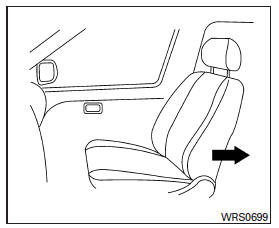
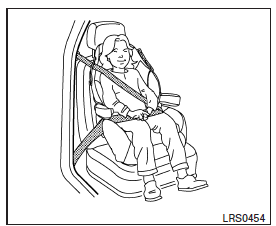
Front passenger seat
- Place the booster seat on the vehicle seat so that it is stable.
If necessary, adjust the head restraint height or remove the head restraint so that the booster seat can be installed properly.
If you have removed the head restraint, store it in a safe place. Be sure to reinstall the head restraint when you remove the booster seat. Refer to the "Head restraint" section in this chapter for more information on adjusting, removing, and installing the head restraint.
If the seat's head restraint is not adjustable and interferes with the installation of the booster seat, try a different seat position or a different booster seat.
- Tighten the lap belt portion of the seat belt low across the child's hips. Follow the seat belt routing instructions provided by the booster seat manufacturer.
- Pull the shoulder belt toward the retractor to remove slack. Make sure the shoulder belt is positioned across the center of the child's shoulder. Follow the seat belt routing instructions provided by the booster seat manufacturer.
- Observe the warnings, cautions, and seat belt installation instructions given previously in the "Three-point seat belt with retractor" section earlier in this chapter.
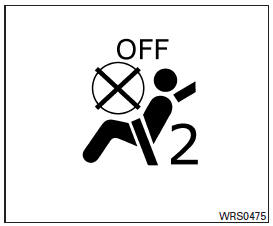
- If the booster seat is installed in the front passenger seat, turn the ignition switch to the ON position. The front passenger air bag off indicator
 may
illuminate, depending on the child's weight or the type of booster seat used. Refer to the "Front passenger air bag and off indicator" section later in this chapter.
Test yourself
A quick Nissan Altima quiz: every answer comes with an explanation and a link to the manual page.