Child restraint precautions
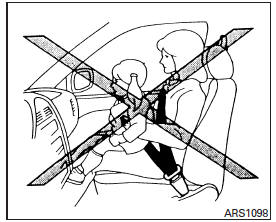
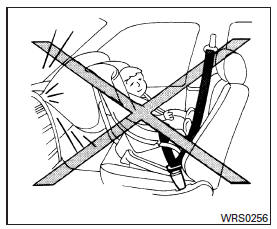
WARNING
Failure to observe the warnings and instructions for the correct use and installation of child restraints could result in serious or fatal injury to children or other passengers in the event of an accident or sudden stop.
- The child restraint must be used and installed correctly. Always follow all installation and usage instructions provided by the child restraint manufacturer.
- Never travel with a baby or young child seated on your lap. Even the strongest adult cannot resist the forces involved in a collision.
- Never use the same seat belt for a child and another person.
- NISSAN recommends that all child restraints be installed on the rear seat. Studies show that children are safer when properly restrained in a rear seat rather than a front seat. If you must install a forward-facing child restraint on the front seat, see the section "Installing a child restraint using the seat belts" later in this chapter.
- Although this vehicle is equipped with NISSAN advanced air bags, never install a rear-facing child restraint on the front passenger seat. A deploying air bag can cause serious or fatal injury to a child. A rear-facing child restraint must be installed only on the rear seat.
- When purchasing a child restraint, make sure it is suitable for the child and the vehicle. Some child restraints may not fit properly in your vehicle.
- Child restraint anchors are designed to withstand the loads applied by properly installed restraints.
- Never use the seat belt anchorages or the adult seat belts' anchor points for child restraints.
- A child restraint equipped with a top tether must not be installed on the front passenger seat.
- Keep the seatback as upright as possible after installing the child restraint.
- When riding in the vehicle, babies and young children must always be seated in an appropriate restraint.
When the child restraint is not in use, keep it secured using the lower anchors and tether system or a seat belt. In a sudden stop or collision, unrestrained objects can injure occupants or damage the vehicle.
WARNING
A child restraint left in a closed vehicle can become very hot. Check the temperature of the seat surfaces and buckles before placing a child in the seat.
This vehicle is equipped with a universal child restraint anchor system called the LATCH system (Lower Anchors and Tethers for CHildren). Some child restraints have rigid or strap-mounted connectors that can be attached to these anchor points. For more information, see the section "LATCH system" (Lower Anchors and Tethers for Children) later in this chapter.
If you do not have a child restraint compatible with the lower anchors and tethers for children (LATCH) system, you can use the vehicle's seat belts.
Many manufacturers offer child and infant restraints in various sizes. When choosing a child restraint, it is essential to consider the following points:
- Only choose a child restraint bearing a label certifying that it meets Canadian Motor Vehicle Safety Standard 213 or United States Federal Motor Vehicle Safety Standard 213.
- Make sure the child restraint fits properly in your vehicle and is compatible with the seat and seat belt.
- If the child restraint system is compatible with your vehicle, place your child in the restraint and check its various adjustments to make sure it fits your child's size. Choose a child restraint system suited to your child's height and weight. Always follow all the instructions provided.
In Canada and the United States, the use of approved child restraint systems is mandatory for babies and young children. Canadian regulations require that the upper tether strap of a forward-facing child restraint be attached to the designated vehicle anchorage point.
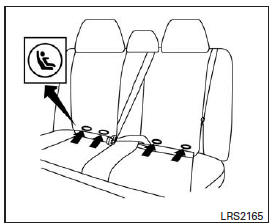
Location of LATCH anchors
Test yourself
A quick Nissan Altima quiz: every answer comes with an explanation and a link to the manual page.